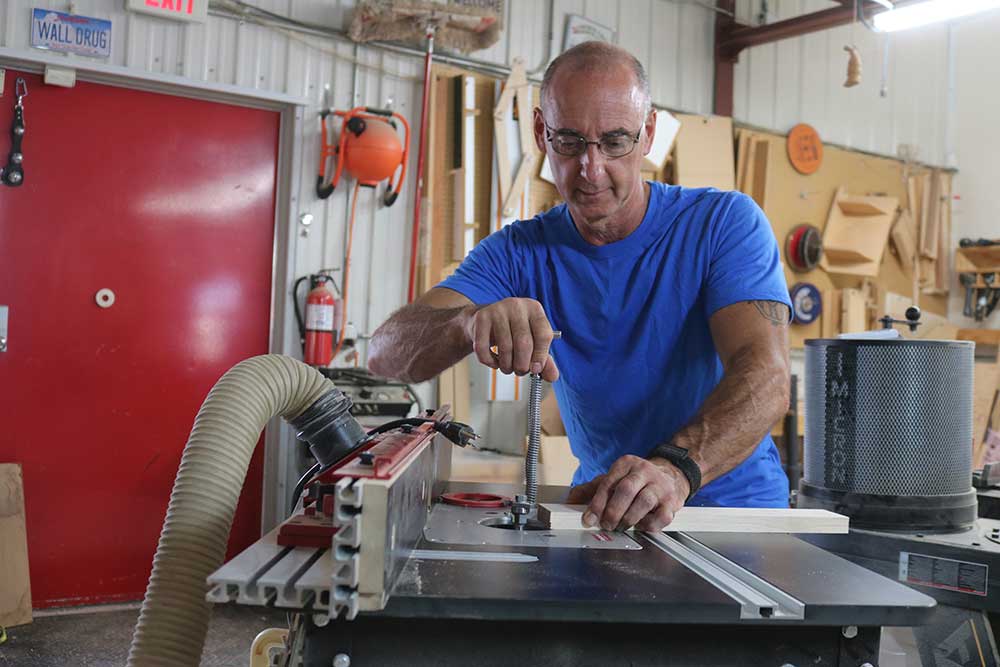
Router Technique to Bridge a Crack
George VondriskaIf you are working on a project and the stock has a crack in it, don’t sweat it. You can reinforce the wood and add a beautiful detail at the same time by installing a butterfly joint and “celebrating” the imperfection rather than removing it or attempting to hide it. Once you learn how to make custom-cut butterfly joints, you can use this router technique on a variety of projects such as tables, desks, benches, and more.
Although the end result is beautiful and looks complicated due to the precision fit, the key to this joint is applying a simple router technique that is detailed in this video. At a high level, the steps for the overall process include:
Choose the location. You’ll want to choose a spot that can provide the maximum holding power over the crack, as the natural forces of expansion and contraction will be working against the butterfly. If the crack is quite long, don’t hesitate to install multiple butterfly joints to achieve maximum stability.
Cut the butterfly. No need to use a template or try to be overly precise; just create a shape that is pleasing to the eye and has plenty of holding power with the appropriate angles. Position the long axis of the butterfly in the direction of the grain to maintain maximum strength. You’ll rough cut on the bandsaw and clean up with a sharp chisel.
Installation. Here’s where your router technique comes into play. Install a small bit in a plunge router, and use careful freehand technique to remove the bulk of the waste. Your router technique should get you close to the line, but make sure to leave a slight buffer and do not cross the line. After the majority of waste has been removed, pare to the line using a chisel.
I am really excited to be working on this natural edge white pine table. This is one of the legs for it and it's got a problem. It's got a crack in it. Now, part of this is gonna go away. I'm gonna cut a curve out of this.
But this part up here is gonna remain. And what I wanna do is make sure that that crack doesn't continue. A real common approach to this is to cut in a butterfly, or a bow tie, that straddles the crack like that. That one, ties everything together, so it stabilizes the material. Two, it adds a really nice decorative accent, if you do it in a contrasting material, which is what we're gonna do.
Now, one of the things you don't wanna do here is, don't try to push glue in there and clamp that back together. You might be able to draw it closed with a really big bar clamp, but you're fightin' nature, and it's probably just gonna pop open again later. First step in this: we're gonna lay out everything by hand. We're gonna make the butterfly completely by hand. So first step is figure out, well, how big do I want my butterfly to be?
So looking at this, I'm gonna make my butterfly, overall, let's go inch and 1/4 mark is on the crack, so it's gonna end up being 2 1/2 inches long. That's my first step. Next step, I'm gonna grab some material that I can use for the butterfly itself and show you how to do some layout. I'm gonna use a piece of walnut for my butterfly, and that's gonna provide a great contrast against the white pine. I've machined that to be about 1/3 the thickness of the overall thickness of my piece.
I'm only gonna butterfly from one face. This is gonna work out just fine. Now, remember our number. I decided I wanted about 2 1/2 inch long butterfly or bow tie, so from that walnut, I cut a piece to 2 1/2 inches. A couple things for layout here: first, let's find the center of that.
Now the next thing, we wanna to strike some angles on here. Good angle for this is somewhere around 14 degrees. And a great way to do that is with an adjustable or sliding T bevel, and I can adjust that to any angle. Using the protractor, I'm gonna set that to 14 degrees, and as long as you're close, you're gonna be fine, as long as you don't change partway through. Lock that.
Now, first step is: trace, flip and trace. So they're meeting on that center line, that's why we drew that. Now, next step, how wide do we want the butterfly to be? This is the tail out here, and then that's gonna angle in. Tail, angle in.
In order to keep this in scale to my work, I'm gonna go there and we'll do the same thing, once I get organized, there we go. And meet on the center line; meet on the waist of the butterfly. That takes care of layout. Next step: off, we go to the bandsaw, in order to cut out our butterfly. I'm running 1/4 inch four tooth per inch blade in the bandsaw, and the key to this is to cut outside the line.
We're gonna come back and trim to the line on the next step. Don't worry if you're just a little kerflooey, we're gonna take care of that. Next step is cleaning up those bandsaw cuts. And that's why I said you don't have to be too careful on the bandsaw, 'cause we'll fix it here. One of the things we do want to point out, the grain in the butterfly needs to go this way.
And that gives it the most strength, and lets us do this next step, which is pairing to the line. So all that means is that with a nice sharp chisel, we're gonna go over the high spots of the bandsaw cuts here. And a couple of things here, want to make sure that the chisel doesn't rock. Wanna make sure that this edge remains perpendicular to the faces. What I'm doing is I'm pushing down with my left thumb here to get the back of the chisel to really ride down that slope.
And if I'm quiet for a second, you'll hear it kind of ch-ch-ch, cause it's riding over the high spots of the cut. And we'll get less and less of that sound as I clean it up. The other thing to notice is that, in addition to pushing down with my thumb, I'm slicing left to right, kind of skewing the chisel across the cut. And that makes it easier to peel a nice, thin shaving like that. Now, at this point, don't go uphill on the other side.
Turn this around. Repeat. And then same thing to the other face. And this step will be, hold on... There.
That takes care of the chisel work, now we're ready to get this shape transferred to our piece. Next step, let's take the work we've done and transfer it here. Position the butterfly, and with a nice, sharp pencil, trace. Now, we need to cut that out. Best way to do that is where the plunge router.
I'm using a pretty small bit. I'm using 1/8 inch router bit. And the reason for that small diameter is so that we can get as close as possible to the inside corners. If I go with a bigger bit, of course, it'll cut faster, but I'll have more work to do in a second in order to get the corners cleaned out. First step: how deeply are we going to cut?
I'm gonna disable the stop rod, and use the butterfly itself for my depth. So the way this works is, touch the router bit down, that's my zero point. Right now I'm at the top of the material. Pull the stop rod up, put the butterfly in between, push the stop rod back down. Now, if I do that, the hole I cut is exactly the same as the thickness of the butterfly.
I want it to be just a little less. I want the butterfly to stand proud, by just a tiny bit. So I'm gonna take the butterfly out, push the stop rod down, just a little more, and lock it. That's gonna result in a recess that's shallower than the thickness of the butterfly. If what I just did, if you're a little unsure of that on your work, do a test cut on a piece of scrap before you come to the real project.
Now, I can plug in, and here's the deal: this is all free-hand, but, like the band saw, don't sweat it. Stay to the waist side of the line. And then we do final cleanup with a hand chisel. So I'm gonna come in, I'm gonna plunge, and I'm just gonna work in ever-widening circles, until I work my way out, close to the pencil. Now, we're back to hand tool work again.
We've got a pencil line, gonna bring the back of the chisel to that pencil line, and just shear down. And this is gonna take a couple of efforts. That's good that it doesn't quite fit in there yet. I gotta take a little more wood out. So just eyeball where it's close, where it's not, and keep working on your shear here, until that butterfly slips into the opening.
Very close. But this is why when you're chiseling the butterfly itself, we have to make sure that these sides stay nice and square. Otherwise, if a bevel starts to develop, maybe it fits on the first side, but it doesn't fit on the top. This looks pretty good. Once it gets to where it looks like it'll tap into place, don't push it in any further because you may never get it back out.
So once it looks like it's gonna go in, stop, and then we'll glue it in place so that it's a permanent fitting. Okay. Finger pressure is pushing it in. I'm happy with that. Glue is next.
Next step is easy peasy, some glue in the bottom, butterfly, and clamp. Let that sit til the glue dries, and then I'll come back and show you how to clean up that top face, where it's proud of the surface. Next step, we gotta get that butterfly flush with the surrounding wood. And really, I really like a hand plane for this. Could fire up a sander, but, benefit to the plane is it really keeps everything nice and flat, where with a sander, maybe we'd start rocking and rolling.
Now this grain is going this way. This grain is going this way. So as I get close to being done, as we sneak up on flush, you do have to be careful that when I'm cutting in this direction, I don't scar. I don't hit cross grain on that surrounding material. And once it's close, if it's a fingernail high, I'll finish it with sanding.
Right about there. Now, if you have the problem I have, which is a slight over cut, my pocket is just a little bit bigger than my butterfly. It's a little gappy. Don't panic. Here's the fix.
Put a little yellow glue in there. That's too much. Little gappy there, little gappy there. And then get the yellow glue off the surface. And now while that glue is wet, sand, 120 grit paper.
And what happens there is the sawdust we're making goes into that crack where the glue is, fills it in, and once we get finish on that, it's gonna be pretty much impossible to tell you ever had a little woopty-do there. Now the crack itself, this is actually still open here. You can do whatever you want there. If you want to put some epoxy in there and fill that, you can. I actually like leaving the cracks alone.
I like the fact that they show, I think it adds a little bit of character. That sanding is our last step in taking care of the butterfly. I think it looks great. I'm glad I picked the walnut to go with the pine and, structurally, it's gonna keep that crack from getting any worse. So it's a great way to take care of this kind of problem on your project.
Another question . . . the walnut burl slice I'm patching has a number of cracks . . . how small does the crack have to be before I don't worry about patching it? I can send a picture, if you'll tell me how. :-) FWIW, I'm planning on patching any cracks that go all the way through the piece (only one of those), and any cracks that are more than 1/32" wide (and there are a dozen or so on each side). Yeah, it might look like a lot of bandaids, but I'd hate for this thing to continue cracking over time. My butterflies will be about 1/3 to 1/2 of the slab's thickness . . . maybe I don't need to patch both sides?!?
I have several live-edge walnut cookies (about 24" across) that have some cracks in them . . . this looks like a great technique for stabilizing those cracks (probably w/natural maple bow ties). Should I add the bowties before or after flattening the surface (using a router sled)? Thanks!
I know George is a great craftsman but I don't believe the butterfly was perfectly symmetrical. I think George would have had an easier time fitting the butterfly in the socket if he had identified one end.
Why not use a 12"x12" piece of 1/4" hardboard and cut several different size bow ties in it? Label each one by size and then use a 1/4" pattern making bit. Then, the only use for the chisel would be squaring off the corners. I think the same process could be used to cut out the bow tie itself. The chisel only needing to be used for the centers.
Hi George - what about very slightly tapering the butterfly itself, so when you pound it into the recess, it fills it automatically?
What was the plunge base George was using on the Colt?
Is there anyway to see the completed natural edge table? I want to see how George attached the legs he was working on. I'm doing something similar with cedar tree and looking for ideas. Thanks in advance!
Why not put glue on the sides of the maple butterfly? It seems it would have eased installation AND would have filled any gaps automatically.