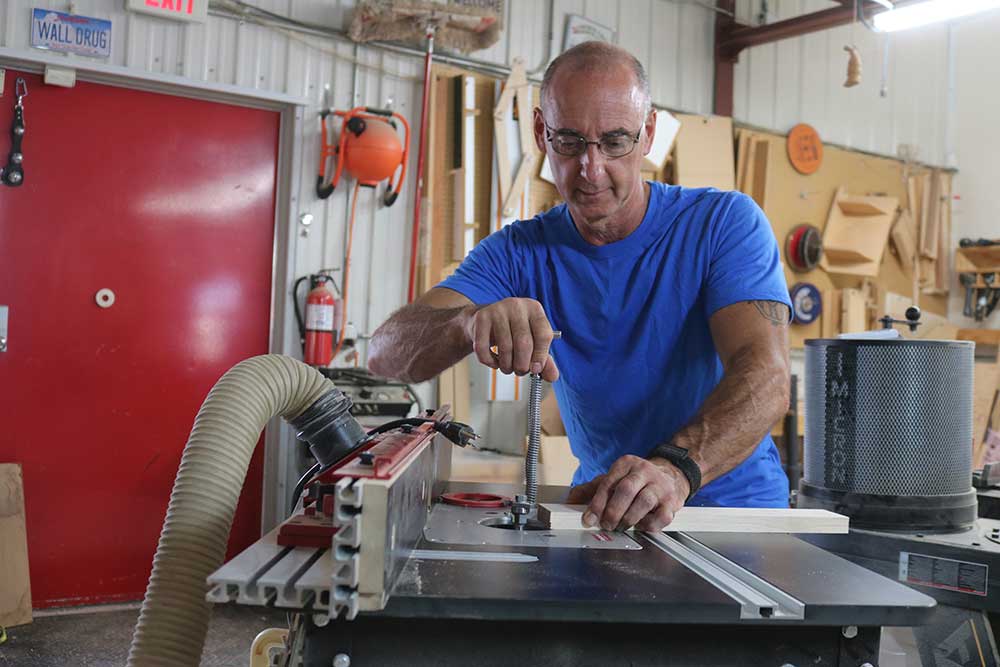
Sliding Dovetails on the Router Table
George VondriskaSliding dovetails are a unique joint that allows you to make wooden drawer slides and other unique applications where wood is allowed to move in one direction while being locked in another. Sliding dovetail joints can also be used as a fixed joint, and a great way to create an extremely strong joint that cannot be pulled apart by common stresses on the joint. Creating sliding dovetails on a router table requires some careful setup as well as a thoughtful sequence of steps. As George provides an overview of how to create sliding dovetails on a router table, he covers several important topics:
Choosing the right diameter of router bit. This is an important decision and one that will affect the outcome of your joint, so be sure to follow George’s guidelines for how to select the right bit.
Sockets first. In the machining process you will want to create the sockets prior to milling the tails. This is because the sockets are formed by a fixed sized router bit and it is difficult to make adjustments to the size of the sockets.
Make tails to fit the sockets. This will involve some careful setup of your router table fence and a trial and error process. Start by milling on a piece of scrap wood to get your setup dialed in prior to making cuts on your final work pieces. George will help you understand what the right fit is for a sliding dovetail joint, which will be important to know as you are making adjustments to your fence.
When you are first learning how to create sliding dovetail joints it will be important to “practice, practice, practice”. Once you have mastered the sliding dovetail joint, which project will you include it in first? A dresser? A jewelry box? Some other creative application for sliding dovetails? We’d love to hear your thoughts on this in the comments below.

Sliding dovetails provide a great way to put parts together. For instance, on an overlay style drawer, the drawer front could be connected to the drawer side using sliding dovetails. Router table provides a really easy way to do this. There's some set up stuff you got to understand. First, the diameter of the router bit needs to be less than the thickness of your material.
That's gonna make more sense as we move along. I'm using a half inch, 14 degree cutter here with my three quarter inch stack. What I'm gonna do first is make the sockets and that's always the way you want to go after the sockets are formed. We're gonna make the tails to fit the sockets. So this part is easy distance from the fence to the bit is the distance then from the edge of the board to the cut and that's gonna control how far away from the edge our drawer side is gonna be that takes care of sockets.
Now to make tails, what's going to happen is if you want a test board, it has to be exactly the same thickness as your real pieces. The way we're gonna do this is unplug the router because we gotta get up close and personal with that cutter. And we want to bury the bit in the fence and sneak up on the right side size. Don't try to get this on the first try. So, what I'm looking at here is having just a tiny bit of bit, just a little bit of dovetail cutter sticking out and then with our test piece, now we feed vertically and it's gonna be a past and a pass which will result in a dovetail.
Hopefully a dovetail, it's too big. So comparing that tail is obviously bigger than that socket. And when I look at it this way, I can certainly see it's not gonna go in and I'm gonna say I'm guesstimating that tail is 316, maybe a quarter too wide. Here's where it's easy to mess this up if that's a quarter inch too big, you only move the fence in eighth because we're taking material off both sides. So, what I like to do is mark the table because that's my starting point as I sneak the fence over, it's easy for this to get away from you and you kind of lose track of where your first cut was.
So let's say I over cutt, I end up with a tail that's too small. I wanna go back to where I am now, that's what those lines on the table will do for me. The other thing that line does is, gives me a perspective as I move the fence, the line is there to take more off. I have to move away from it. So right there, that's about an eighth inch.
Move on that side. If I don't move this side at all, it's not an eighth total, it's a little bit less than that. And that's where I wanna be. This is a race that goes to the slow and steady, not the quick. So move in small increments, do a lot of test cuts.
We gotta get that tail to fit into that socket. Part of what's key to this is that after the socket before the tail, I didn't mess with the height of the bit and that makes the length of this component exactly the same as the depth of this component. All right, another try checking my work. Got a ways to go rinse and repeat. Oh, it's so close.
That's what we want. We want that to just slip in there. You shouldn't have to drive it with a hammer. Now, the benefit we get from that sliding dovetail is that just like any dovetail joint, we can't pull that in that direction because of the mechanical grab that the dovetail has. So it can be fussy, it can take a little bit to get just to the right point.
But once we have that set that can come out, then bring your project pieces in, put the tail and those and you're ready to put your project together. It's really, really, really critical. I can't say it enough that this test piece has to be exactly the same thickness as your project pieces. Otherwise, these test cuts aren't gonna do anything for you. So this is a great joint to know about.
Take your time, get the set up just right and you'll have a great fit between the tail and the socket.
An important note, only glue one end of the tail board and put the glue at the far end of the tail board. Wood moves across the grain, tangentially, with changes in humidity. If the entire tail is glued it will prevent this movement and cause the board(s) to crack. If the glue is placed at the end of the tail board that will be inserted into the slot first, the near end, that glue will smear across the length of tail. This will make it hard hard to completely slide the tail board into the slot.
Hi, Thanks for the introductions … Could this solution with trial and error instead be solved by measuring and setting up the jig accordingly. Best regards Martin from Sweden
What would be the recommended minimum distance from the edge be?