Info Filled Icon
George Vondriska

Miters on the Router Table

George Vondriska
Duration:   7  mins

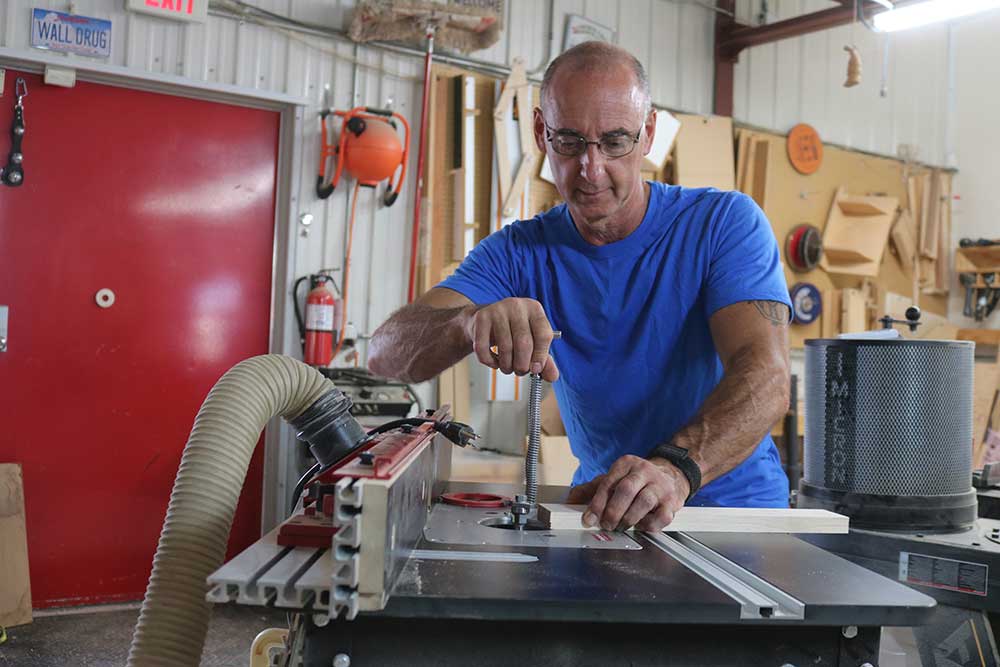
Miter joints add a nice flair to a project such as a decorative box. The crisp lines and precision joinery give it an unmistakable endorsement of craftsmanship. Miter joints can be challenging to execute on a table saw or miter saw which are the most common tools that woodworkers use for this operation. There is another approach that allows the woodworker to take advantage of the precision machining of a router mounted in a router table.

As George demonstrates the process of creating precision miter joints on your router table, he will cover a few key tips that will help ensure your success:

Choose the right router bit for miters. There are many different router bits that have a 45 degree angle, but not all of them will be suited for your project. It will be important to understand the correct height of the bit based on the thickness of your material. Here is the bit used in this video.

Adjust height for perfect setup. You’ll need to get the bit height dialed in using some scrap material for test cuts before cutting your actual work pieces.

Align bearing with the fence. It is critical to get the fence positioned properly so that your miters will be cut accurately. You’ll see a simple approach for getting this right every time.

Cut depth is critical. Depth of cut is important to understand and control.

Undercut for efficiency. For thicker material, it is a good idea to remove some of the waste on the table saw prior to working at the router table. This will reduce the wear on your bit as well as your router.

After you’ve mastered making miters on your router table, use your new skill as part of one of your next woodworking projects.
Share tips, start a discussion or ask other students a question. If you have a question for an expert, please click here.

Make a comment:
characters remaining

One Response to “Miters on the Router Table”

  1. DanD

    I like that concept/technique very well! And very nicely explained as well.

When you're making a box like this, a really nice craftsmanship way to do it is to have mitered corners. And what we get from that is grain floor on the outside of the box, no end grain showing like we would get from a rabbit. But cutting those miters on a miter saw or a table saw can take a lot of fussy set up, be a little bit of a pain to do. It's actually really easy to do here at the router table. You have to have a 45 degree chaffer bit and that cutter has to have enough length of cut on it that it exceeds the thickness of the material that you're working with.

So when you buy that, you got to match it to that. The way we're gonna make this work is I'm gonna adjust the height of the bit so that I know the ball bearing is a little bit above that face and we're gonna dial this in tighter as we go somewhere about there. Then I'm gonna bring the fence in and using a straight edge. I want to align the ball bearing with the fence like one end let the other end pivot a little bit and lock the other out. Now, we get to the critical part of this setup.

What we need to do is get a piece of material against the fence and we're striking a line that is face of the fence, top of the material carbide on the cutter. So the way to do that is to put a straight edge in there. And then when I slide this out, I wanna make sure the bottom of that ruler is missing the top of the carbide. So if I come up a little bit right there, they're touching. The bid is too high.

When we have this correct, you'll see this in a second. I want this low and we're not gonna produce a perfect knife edge on this. I'll show you this. Once we do a test cut to do your test cut, you have to have material. That's exactly the same thickness as your project pieces because this whole setup is very thickness specific.

Uh in order to make your cuts, grab a piece of scrap and we wanna chase that project piece with the scrap. So it doesn't blow it on the end. That scrap is also gonna help support this so that this isn't walking all over the place as you make the cut, these two are gonna feed together just like that once I get plugged in. All right, let's see what we have that came out pretty good. What I'm looking at is the miter comes up here and then I can see right here there's a flat, it doesn't come to a perfect knife edge.

That little flat is gonna get dealt with at the end after the box is put together. What's gonna happen? If, if you try to make a perfect knife edge, there's too much chance of you destroying, over cutting that edge as you go and then basically, you're sniping it like crazy. And when it gets to the out feed side of this cut, it's gonna collapse into the fence and you're gonna ruin your joint. So we wanna undercut it just a little bit.

Once you have that right, then we're good to go. Now, if you're doing this with thicker material, if you're doing this in three quarter inch stock, I would definitely do this little undercut before you come to the router table. You can do this on the miter saw or the table saw, take away some of the material. So the router bit and you don't have to work as hard to make this cut on this half inch stock. It isn't as critical.

I've put this champer at the miter saw on a bunch of these pieces. I did not do it on one of these walnuts just so you can see the feed difference between the two. Let's start with. This guy does not have the undercut on this end and I'm gonna be doing this miter on all my parts. Not bad, but that's a lot easier.

No, nothing succeeds like success. Let's see what we got. Ok. I love band clamps for putting mitered stuff together. Yeah.

Pretty cool. Pretty painless. A really, really easy way to make miters as with any miter project, as with any project, you gotta make sure these two pieces are exactly the same length. These two pieces are exactly the same length. Otherwise, regardless of how good the miters are, that box is not gonna come together.

Well, glue it up just like this. Then after the glue is dry, remember we left it with just a little bit of a flat out there. By the time you finish saying the outside of this box, you're gonna have a perfect corner that flat is not gonna be visible. The key to that is that that flat you're leaving is very minimal. So next time you need to do a box with miter corners like that, try the router table instead of the miter sawer tables up.

Get exclusive premium content! Sign up for a membership now!