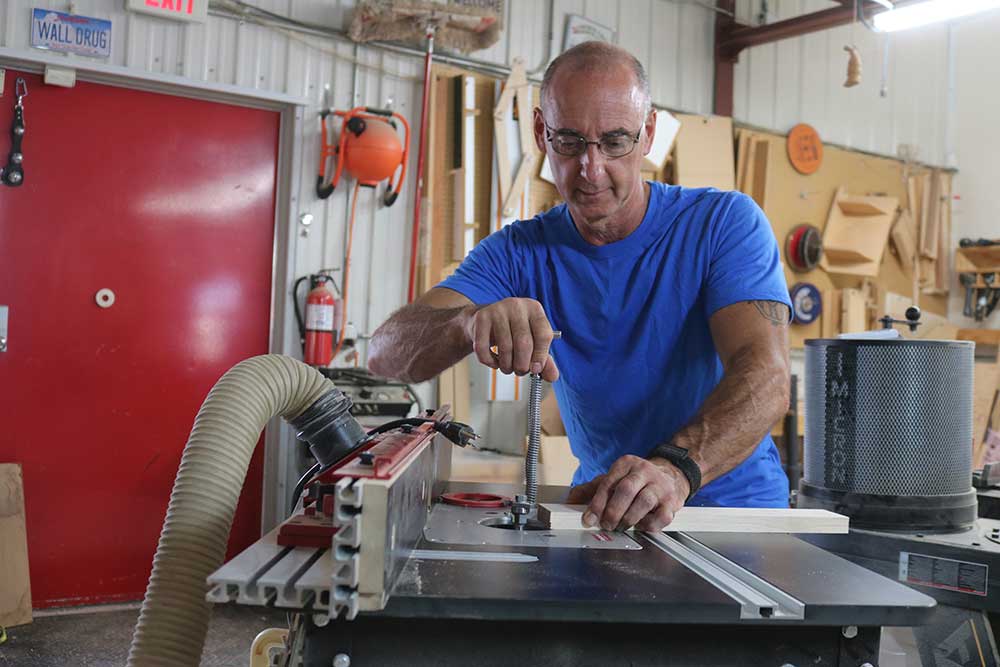
Half-Lap Joint: Dado Head
George VondriskaThe half-lap joint is an excellent option to have when building a frame or other project that requires piecing together rails. You can easily create a half lap with a dado head on your table saw. Try using half lap joinery on your next woodworking project!
Related Videos:
Half-Lap Joint: Tenon Jig
Make a Jig for a Half-Lap Joint
Half-Lap Glass Panel Door
Half lap is a great joint for you to have in your arsenal. It's very, very strong once we have glue on there. Lots of ways to do it. Right now, what I wanna do is show you how to do this with a dado head on a table saw. So a dado head, what I've done so far is put 3/4 of an inch of dado in there 'cause we have a lot of material to take out and I don't wanna do 80 million passes.
So a nice, wide dado for our nice, wide half lap. Now, the premise here is that we're gonna take away half the thickness of each of these two pieces so when they overlap each other like this, they end up flush on the front like this. So we have to control two things. One is the depth of our cut so that we get this. The other is the location of our fence so we get this.
We'll talk more about that in a second. First step is height of the dado head. To get to that point, to get the height approximated, I'm gonna use the pencil and the tip of my finger like a marking gauge, strike a line. Don't move the pencil or my finger, strike a line. So the bottom line is that from there to there is exactly the same distance as from there to there.
The effect of that is it brings the faces of the board closer together, which makes it easier for me to then guesstimate where the middle is. So how you do this doesn't really matter, but we do need an indicator on the end grain showing where the center of the board is. I'm gonna take advantage of that, let me darken the line so it's a little easier to see, it's that whole bifocal thing, take advantage of that. I need to find the point where the blade is at its top dead center of rotation, I'm about there, at the same time I'm raising the blade, all of this being done with the saw unplugged. So spin, raise, spin, raise.
And I wanna end just below that pencil line. And the key is if I'm short on my cut, if I've not taken enough material off, I can raise the blade and make another cut. If I cut too deep right now, then I have to cut that end off and start all over again instead of sneakin' up on the cut. So we wanna start low, gradually raise the blade until we get it to just the right height. That'll take care of the approximation on the depth of cut.
The next thing we wanna do is locate the fence. Easiest way to make that happen is not to measure, it's to transfer measurement with our existing boards. So it's really, really, really, really, really really, really, really, really, really important that the test pieces are the same thickness and the same width as your project pieces. 'Cause what I'm gonna do here is put the edge of the board against the rip fence. Bring it down like this.
And what I'm lookin' for is the relationship between this edge and that tooth on the dado head. I want that tooth to project just a little bit past the edge of the board, about a 32nd of an inch. So I gotta scoot over just a skosh. That was too much. The universal micro-adjust, tapping the fence with your fist.
There we go, that's where I wanna be. It's probably not visible, but I can feel the tip of that tooth just a little bit past the edge of that board. Now, step one. I'm gonna pass the material over the dado head. Do both boards, test the depth of cut.
I'm not too worried about that fence location just yet. We're gonna come back to that later. So I'll plug the saw in and we're ready to do our first test cut. Here's our test. We bring these boards together like so.
And what I'm lookin' at is the relationship between this face and this face. They have a lovely relationship, except that this face is too high. What that tells me is that our half lap isn't deep enough yet. Now, a question for you, put on your thinking caps, is if I'm too high by a 32nd of an inch, how much do I change the height of the blade? Got it figured out yet?
We're gonna raise the blade half that amount 'cause we're takin' some of the wood off of this face, some of the wood off of this face, half on each one. So I need to raise the blade just a tiny bit. This is where raise the blade a little bit. Do a test cut, check 'em again, test cut both boards. Check 'em again, raise the blade, check 'em again, raise the blade, check 'em again until you sneak up on the perfect elevation of that dado head.
One more tiny bit. And that gets us to where we're flush. Now, if you overshoot, which believe me, I've done 80 million times in my woodworking life, in other words, if you take too much off, just cut the ends off, back the blade back down, and you just gotta start over again. Now that we know that our depth is correct, next thing we wanna check is the fence. Gonna kiss the material against the fence, make our cut, remove the material, come back, make another cut.
Key out of this, never back up over a spinning cutter. Now, what we're looking for is the relationship between the end grain of our pieces and the long grain. And this is right where we wanna be. There's just a little fingernail catch. That end sticks just slightly past that long grain.
Now, the deal is that if we mess with the fence, we could get it perfect. But the danger is if we get real close and it ends up short like that, in order to get this right, we have to skin this entire long grain down to make it right. If we make the mistake we know we can fix, which is end grain sticks out too far, little bit of cleanup with sanding or a block plane, and that's gonna look like you did it perfect right from the get go. So this half lap joint, easy to do on the dado head. Set up is just a little bit fussy.
Take your time, get that height just right. Once you've got it right, we're flush on the faces, little bit of a fingernail catch on the end grain, lot of room for glue makin' for a real strong joint. You wanna add a cool detail after the glue is dry, put a dowel in here of a contrasting wood color like a nice piece of walnut goin' into this maple, and it really looks nice. When you cut your project pieces, if you find that on the exit side, they're chipping on ya, just use one of your test pieces as a backer board in front of that project piece. And that's gonna eliminate that chipping on this side.
Last bit of advice, make sure you're cuttin' all your pieces on the same faces. We wanna cut this end, and then this end, not this end, and then this end. I only know that because I've done it wrong a bunch of times. So that takes care of what you need to know for half laps on the dado head. It's a great way to make this joint.
Hi! I'm making a base for a live edge end table . . . using 5/4 material . . . the base crisscrosses in the center (obvious half lap application), but the legs splay outward at about 12-14°. I'd like to use half laps to join the legs to the base stretchers . . . any tips? If that didn't make sense, tell me how to attach a photo and I'll show you what I'm trying to do. Thanks!
o... when i was making dovetails in maple drawer boxes. i left the end grain a fingernail long like you demonstrated here with the half-lap. i tried to sand them flush with the RO and found that it mostly sanded the face grain, not the end grain,. the end grain always felt a little proud. what do you use to ensure they are flush?
Great tips on easing into the middle, and establishing the width versus trying to get everything precisely correct the first time.