Info Filled Icon
George Vondriska

Porter Cable Dovetail Jig: Cutting Pins and Sockets

George Vondriska
Duration:   13  mins

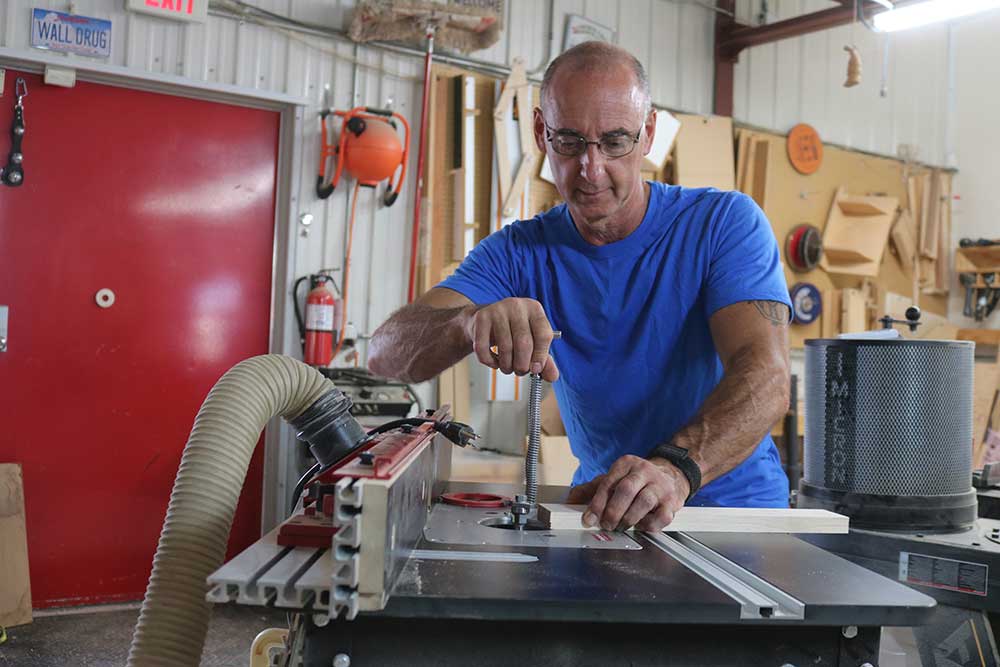
This is part three in a three- part series that will prepare you to successfully create through dovetails using a Porter Cable 4212 dovetail jig. Part one covered the initial setup of the jig, part two provided instruction on how to cut the tail portion of the through dovetail joint using the Porter Cable dovetail jig, and this video discusses cutting the pins and sockets and pulling the joint together.

Using a Router to Make it Easy and Repeatable
While some craftsmen cut these intricate joints using a mallet and woodworking chisels, many modern day woodworkers utilize the efficiency of cutting them using a router along with a specialized router jig that is developed specifically for cutting perfectly interlocking pins and tails. Once mastered, the Porter Cable dovetail jig can make the process of creating properly fitting pins and tails a nearly foolproof endeavor. As with any aspect of the woodworking craft, however, dovetail joinery (even with a router jig) requires some knowledge and practice. This video series provides the required knowledge; the practice is up to you.

Dovetails: The Ultimate Woodworking Joint
The longstanding popularity of dovetails is no coincidence. The joint provides beauty and indicates quality construction. In addition to its aesthetic value, it is also one of the most durable joints in woodworking. The interlocking angles of the pins and tails are designed to withstand the stress placed on the joint over years of strenuous use. That is why many craftsmen choose this joint exclusively for some of the most demanding joinery applications.

Continuing Your Dovetail Education
If you’re interested in learning more about the Porter Cable dovetail jig we also have a video on setting up for half blinds. Once you have mastered this versatile jig, you might be interested in exploring some additional woodworking jigs, and WWGOA has plenty of videos on other woodworking jigs as well.

Share tips, start a discussion or ask other students a question. If you have a question for an expert, please click here.

Make a comment:
characters remaining

5 Responses to “Porter Cable Dovetail Jig: Cutting Pins and Sockets”

  1. Lawrence Thurman

    37 minutes to watch a 13 minutes video

  2. Lawrence Thurman

    Our setup is done. PAUSE, Our tails are cut PAUSE. This is ridiculous. Never have issues with youtube

  3. GREG

    I have an omni jig 24 inch nd this video works for it too

  4. wvalentin

    Hello George, I have a question. You said that the inside face of the tail board should face you as you cut the through tail. Does this also apply to the pin socket board?

  5. Robert

    I tried this technique with 1/2 baltic birch from Woodcraft (the quality stuff). I did the climb cut as shown but still had some blow out. I had to add a sacrificial board to the front of my board, as well as the rear. The other issue I had with the plywood, when placed up to the comb, would pull away (slightly) from the sacrificial board. I think if I used thicker plywood, or a solid board, I would not have that problem. Be aware, when testing the fit with the baltic birch, you can split the wood when trying to get them apart, especially if the joint is too tight. I have to say, George is an excellent instructor. I never made a dovetail joint before and my first ones were pretty good.

Our setup is done. Our tails are cut. Be sure you catch those two videos leading up to this one. Here, we're gonna cut pins and sockets. So those other two videos include that other information.

First thing we gotta do to cut pins and sockets is turn the comb around. It's still in the configuration where we'd have it for tails. So we take that off. Give it a spin. Now, when we cut tails on this jig, all we do is cut the tails.

There's not any fitting involved with that. This is where our fitting comes in. Here's the way to think about this. Gonna get the backer board out of the way. As the comb moves back on the jig, that would allow us to cut a deeper and deeper socket.

So let me show you what I'm talkin' about here. I'm gonna intentionally bring the comb forward. Draw a line. Now, let's say we make a cut there. We get a certain width of socket.

Now, if I dial the comb deeper into the jig and draw a line, we get a wider socket. So the way that we control the relationship, the fit between the tail and the socket we're about to cut now, is by controlling the front to back position of the comb when we're in this angled position. So the way to think about this whole big picture is that when we're using the straight side of the jig, we use the angled bit 'cause that cuts the tails. When we're using the angled side of the jig, we're gonna use a straight bit. That's what we're about to do next.

As a starting point, what's recommended is that you align this seam, this line that's cut into the top of the comb with the back of your pin and socket board. So I'm a little too deep, I'm too far back here. I'm gonna bring that forward. Try that. I'm gonna do the same thing on the other side of the jig.

We wanna make sure that the comb is parallel to the front of the jig. All right, so far so good. Now, our setup is very similar with the board as far as what we did with our tailboard. The board in which we're gonna cut pins and sockets kisses the bottom of the comb, gets held to the left against the stop, lock that in place. I spun our sacrificial board around so we have a fresh end.

That goes against the stop and it comes forward until it's up against the back of our board. Give it a feel across the top here to make sure end grain is flush with face grain. Double-check we're tight against the stop. And that is very good. Depth of cut here, same as what we did on the tail, which is put the board that we're gonna cut or that we're mating to this one under the jig.

I just gotta check my comb, make sure we're down tight, there we go. I could see a little gap between the bottom of the comb and the top of the material. So I loosened the handle, seated it down a little bit better. Kiss the board against the bottom of the comb. Draw a line.

That's our depth of cut, router's unplugged. And I wanna take away the pencil line, that looks good. Now we're ready for a test cut. When we cut pins and sockets, it's different from the tails. With the tails, you're able to just go straight in and straight out.

Pins and sockets, concern is that if I just come in on the left side of this opening and start cutting toward the right, and a wood like hard maple or birch, I could start chipping, and those chips would come down the face. That would ruin my piece. So instead, I'm gonna come in on the right. I'm gonna climb cut just a little bit, moving toward the left. Once I do a couple of passes like that, then I'll come back to a conventional feed direction.

Do that same type of cut on every one of these sockets. Like always, I'm gonna set the router on the jig, then turn it on, let it come to a complete stop, and then take it off. Before that board comes out, have a look at your parts here. What can happen in this setting is that if you don't go in deeply enough, the symptom will be that instead of the wall of this pin being nice and parallel to the finger, you'll have a little whoop, a little curve right there, and a little curve right there 'cause you didn't go deep enough. Very easy to fix right now.

We could just fire the router back up, recut wherever we needed to recut. What we're lookin' for is just, are all of those pins nice and straight, as deep as they should be? Those look good. This can come out of the jig. And then we take our tailboard, and see what we've got.

All right, that really slipped in there, like a little too easily, just a little looser than I would want it to be. So here's the rule. If the joint is a little bit too loose, then we have to make the sockets narrower, which means we're gonna bring the column toward you. If the joint is a little bit too tight, then we have to make it wider, the socket wider, you're gonna move the column away from you. Sequence of events, it's trial and error.

Loosen the black knobs. Turn the knurled knobs back the same amount on both sides to move it back or turn 'em toward you, bring 'em forward, reduce that or increase the socket. Make another test cut, check it again. Of course, don't do your project pieces until your test pieces are comin' out just right. We also need to talk about the orientation of the boards in the jig, let me take this back out.

Our board is cut like this. So the open side of the socket is facing me. When I cut the other end of this board, I need to go to the other side of the jig just like we would have done with our tailboard. So sequence of events would be I'll do all of the pin and socket boards I need to on this side of the jig. Then when I'm ready to use the other side, cut a fresh end on the scrap.

Move that to the other end of the jig. Start cuttin' pins and sockets over here. Let's bring this forward just a little bit. Do one more cut. For the effect I'm trying to get here, I'm just movin' that knurled knob a quarter of a turn.

For my test piece, I'm just gonna flip it, and run the other end because I'm not worried about creating lefts and rights. All we're worried about is checkin' the fit. Notice that on our pin and socket boards, it's the outside of what we're creating that's facing us. On the tailboard, it was the inside that's facing us. Now, it's gonna be second verse same as the first, except I forgot one thing.

Let's have a look at one more setting before we go any further. And that is, are we cutting deeply enough in this direction? We can check that by just allowing our mating board to rest on the bottom if it won't fit into the sockets and check, is end grain stickin' past face grain? Or if we can put 'em together like I was able to with this, same question, do we have end grain stickin' past face grain? Now, just to make it clear, it seems like a good fit, but look at how it's a little bit gappy there.

So it's just a real small connection that we need on these dovetails. Real small connection or correction, I'm not sure what I said there. What I meant is a real small correction. That looks good, our depth on the router bit is still good. Let's go again.

Give it a visual to make sure I'm cut all the way through, nice and straight walls. Inside of board lays down. That's better. What I wanna have to do is that. I wanna have to tap that just a little bit either with the heel of my hand or with a rawhide mallet in order to get 'em to go together.

So now we've got the fit we want. Sequence of events would be glue the joint together. After the glue is dry, then come back and hit where the end grain is projecting past with a block plane or a sander to smooth that up. That takes care of our third in a series of videos on using the Porter-Cable 4212 to do through dovetails. Once you've been through it a couple of times, and be sure you spend the time practicing, you're gonna find it's pretty easy to set up.

And those through dovetails really look cool.

Get exclusive premium content! Sign up for a membership now!