Routed Mortise and Tenon
George VondriskaGeorge Vondriska teaches you how to use your handheld plunge router or router table to cut perfect mortise and tenon joinery for your woodworking projects. He shows you the best way to expertly lay out the dimensions and make the proper cuts.

If you've got routers in your workshop, you can make a mortise and tenon joint, and that's what I want to show you today is how to use routers, a handheld router and then later a router table, to produce perfect mortise and tenon and joints. So, a couple things have happened already, and let's talk about that. I've got some layout lines here on my leg, not my leg, but my leg in order to locate the mortise on there. And what I've done is marked this out so that the mortise is overall 1/2 inch shorter than the width of my rail. That's because I'm gonna end up with a 1/4-inch shoulder on each side surrounding the tenon.
That part's taken care of. Another thing to point out is that the leg is longer than what I need finished. Eventually, for this project the leg is gonna get cut right about there. But when I'm working with the router, life is easier if the leg is still too long, 'cause it provides a bigger platform for the base of the router to sit on. Now, while we're talking about the router, let's talk about the router.
This is a plunge router, and I need a plunge router in order to make this happen. You can't do this with a fixed base. I need to be able to enter the work, make the cut, exit the work. Gotta do that with a plunge router. Now, I'm at a point where I'm ready to do some setup on the router, and specifically, what I want to do is put a fence on here and then locate the fence.
What I could do at this stage of the game is put in the router bit with which I'll be cutting the mortise, but I have found that it's difficult to measure to a router bit like this. It's a lot easier to measure to a router bit that looks like this. This is called a V bit. The center of the cutter comes to a very distinct V point. So what I've started doing some time ago was doing the layout for my mortise and tenon based on the center of the joint.
So in this case, I've got 1 1/2-inch-wide legs. I want the mortise centered on that, so it's 3/4 of an inch to the middle. With a V bit, it makes it very easy to measure from the face of the fence to the V of the cutter and make sure that my fence is exactly where I want it. Notice that, when I put the V bit in, I didn't even bother tightening it into the collar. That's not necessary.
It's just in there temporarily, just long enough for me to get this set up correct. Before I put the bit in, let's talk about the cutter. This is a 1/4-inch diameter. I'm gonna be using what's called an upcut spiral. So what that means is that the flutes on this act very much like a drill bit.
As the router bit spins, the dust comes up the flute and evacuates from the mortise. When we're doing a deep mortise, that makes it a lot easier for the router because the dust is coming out instead of being trapped down in there. It's not imperative that you have an upcut spiral. You could do this with a straight fluted 1/4-inch bit, or any other size for that matter. But if you've got a spiral bit, it does make it a lot easier.
I'm gonna go ahead and get the router bit mounted into the machine, and then we'll have a look at the next step in the setup. Here's where we're at. Router bit is in. Fence is correctly located. I'm almost ready to get on my work and plunge a mortise, except that the router needs to know where to stop.
I need to know how deeply I want to go. Now here's a general rule of thumb with mortise and tenon joints, and that is the tenon should be twice as long as it is thick. So when I produce a 1/4-inch tenon, it should be 1/2 inch long. So my mortise should be just a little more than 1/2 inch deep. So here's the way this works.
With your plunge router, loosen the plunge mechanism, plunge the router down to the work until it touches and lock it in that downward position. Somewhere on the machine, you're gonna have what I have here, which is a stop rod. The stop rod bears up against a turret. That's what's gonna control our depth of cut when we're all set up here. So what I want is at this point 1/2 inch or slightly more in between the bottom of the stop rod and the top of the turret.
Easiest way to do that is to use a piece of bar stock. Put that in between. Now I'm at 1/2 inch. If I come up off of that just a little bit, lock that in place, I can come back and check. I've got just over 1/2 inch in between the two.
That's gonna make my mortise just a little bit deeper than the tenon. That's the way we want this to be. We don't want the tenon to bottom out in the mortise before the shoulders of the tenon meet the face of the leg. So you want to overcut the mortise just a little bit. That takes care of that.
Now I don't want to do this all in one pass. I'm gonna do it in a couple of swipes. So that's where the turret comes into play. By spinning the turret, I can use a setting where it's only gonna get partial depth to cut. Then go to the other setting for full depth to cut.
That'll finish the mortise off. We've got two legs sitting here on the table, and that's very intentional 'cause, like two heads are better than one, two legs are better than one. The reason being it increases the stability of my operation. If I do this with just a single leg on here, there's some chance of that router base is gonna wobble, and I'm gonna have a lousy mortise. If I do it with a couple of legs, there's a bigger platform and more stability.
Now we know that my layout lines are on there. What we also know is that me standing here looking like this, it's gonna be really hard to do when I'm trying to make the cut. It's virtually impossible to eyeball that through the base of the router, watching the bit as I go. It's very easy to eyeball it now. So I'm gonna turn the cutter so the flutes are left and right.
They're basically parallel to the direction of the leg. Then I'm gonna come over here and, on the left side of the mortise, I'm gonna touch this down until the left flute is up against the pencil line. And when it's in the correct position, trace the base onto the leg. And I'm gonna come over here to the right part of the mortise, and with the right side of the flute, do the same thing. These lines, which dictate the outside edge of the base, the left side, the right side, are very easy to see as I'm making this cut compared to leaning over and trying to look down in there.
So now, I'm centered on the leg, my depth is right, and my starting and stopping points are right. My turret is correctly set. So if there aren't any questions, we're ready to make a mortise. Even with our upcut spiral, we get a little bit of dust left behind down there in the mortise, but that'll clean out very easily. That step takes care of producing the mortise in the leg.
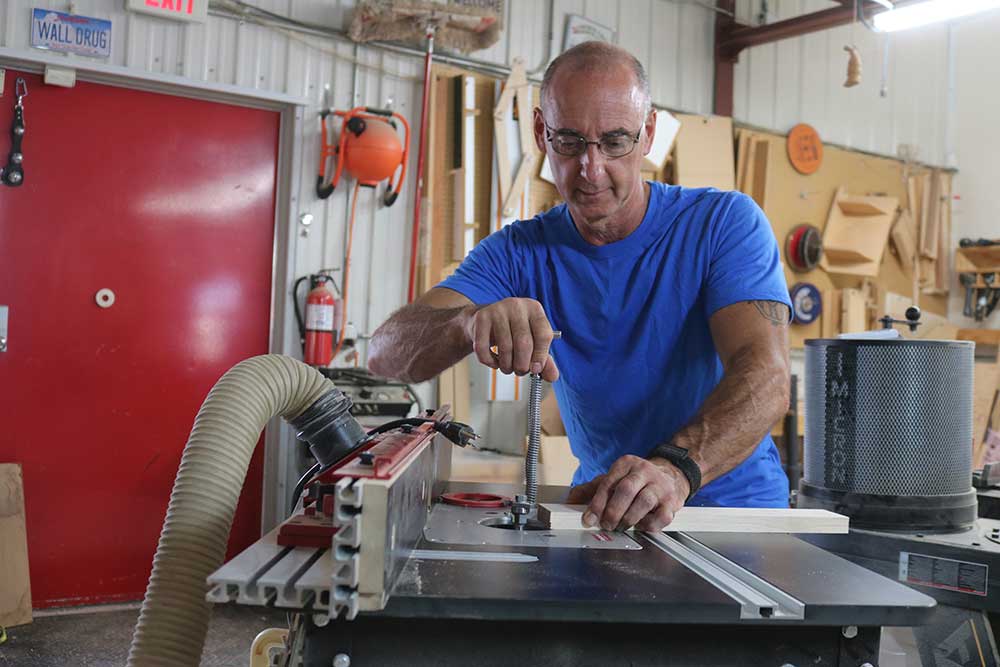
The next thing we'll look at is getting the tenon cut on the ends of the rails. Here at the router table, what I've done is put in a straight bit. I have the router unplugged so I can work on setup here. What you want to do is use a cutter whose diameter is greater than the length of the tenon you want to produce. This is a 5/8-diameter bit.
I'm gonna do a 1/2-inch long tenon. First thing I'm gonna do is set the height of the bit. Now remember, we're shooting for shoulders on this that are about 1/4 of an inch. I've got 3/4-inch stock. I'm putting into it a 1/4-inch tenon.
So I should be taking 1/4 inch off each of the other four sides. When I set the height of the bit, I'm gonna use a piece of my bar stock. Bring the cutter up. Now, I don't want to come right to the top of that bar stock because that might make a tenon that's a little bit too small. I'm gonna stay under it, hopefully resulting in a tenon that's too big.
Then we'll just make test cuts, subsequent cuts, until we get the fit of that tenon just right by raising the cutter as we need to. Next thing I'm gonna do is locate the fence. I've got my 1/2-inch bar stock ready, turning the cutter so that the outside of its cutting circle, kind of top dead center in this direction, is pointing away from the fence. Now in this case, I'm gonna use the bar stock until the tip of that cutter is perfectly aligned with the face of the bar stock. Easier to feel than it is to see.
Lock one end, check it again 'cause if I need to make a small adjustment, I can pivot the other end. That's pretty good there. The key to this test cut is that it has to be done in material that's exactly the same thickness as your real project pieces because as the thickness varies, the size of the resulting tenon will vary also. So I'm set to go here. I'm gonna make a pass this way and a pass this way.
Using this shop-made backup board for my router table. This is made out of MDF. Does a couple things for me. It makes it a lot easier to hold my material square to the fence. It also provides backup so that, as the router bit exits, I don't get a big chip on the exit side.
The face of the fence here is replaceable. I made a bunch of these when I made this thing, so I can take the screws out, put another piece on, keep using the base of the jig over and over again. Just sacrificial fences. So this looks good. We'll do just the face cuts.
See what kind of a fit we have for the mortise. There's the mortise that we produced earlier, the tenon that we produced now, and when I try to put those together, it ain't gonna happen. The tenon is way too big. What I want to do is approximate how much too big. I'm gonna guess it's about 1/8 inch or so too large.
On this system, what I can do is calibrate that by controlling how far I turn the crank. A full revolution of the crank is gonna raise the bit 1/16 of an inch. Then of course, a portion of a turn will raise it less. I don't want to try to come all the way up right away. I'm just gonna come up part of the way.
We'll keep sneaking up on a good fit. So I'm gonna do 1/2 a turn just to be conservative. We'll do another test cut. I can always take more material off, but I can't put it back on, so I'd rather sneak up on this until I have it just right. It always takes a couple tries to get this right.
It's worth taking your time being careful. This is the fit I want. I want to be able to push that in by hand, not have to drive it in with a mallet. And when I pick it up, I want 'em to stay stuck together under their own power. Next thing I can do, now that I know that's right, is take care of the top and the bottom shoulders.
So my normal sequence of events would be face, bottom, face, top. Then the tenon'll be completely done. Without question, having a router lift in my router table makes life easier because I can use that crank to very gently finesse the height of the cutter. However, even if you're working with a fixed base router and adjusting from below, you can do this exact same setup on any router table. Now we've got a tenon that fits, technically, except that it still ain't gonna go in there 'cause we're doing a square peg in a round hole.
So when we do a routed mortise, we have to do one more step in order to get the tenon to fit. Here at the bench, what I'm doing is I'm just taking the square corners off of the tenon, using a good sharp chisel. A couple things that are noteworthy. One is a good sharp chisel. If the chisel's dull, you're gonna struggle with this.
Two, I've got the rail in a vise so that I can work on it, rather than trying to hold it at a bench and work on it, because that's a good way to get cut by that good sharp chisel. What we need to do is just take enough off of the corners that it's gonna fit into the rounded ends we've got on that mortise. And it's okay if you take off a little bit too much because, really, the strength of a mortise and tenon joint comes from where the sides of the tenon meet the sides of the mortise, not from where the ends meet. So I'm just gonna eyeball this. I gotta do another little cut or two.
Once we've got those ends rounded off, our tenon drops into the mortise. We've got a great fit. When we get some glue on there, we're gonna have a nice strong joint. So, that procedure will take you through using a handheld plunge router and a router table, and then, of course, a chisel here at the bench in order to make a perfect mortise and tenon joint in your shop.
How would you cut the tenon it you were using a table saw and a dado blade? If I made a 1/4” mortise then I’d use a 1/4” dado blade make my test cuts then do my project parts right? Thanks
If the length of the tenon is 1/2" why did you use a 5/8" router bit in the router table. It would seem that the little bit of extra space/depth that was made in the mortise to accept glue would be taken up by the 5/8" long tenon. Am I missing something?
Can you share the tools brands you used?
Excellent, George. Very helpful.
Thank you George! This has been most helpful specially how to mark out where to start and stop the plunge router when doing the mortise cut.