Titebond: Make a Tambour Door
George VondriskaTambour doors add a very interesting touch to a project and are easy to do, with a few tricks. Making a tambour door involves gluing canvas to the back of the door slats and Titebond Original is a great glue choice for the project.
The slats and groove
There’s no set size that will work for every tambour door project. The slats in this door are ½” thick and 5/8” wide. You may need to change the size of the slats depending on the curves you’re intending on putting the completed door through. The groove for this door is ¼” wide, ¼” deep and has curves with a 3” radius.
Glue, check, wait
After the canvas is glued to the slats give it a little time to dry, 20-30 minutes, and check it. Handle the door carefully and make sure it bends. It’s possible that some glue got between the slats and they’re stuck together. Make sure every slat is able to flex, then return the door to the jig to dry completely.
Machine the rabbet
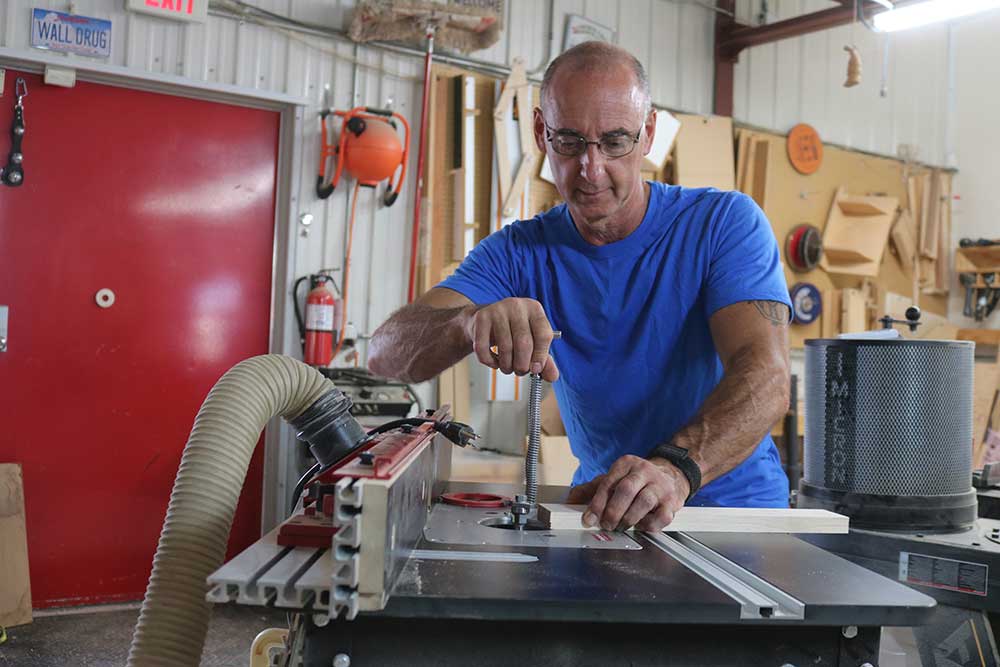
Use a table saw equipped with a dado head or router table with a straight bit to make the rabbet and resulting tongue. The length of the tongue is equal to the depth of the groove. The final thickness will be less than the width of the groove to allow the door to navigate the curves. Sneak up on the perfect fit by making careful test cuts.
More info
For more info on Titebond products visit the company's website.
Let's make a tambour door first off, if you're not familiar, what a tambour door is. This is a tambour door, and what's laying there looking like a cherry panel is actually way cooler than that because it does this. So the beauty of a tambour door, like you might have on a roll top desk or a bread box, is that that door can flex rather than being in one solid panel. A bunch of stuff is gonna come together here we're gonna be working with. Cherry slats.
And canvas and hide glue on original is the perfect glue for this. When you're getting going. You need to build a jig. And the thing that's critical with this jig is this component and this component are square to each other. They're perpendicular.
What's about to happen is that all of my door slats are gonna go in here like this, and it's this jig that's gonna allow this to come together perpendicular, and in the absence of these rails, we might glue it together curve fluid. So first step is getting all these in. And yes, some of my slats have a little bit of epoxy in them. They're going into the jig good face down. Part of the purpose of the jig and so that we can do this.
I'm gonna put pressure on this piece, drive those screws that's closing all of these seams. When you build the jig, make these retainers lower than your slats. My slats are half inch thick, five eighths wide. These have to be less than a half inch thick. The reason being we have to be able to drape canvas over the top, and in order to do that, we need to have those lower.
So next thing I'm gonna change to a Rolly-Poly cap on this, and then we'll be able to get our canvas on after the glue is on. Now as I'm rolling glue around, you'll notice the addition of that masking tape. That masking tape gets positioned the width of the rabbet from the edge. So what's gonna happen in the next step here is this door is gonna get rabbited to fit the groove that the tambour door goes into. We don't want canvas there, so by having that masking tape in place.
That's gonna prevent the canvas from being able to get glued to the door there. So, in this case, it's a quarter inch up from the end. Once you've got good coverage, you're ready for the canvas, and this canvas you can get anywhere; buy it online, you can get it at a fabric store. There's nothing timber door proprietary about it, it's just a piece of canvas. Stretching that out, I don't want wrinkles on the back of this.
And I want to make sure it goes past the edge of the panel. And we'll trim that to fit later. Then, to make sure it seats in the glue. I'm gonna take a roller. And roll that out.
And we need a bit of old clamping call to make sure that everything is gonna stay down before the call goes on; wax paper goes on. To make sure we don't accidentally glue the call to the canvas. Just in case the glue bleeds through a little bit. A piece of MDF makes a great call. And a kettlebell makes a great clamp.
We're gonna let that sit just a little bit. We don't want the glue to fully cure. I'll talk more about that when we come back and look at that panel. The glue is not fully dry at this point, but we have to do a little intermediate step. It's about 25 minutes-ish since I put all this together.
So, one thing is have a look. At what your cure level is, and I'm just doing this to make sure that the canvas is stuck. What we need to do is take out this retainer. And then gently take this off the jig. What can happen is if glue ends up in between those seams you're not gonna have a timber when you're done.
You're gonna have one solid panel. So, I'm being real careful because we know that this isn't fully cured. But what we need to do. And Nick, we're looking, we need to make sure that every slat is able to open. Once you know you have that, gently Just put everything back together.
And wax paper goes back, call goes back, then let that fully cure overnight. And then we'll come back and look at what you gotta do to make those rabbets and get this to fit the groove you have in your project. Let's see what we got. This is now overnight dry. So, fully cured.
That is cool. It might still be just a little bit sticky like that, so you maybe got to pop it open, but doing that preemptive step of taking it out before the glue is fully cured to make sure that the tambre is gonna flex is really important. Next step. Get rid of the excess canvas. And that's very easy.
And these edges with a good sharp utility knife. Just follow the wood. And then on these edges. I can look through the canvas and I can see the edge of the masking tape cause it's blue. Through the white canvas, so I'm gonna put a straight edge there.
And there. Now we need to do your mission, gym, if you choose to accept it, and you kind of got it because we're making a tambre door. You gotta have your case component ready. On this one, that curve is a 3 inch radius and again my slats are 1/2 inch thick, 5/8 wide, but we have right now. Is 1/2 inch thick material that's gotta fit into a 1/4 inch groove.
We're gonna take care of that by going to a router table or a table saw, so you could do this either with a router bit or a dado head. In this case I'm doing it with a router bit and doing it is. On the front of the tambre. On that face, we're gonna cut a rabbet. And then the question of how do I know when I'm done is answered by.
The remaining tongue there on the bottom. As to fit into the groove. Doesn't yet and it's got to be able to make the turn. So I'm gonna just keep, I'm gonna raise the bit. Do another cut, raise the bit to another just keep testing it here and this is a race that goes best to the slow and steady.
In other words, raise the bit in just small increments, do another cut, come back and test. It's pretty magical when it all comes together and works. Couple wrap ups here. The length of that tongue is the depth of the groove, meaning. That tongue right there.
The length of that is the same as the depth of the groove. And then you can see what has to happen here is that the resulting tongue has to be quite a bit narrower than that quarter-inch groove, so they can navigate the turn. This is why we have to put the masking tape on the back, because you don't want canvas here or it would interfere with this panel's ability to travel in and out of that groove overall. Pretty simple process. A lot of just finesse along the way to make it work, and as I just said, it's really cool when you get it to navigate that groove.
It's even cooler when you get the cabinet done and your timber doors installed and you can have this amazing look on the front of your project. So thanks to Titebond for being the perfect adhesive for pulling that together. I hope you try this timber door process. It's really, really fun.
Share tips, start a discussion or ask other students a question. If you have a question for an expert, please click here.
Already a member?
No Responses to “Titebond: Make a Tambour Door”