
Finishing Part 1: The Perfect Finish Starts with Sanding
WWGOA EditorsJim Heavey from WOOD Magazine starts a three-step process for creating a perfect finish on your next woodworking project with tips on sanding. The first step is to understand the properties of different grades of sand paper and knowing when to use each. Jim takes you step-by-step through the sanding process.
Related Videos:
Part 2: Choosing and Using the Best Stain
Part 3: Applying a Top-Notch Top Coat
So maybe you've just finished constructing your project or you bought a chair like this unfinished, it's time now to put the finish on it. And that's where the little demons come out. Well, it's a relatively easy process if we take it in three steps. And we're gonna show you how to do that. The first step is in prepping it, where we'll talk about sanding.
The second step is in putting our color on it, like staining. And the third step is putting a top coat. And in this case we'll probably use polyurethane. We're gonna really increase the confidence level you'll have when you do a project like this, after you've seen what we're gonna show you. And now let's show you step one.
Now, your preparation begins very basically with sandpaper, and maybe we should take just a minute or two to talk about sandpaper. You're gonna find when you start standing that you'd like to choose the correct grit. In this case, we're gonna start with 120 grit, a little bit more coarse than 240. And let me explain. When you see the numbers on here, in this case, 120, in this case, 240, it talks about the grit size.
120 is a much more coarse grit than is 240. So we wanna start with 120 and start our sanding that way, and work our way through maybe 150, then 180 to 220 or 240. So that's what you see in the first part. The second part is whether or not this is open or closed coat. Now, an open coat, it just means the grains are a little bit further apart, allows the sawdust to fall out while you're sanding so that that sandpaper doesn't become clogged.
And the last thing you may notice on the paper is weight. In this case, the paperweight A is a relatively flexible, smaller, thinner sheet. Paper weight C is a little bit heavier. Both of those are appropriate when you're doing sanding. Now, one more thing to add, and we'll probably talk about this a little bit more during our finished section is papers that go up starting from about 400 to 1500 grit.
And these, the grits, as the numbers get bigger, the grits get even finer. This will allow you to sand either between coats of finish, or actually do a rub out on your final coat of finish. So, now your choice is how you're gonna do your sanding. There's a couple of different options. The first is just to fold a sandpaper and use it by hand like you see here.
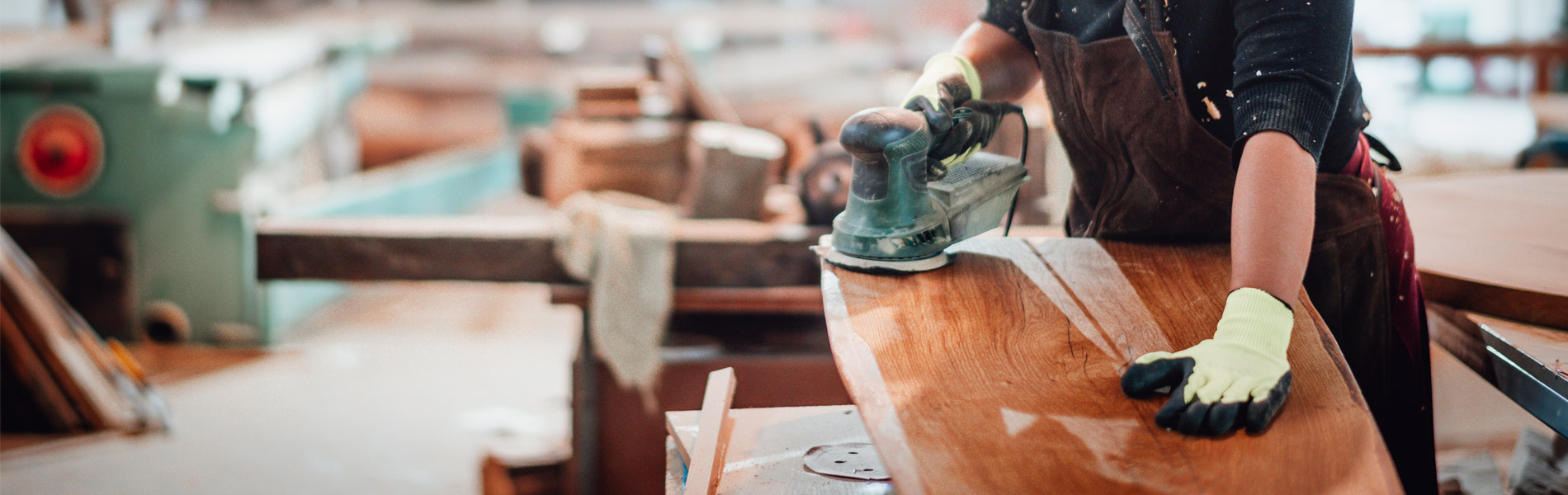
The second is to use a sand pad, and on long, broad surfaces, in a lot of cases, it's a good idea to use a pad. And there's a lot of different types. Good idea to kind of look around, see which ones fit your hands well. And the third way to do it, especially on larger, bigger projects, maybe to use a power sander. And you see one here, this is a little pad sander, they work really well.
The one option I would give you is, this one's got a bag on the side of it, which does a nice job collecting dust. But if I have the opportunity anytime, I'll try and use a vacuum hose. So this you can remove and put a vacuum hose on it. It's just a lot more efficient way to take the dust out. And lastly, if you're sensitive to sawdust and maybe even all the time, it's a good idea to wear a dust mask like this.
Really helps keep the dust out of your lungs, and it'll make the sanding a little bit more pleasurable. Now on this chair, the surface relatively smooth, but on your project, it may be a little bit rougher. In either case, it's nice to start out with 120 grit paper. So what we'll do is we'll start with 120 and go over this entire chair by sanding evenly in all these surfaces. And it's very important to make sure that all the surfaces are sanded to 120 before you move up in grits.
Now, after you've finished sanding with 120 grit sandpaper, and you're fairly comfortable you've sanded everything on the chair, it's time to switch to 150. Again, remember, we're gonna work our way from 120, to 150, to 220 as we work up. After I'm done with my 120, a little bit of this 120 grit, fairly coarse grit is still lying on the chair. It's important, especially when using your hand and sandpaper like this, to follow up that 120 grip with a vacuum hose attachment. And just vacuum that off a little bit.
That way you don't have some of that bigger grit sitting on there, so that when you start with your 150 grit sandpaper, you're not rubbing that 120 grit, that one that was previously there, back into the surface again. It really makes that job go easier, and the chair gets smoother quicker. Now here's a tip for you. We're planning on ultimately putting some stain on this chair, and it's really important that the end grain, and you'll see it here on the end of this chair as opposed to the side grain, or maybe the top, the end grain is always more porous, and it's gonna attract an awful lot of stain and really dark and the looks of this. So what I'll do is use finer sandpapers beyond the 220 to sand just that end grain.
My thinking is if you have 220 here, do twice the grit. So go up to 320 and then finally, 400 grit sandpaper and sand just the end grain. This additional sanding will reduce the porosity in here and make this edge look a lot more like the surface after stain has put on. And one more thing, sandpaper does wear out. Every once in a while, you're gonna have to break down and use a new piece of sandpaper.
You'll be surprised how much faster this job will go if you'll just change it every once in a while. One last thing I wanna show you, and that's cleaning up the chair in general. My favorite is to take the hose that comes with your vacuum or maybe even your shop vac, and actually use that little brush on the end to vacuum up all the loose dust. It does a really nice job of taking the residual dust off the surface of that chair. For those of you that have one, a blowgun and your compressor also does a very nice job removing the dust and does a remarkable job of removing dust, especially on end grain.
There are a couple of things that people will read about using either a tack rag like this, or maybe mineral spirits on a rag. And I'd like to talk about two of those issues. Using mineral spirits on a rag I think works well between coats of finish. When you're it using on raw wood, I think all it does is make the wood wet. You will have to re-wet it quite a bit and keep changing that pad to make sure that you're not just moving the dust around.
I think vacuuming is a better bet. If you're going to use a tack rag, make sure that the tack rag is used extremely lightly, almost as though you were just lightly passing over the top of this. The more pressure you put on this tack rag can take some of the chemicals that are in this rag, the ones that you feel on your fingers when you're using it, and actually transfer that to the surface of the wood. Those are not a good thing to have when you're trying to put a stain or finish on. So again, my preference would be, just use the vacuum attachment on your, either your vacuum or your shop vac, and vacuum this off.
You didn't mention one of the most important parts of sanding....grain direction and sanding with the grain.