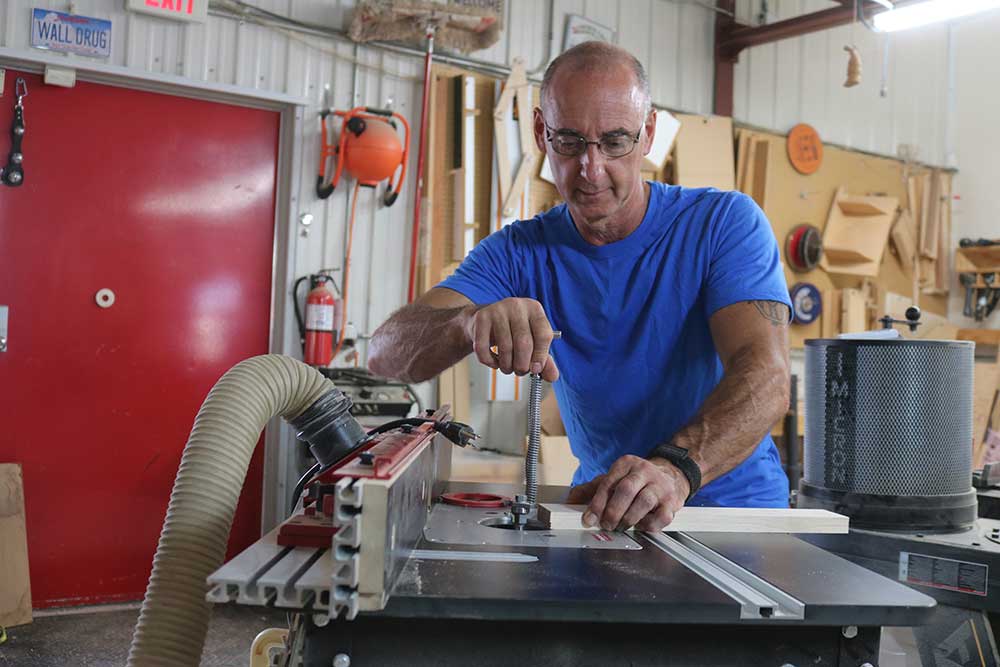
Extend Your Rip Fence with Bow Products
George VondriskaBow Products has a great solution for adding safety and support when you’re ripping on your table saw and bandsaw. Their fence is a robust aluminum extrusion that easily clamps to your table saw rip fence or bandsaw fence. Shelves on the fence provide support on both the infeed and outfeed sides of your cut.
The 5” tall fence adds real estate that’s very handy to have, especially when you’re resawing on the bandsaw.
Featherboards, too
Bow has a complete system. In addition to their aluminum fence they’ve got great feather boards and a handy push stick. All of this is working toward keeping your work secure and you out of harm’s way.
More info
For more information on all of Bow’s products visit the company's website.
Compact table saws have come a long way, and they're wonderful tools. But one of the downsides is the real estate that we have front to back on these smaller Table saws, and where that becomes problematic is especially when ripping. There's a tendency for the board to be tippy this way. And on the outfeed side, same, finishing the cut, there's a tendency for it to be tippy. Way.
So the fence is kind of small; that system is Kind of small. There's a cool product from Bow. That helps you overcome that, and this fence can easily be added to the existing Rip Fence On your saw by clamping it in place. And then a couple of attributes here. The bow fence is long, and it's 5 inches tall.
Extruded aluminum, very rigid, very robust, very straight. One of the things that helps us now when we're cutting long stock is the addition of these. Little shelves, these ledges. It goes like this. And intuitively, you can see what's going to happen here as our material comes by.
It's going to rest on this on the infeed side. It's going to rest on this on the outfeed side. If you want to, you can add a leg. There’s a screw hole right there. We could give this saw even more support by putting a vertical under it.
The other thing going on with that extrusion is it's got slots in it so that we can add Featherboards. In addition, then, to giving us that in-feed and out-feed support. The featherboards give us hold down. And one of the things when I teach woodworking, I talk about all the time is safety. Safety, safety.
We're getting a lot of that here because we're Taking a lot of unknowns away from handling this board on the table saw. The other thing that's handy to have. Once we're set up to cut. I Sideways pressure, lateral pressure. To help hold our material against the fence.
Now, remember when you do that. You want to lead the cut with this featherboard. In other words, I don't want it up there by the blade; I want it in front of the blade. So I'm doing a little bit of pressure with my left hand, Tighten that knob. So even without me holding on to the board at this second, We're supported.
We're lateral. We're held down. Next thing we're going to add to this is a push stick. A very important step to help keep your pinkies away from the blade. See what this looks like when we cut.
Really simplifies and safes, is that a word, the way we can make rip cuts on the table saw. This is also very useful on a bandsaw, so I'm going to change the setup a little bit and Let's see what benefits we get out of that Re-sawing. When we apply the fence to the bandsaw, we've got a bunch of cool stuff going on here. If the fence on your bandsaw is short, then again, this one is 5 inches tall. And especially when it comes to re-sawing, taller is better.
We have that, too. Then we’ve got our little shelves on the infeed. Side and on the outfield side. So as I'm starting to cut, my board has a place to rest on the outfielded side. Same.
The other thing we're going to roll into the Equation here, really cool for bandsaw work is the Guide Pro that's going to go into the Miter gauge slot like that, position it where you want it to. And then you'll see in a second when I start cutting, it'll rotate just a little bit And apply uniform lateral pressure this way. So it's a feather board, but it's a feather board that's tall. So it's really going to do a nice job of keeping my work against the fence. And really, the proof is in the pudding, right there.
The material I just re-sawed is still sitting there by itself without me having to support it. Not having to build an outfeed table, great addition to the bandsaw. So overall, what I like about this anytime we can add safety to a tool, That's a win. And just making woodworking easier, That's a win, too.
Share tips, start a discussion or ask other students a question. If you have a question for an expert, please click here.
Already a member?
No Responses to “Extend Your Rip Fence with Bow Products”