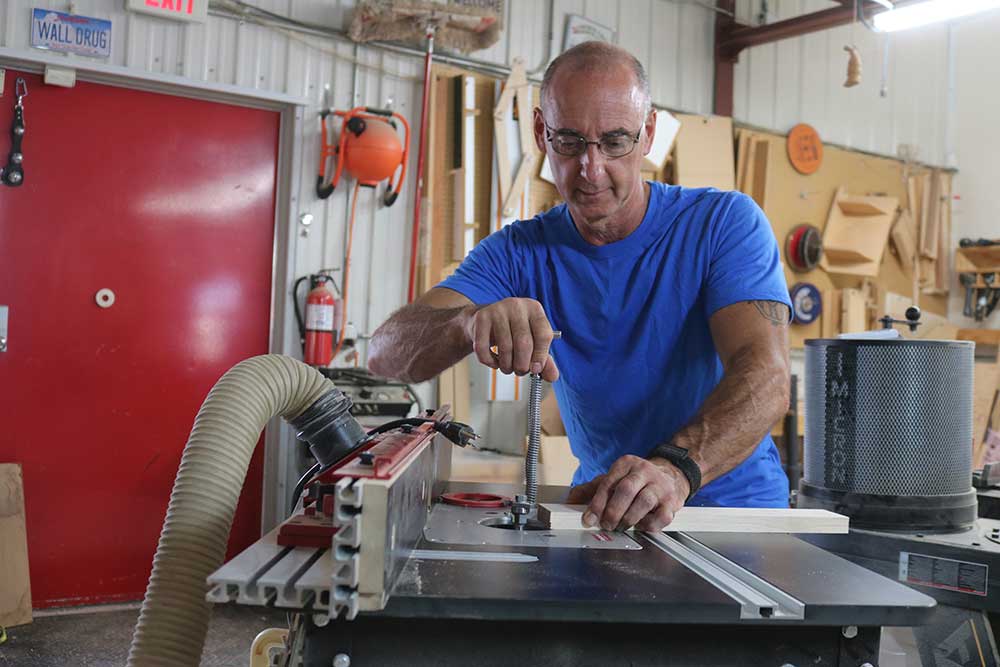
Arbortech: Build A Bench Part 2
George VondriskaThis is Part 2 of my Build a Bench project. Be sure to watch Part 1 and Part 3.
In order to cut square ends on our live edge bench slabs we need to do some layout. This is a great process to understand when you’re working with live edge slabs. Once this is established the slabs can be cut to size.
The seat and back for my bench are bookmatched and taken from sequence cut slabs. It’s important to keep track of those parts so you don’t cut in the wrong spot and lose the bookmatch.
I want the bench to be comfortable, so I dished the seat out using Arbortech’s Spheroplane. The Spheroplane simplifies making concave and convex surfaces, and getting them consistent. After creating the concave shape using the Spheroplane I switched back to the sander to smooth everything out. Variable speed on the Power Carving Unit makes it easy to stay in control of sanding.
There are SO many fun things you can create with Arbortech’s tools. Be sure to have a look at all the possibilities.
More info
For more information on Arbortech tools visit the company's website.
If you're doing your project in live edge slabs, like I am, and they don't have to be live edge slabs, they can just be slabs, but if you're working with a live edge like I am, one of the things we're up against now is we need to be able to cut these to their final length, and we want the seat in the back to be identical in length, which means we need to square an end. And then we have to cut the other end. So what's weird with live edge slabs is that because I've got this weird organic edge, there's no place for me to really put a square up against that and square an end. So in order to get your slabs, and my slabs looking like this one, which is square two ends and cut to final length, here's a great trick I have that I'm gonna show you. Here's how this works.
We're gonna do this by creating a center axis on the slab. So it's just what it sounds like on this end. I'm gonna measure width, and it doesn't really matter where you do it because in the end, we're gonna end up with a center line. So I'm gonna go right here. The width is 20, making a mark at 10 because that's half of that.
Then somewhere down here, the end here has got a lot of shape going onto it, so I'm gonna measure more here someplace this will work, and what I like about this spot, the edges are more parallel here than they are down here because there's a lot of, like I said, a lot of organic shape going on there then. We're gonna connect the dots. You need a straight edge. I'm on each of my lines. And I do this.
Now at this stage of the game, eyeball that line and see, huh, does that look like a good spot? So in other words, Is it centered? Is it running down what looks like the center axis of our slab? That one looks pretty good. We're gonna use that to create our squaring line for the end.
The way we're gonna do that is grab a square. And with this square, I can put that. So it's on the center line. That leg of the square is on the center axis I just created. And draw a line this way.
Now this line is perpendicular to that center axis. Then do the same thing in this direction. Or grab a longer straight edge. So I'm gonna go back to this and extend the line you already did. T like this.
What that gives us is this and is now perpendicular to that center axis. Now you could use a track saw, a circ saw with a guide. The commonality being I'm using a fence to guide the saw. I'm not just doing this cut freehand. So we can use a saw and a guide to cut to this line.
From there we can measure overall length that we need, cut the other end so that again the seat and the back have to be identical. This particular board, this is gonna be what's used to create our support blocks. We'll talk about those more later, but we also will need to do the same thing to the verticals, the parts here that will be our legs. We're gonna want those to be the same size. So this is a great way, the center axis is a great way to define how we get square cuts on the ends of these irregular slabs.
Let me get you caught up on where I'm at and where we're going with the slabs themselves. We have identified a back and a seat and part of what's happening here is that we're gonna have a book match between the back and the seat when we're done because they're sequence cut slabs. So when I do this, A real obvious thing to look at is the bark conclusion over there and the bark conclusion on the seat and you can see that they match up and then if we look closely, there are other components in the grain that also match up. That's gonna be cool. I identified right away this is the back and this is the seat because it would have been so easy and such a shame to get these parts mixed up or, as we start working with them now to make cuts in the wrong face and then lose the book match that I've worked really hard to get up to this point.
So this is the face of the back, that's the face of the seat and that's gonna keep me on track as we move forward. With the seat, remember there's a span of widths. That'll work for a seat on a bench, 15 to 20 inches or so. When I looked at this seat, there was this part back here that's icky, that's the technical jargon. So one, I wanted to eliminate that.
Two, with a 20 inch deep seat, that's pretty deep. So you're sitting way back on the bench on that, meaning it could make it a little harder to get. Out of when you no longer want to sit on the bench. That combined, that came together such that I cut that off. And I reduced the slab to 16 inches wide.
Now, where we're going next is we're gonna make this more comfortable by not leaving this dead flat for that. I'm gonna use the Spiroplane, and this is another just crazy cool arbor tech product. Once again, we have a shroud, and the way that the shroud works here is that when I unlock it, we can dial that shroud up or down and a lot like the turboplane and the leveling shroud, this is controlling how much or how little cutter is exposed. Now, in this case, it's not about leveling, it's about do we want concave or convex, and for the seat, we want to do concave. So when I want to do concave, I want it to look like this, which is I want the cutter to project past this shroud.
If we want to do a sphere, hence the name, we can turn this the other way. We want the cutter for a sphere to be slightly up inside that shroud. Like that, that will give us convex. I always have to think about those two words and make sure I'm using them right. So outside of the bench, we're gonna do here, this is a great way to do both.
Because one can do the outside of the bowl in this configuration and then go back to where we want to be for the bench to do the inside of the bowl, and you're gonna see in a second it's a really, really easy way to control what you're doing. I'm gonna get some layout lines on this piece that are gonna help me make my cuts, and from there, we'll be ready to. Here's my layout. The back of the bench is against me, the live edge of the seat component, the bench component is gonna be forward. I've got a line here that's 2 inches in from this edge.
This line is 15 inches from the edge. This line is the center between those two. That's gonna be the deepest part of the dish, on the end grain I marked out a half inch deep. I did that on both ends. That's gonna be my gauge as I sweep, sweep, sweep.
So what I'm looking to do is bowl this out and get from that half inch deep part, it's gonna shallow up to the end like that and shallow up to that end like that with just kind of a natural, organic flow between them. Here's my agenda. Here's my approach on each end. I have dished down to that half inch mark, so I've got the bottom of my concave at that. Up here on the sides, I'm still short of those pencil lines, so what I want to do is try to get the depth established all the way across so I know that's consistent, and then I'm gonna flare up from there, and I stop when I hit these other two pencil lines.
So half inch deep, 1/2 inch deep, where am I here? I'm gonna do that with a straight edge. Like this, and There's a gap right there, and it's the same on both ends. I'm not touching there, and I'm also not touching there. That's good.
That means I'm high in the middle. grab a pencil, and when I look at this right now. I'm rocking kind of on this high spot right there. Maybe there. So you can see where this is going.
What I'm gonna do is I'm gonna work on these high spots that I just marked, and then I'm gonna check with this again. What I'm looking for is to get to a point where I've taken it down with the sphero plane, my straight edge's touching all the way down. That's it, and be done there except for sanding, and then I'll go uphill from there and flare up toward those other pencil lines. That should give me a pretty consistent depression, but depression in my bench, in my seat all the way across. I know I've said it before.
The other thing I want to point out again is considering the amount of material I've taken off, the dust collection on this thing is so good, and once again, we don't have airborne stuff all over the place because it's going over into the vacuum. You can always take more material out. You can't put it back in. So as you get close, frequent checks are smart. See where I'm at?
I've still got a gap there, and I've still got a gap on this end as well, although I'm pretty close over there, so I think. Marking out my high spots again for sure right there. And I'm gonna say right there, and it makes a little bit of sense. There's a knot right there, and a knot right there, so those are harder than the surrounding material. They're cutting just a little bit harder, so it's natural that they're gonna be slight high spots, and I'll work those down, and we'll just keep doing this check over and over again.
Nice. I've got the bottom of this dished out to where I'm down to my half-inch duck that cut on both sides. So that tells me because I've got the level in there, I'm a half inch throughout, I'm a half inch deep all the way across. So where that leaves me now is I just got to leave this part alone, and then I'm gonna work this up toward the line, keeping in mind that this step gets followed with sanding. So I'm actually gonna not go quite to the line.
I'm gonna let the sander finish some of that, but it's looking really good. What I'm concentrating on now, I was just. Light touch, cleaning up mill marks so I don't have as much sanding to do and I love the way this is dished out. And I'm gonna go back, I'm gonna do a little bit more cleanup on this, and the next step, we'll run a sander over this. What I did with the profile relative to the line is I stayed back, oh, I don't know, half, three-quarters of an inch from the pencil line.
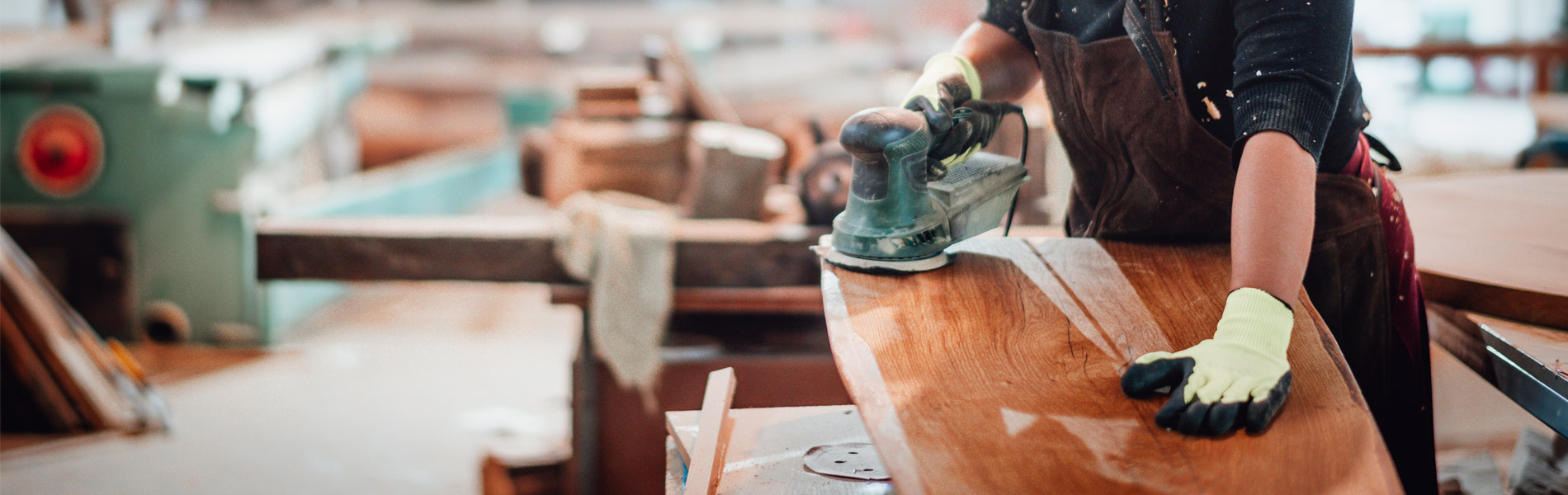
Again, remembering that as I come along with the sander, I can continue to feather this toward the pencil line and finish cleaning that up. Really looks good. It's really coming along nice and it's really coming along fast. I'm back to hitting the sanding head on, and of course, Velcro on there so I can change paper. I've got a shroud on that kind of looks like the leveling shroud, but it's not.
It's a shroud that still gives me dust collection, so that's important for this. The other thing to remember, the power unit is that it is variable speed. So, right now I'm running about half speed. If you feel like you're grinding instead of sanding, we can, of course, change sandpaper and go to a different grit and or slow the machine down. And I find if I run a little bit slower, at least to start as I'm getting a feel for how this handles, it gives me a little bit more control.
So take advantage of grip changes, take advantage of the RPM, adjustable RPM, in order to finesse this and get it exactly where you want. So now, I'm just down to cleaning up sanding marks, cleaning up milling marks, and getting this to look nice and feel nice. It's pretty good already. Progressively finer and finer grits, I'm at 180 right now. And boy, that looks and feels great.
And part of what I'm doing with the sander is, as I said, I'm taking up machine marks, but I'm also rolling this over where I had that transition from flat to curve. So I'm putting a little bit of curve on that. That's where the pencil lines are gone now. So this is nice, and what a nice touch. It's gonna make this bench so much more comfortable to sit in, and that depression in there, so a little more finished standing on this, and then that seat is done.
Share tips, start a discussion or ask other students a question. If you have a question for an expert, please click here.
Already a member?
No Responses to “Arbortech: Build A Bench Part 2”