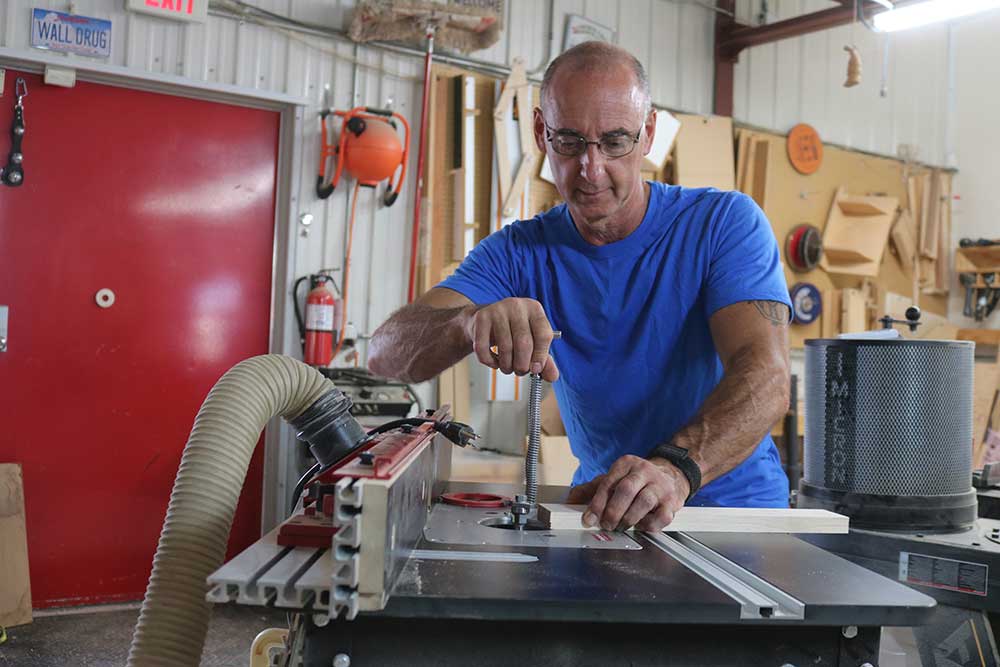
WWGOA LIVE! September 2019
George VondriskaThanks for tuning in. Here’s what we covered.
2:00 George’s new old router
6:00 Dado head on a Delta table saw?
7:15 Breadboard end on 42” wide table
8:45 Veneer on Lane Hope Chest
9:50 Box joint blade vs dado head for box joints
11:15 Hardwood suppliers in the Mpls/St Paul area
13:00 Good beginner project
14:40 Good skills for beginner woodworkers
16:50 Wood for 3D CNC work
19:00 Dimple a framing square to make it square
22:40 New Axiom air filter
23:00 Kreg Accu Cut, DeWalt track saw
28:00 Squaring panels
29:15 Cheap way to install dust collection
30:10 Dust collector advice
31:40 Bandsaw tuning
33:00 Dust collector remote
36:50 Wooden shop floor vs concrete
39:40 Angles for curved lid of treasure chest box
40:00 Crosscut sled, cutting large panels
42:00 Banjo comes loose
43:40 Grounding a dust collector
44:00 Air compressor plumbed?
45:20 Wall art. Glue over stain?
46:20 10” miter saw advice
47:50 Magport quick connects
48:15 DeWalt planer dust collection
48:30 Resawing on a Laguna bandsaw
49:00 Plans for George’s workbench
50:15 Narrow raised panels
52:00 Beginner CNC book
53:50 Stopped cut on router table
55:20 Stuff in George’s shop
57:00 Closed captioning
58:00 George’s teaching schedule
WWGOA LIVE is brought to you by:

Share tips, start a discussion or ask other students a question. If you have a question for an expert, please click here.
Already a member?
14 Responses to “WWGOA LIVE! September 2019”
Well, Sam says we're live, isn't that cool? And I, you know, Sam was behind the scene, Sam. She's texting me on my phone to tell me that the system is hot here. Sam does not get enough credit for all the great stuff she does. When we run into technical issues, which we do every once in a while, she is like wearing the finger prints off of her fingers, tapping away at her computer trying to fix that stuff so desperate.
So again, Sam behind the scenes, thank you for everything you do to help drive this crazy train. That'd be a great name for a song. What is the name of a song? Hey, welcome to September Live and as always a big thank you to Titebond for underwriting this and keeping this free for you folks. Couple of things going, you know, some of my standard announcements, one, if you're watching this on YouTube, I peek at YouTube as I can.
I'm more primarily, I'm watching questions on wwgoa.com. So Sam who does everything so well, Sam, if you could be so kind as to, like you often do put the link for the WWGOA LIVE on YouTube. So people know where to go, tell people where to go, would you? But I'll, like I said, I get over to YouTube a little bit to look at questions there. But primarily, I concentrate on picking up the questions from wwgoa.com, which I'm going to do in a momentito.
But I want to show you something because I think it's cool. I'm kind of stupid excited about this and it's Thursday, right? So we should have throwback Thursday and here we are for throwback Thursday. I was at a Habitat for Humanity store. So in my area, they have those people donate stuff, they sell it and it helps drive the revenue train for Habitat for Humanity.
And they had this router, in that a cool little R2D2 looking thing. And if I'm gonna bring you the label, which if you know can read what it says on there is Rockwell and maybe I don't know this. So like, there's this family Rockwell, Delta. And then for a period of time, Delta Porter-Cable. Where the, basically the same company, they were both owned by a company here in Minneapolis called Pentair.
And what caught my eye with this is a couple of things, one, it's just kind of cool looking, two, if you're familiar with the Porter-Cable 690, which is the very first router I ever had. I got that, well, it's the second router. It's the first good router I had. And I got that in, let me think a second, 1984-ish. It looks very, very much like this.
So, I just kind of have this feeling, like this original Rockwell is a throwback or was the predecessor of the Porter-Cable 690 that I eventually owned. And I got it for a couple of reasons. One, look at this label, 15 American dollars. So it was very inexpensive. I'll plug it in in a second and run it for you.
It runs well and it's small. I can handle it in one hand, like a trim router. So I thought, well, and here's the deal. Everything in the store today was 25% off. So, 25% off of 15 is some low number.
I paid like $11.25 cents for this. So, in all likelihood, what I'll do is put some commonly used bit in here, like an 1/8 inch round over, a 1/4 inch round over. And it's just gonna stay in there and then that's gonna be purpose set for that. It's got a 1/4 inch collet only, can't even, can't run 1/2 inch shank bits but that's fine for this diminutive little router. Let me run it for a second.
It just, it sounds great. You know, I have expected the bearings to be out on it or something. Make sure we're off, yes, okay. Ready? I feel pretty confident that I can get $11 worth to use out of this.
So, the downside is gonna be, here's what's gonna happen. I may use this in a video and one of your people is gonna say, where can I get a router like that? That's cool and I can't source it for you. So that's a downside. And then I'm gonna say this other thing because it's throwback Thursday.
Who remembers these router bits? This was in it. Look at that baby. It's steel, not carbide. It doesn't have a bearing on it.
It's got a pilot, which you can tell was overused, just a little bit. Man, when I was first using the router bits this was all you could get. Thankfully, things have come a long way since then. All right, I digressed a lot and there are a lot of perguntas, a lot of questions. So, I am going to start having a look here.
All right, guest, whomever that is, can I sit? Is that okay? Are you okay if I sit down? I've been in here since six o'clock this morning. What is that?
13 hours ago? So, my Delta 12 inch Table Saw it doesn't seem to have enough threads, to do a 3/4 inch dado stack, it should, right? Maybe, maybe not. If it is, especially in the Benchtop Saws or Contractor Saws, a lot of them are not designed to take a dado head. So, the limitation for the saw could be, if it doesn't quite have enough oomph, it doesn't quite have enough, I don't know, horsepower to drive a dado head.
One way they limit your ability to put a dado head on those saws is by keeping the Arbor short. So you can't do a dado buildup. So it's something, in the world of table saw shopping. I own the Bosch. It's like a 4100, 4400, something like that.
That saw we'll take a dado head. I've used a DeWalt, so I don't remember the model number. That saw would take a dado head. So, it's something you have to check upfront. The other thing to look at, is some of those Benchtops saws will take up to a 1/2 inch dado head, but not beyond that.
And again, that's controlled by how much Arbor they give you. If dado inserts are not available for the saw, it won't take a dado head. So that's another way to look at it. Another way to find out. Another guess, best method of securing an end board, a breadboard to a kitchen table, approximately 42 inches wide.
Wow, that's wide. Traditional breadboard end stuff is gonna work, tongue and groove. Well, you have to be very, very careful about is, well, today is a great example. It's pouring. I'll tell you my standard joke.
It's raining cats and dogs, and I know it is because I was out there and I stepped into a poodle. It's raining like crazy, humidity is high. Anything made out of wood, today is gonna be really, really wide. In January here, it's gonna be very dry. I do humidify my shop, but still it's gonna be very dry.
Things are gonna shrink. 42 inch wide table, depending on the material, could easily expand and contract a 1/2 inch from the driest times of the year to the most humid times of year. So, when that breadboard end goes on, you have to, you don't glue it on. You have to attach it in such a way that the field, the tabletop can move independently of the breadboard end. So, a tongue and groove is gonna work but you have to let it float in order to make that work.
Richard says I have an old 1952 Lane Hope Chest, which are cool. Would it be feasible to remove the outer veneer layer with heat or just veneer over it? Boy I don't know. Very intentionally don't do a lot of furniture repair because I'm bad at it. And it frightens me that I'm gonna screw something up.
I would find, you know, an online forum or something where furniture repair, furniture restoration is more their forte. For us, for WWGOA and it's myself and all my editors were really more about new woodworking. We touch on repair ever so lightly. Damon Kendrick has done a lot of veneer work, Seth Keller has done a lot of veneer work, but even that is more from the perspective of new work, not repair. So unfortunately, sorry, I'm just not a great resource for you.
It's like answering finishing questions. I'm always definitely afraid of giving a bad answer and screwing up somebody's project. So, I just don't have an answer for you there. Is there a quality difference between a box joint blade versus a dado stack? So, if you're not familiar with this, there are companies, Freud, that specifically make a box joint set and it's kind of like nothing but the rim blades of a dado set and some of them it's interesting.
I think, the way the Freud one works is, if you put it face to face this way you get one width, maybe that's a 1/4 and if you put it face to face this way, it's 3/8 or something like that. I think that's how it works. I don't know one. So one thing you have to watch on box joints with a conventional dado head is, if you're using only the two rim blades and they have basically an alternate top bevel tooth pattern to them, you can have, you can end up with a finger joint that isn't perfectly flat. You have a little high spots on the end and that's gonna be unsightly on the outside of your joint.
But other than that, whether it, if you're saying in the question goes on to say, may never need to make wide dadoes. If you don't need a dado head but you do want to do finger joints. If you think you're never gonna use a dado head, you'd be fine with just the finger joint specific set. So this is a geographically specific question, with Youngblood close, where's a good place for cabinet grade plywood. As to us hardwoods, I'm about 20 minutes from your shop.
So I use, I'm gonna tell you about three places, I order and get delivered material from Metro Hardwoods and from Industrial Lumber and Plywood. They're both in Minneapolis-Saint Paul, I don't know for them. So I'm buying commercially, you know, fairly good sized quantities. I don't know for them, if they do what I would call retail trade. Where if an individual just wanted a few board feet or a sheet of plywood, I don't know how they works.
You'd have to call them and check. A new place just opened in Minneapolis. Wood From the Hood has been in business for a long time. And what they do is they concentrate on turning trees that were harvested in Minneapolis-Saint Paul into lumber. They have just opened a retail store.
Look them up online. Their hours are a little bit limited right now. They're open at Saturday or two per month and then some weekdays in there. But they, I was there on their grand opening and they have a huge array of amazing stuff. And you can go in there, you know, drive your truck and trailer there, go in, handpick the boards you want.
It's a very cool spot. So that would be worth having a look. Johnny has a good beginner project for the wifey. Something not too difficult, not too simple. For her and a five-year-old to attack together.
Here's my project advice. And other people who do that kind of thing I do or in this field, I've heard give the same advice. It's like, it's so hard for me to advise you on a project because, or your wife and five-year-old. Because if I say, here's the deal you should make this box. And they look at that and they have zero interest in it.
It ain't gonna fly or They're just not gonna enjoy it. And I actually get this question and other people I know. When we go out, I've done meet and greets with Jay Bates, Nick Ferry, April Wilkerson, Matt Cremona. And we get this question all the time, John Malecki. And it's so subjective that I honestly, I can't provide an answer.
What you should do is say, you know what? I could really use a organizer for my dresser top. So I'm gonna look online for plans for dresser top organizers. So then, you're like emotionally invested in the project and it's just, it's gonna be so much more fun to do. And that's, so not just for John but for people across the board.
If you're looking to grow your skills, do it by finding something that you want to do and go from there. That's the best way to make sure you're interested. What are, boy, here's a hard question. Top skills that beginners should learn to do well when starting. Let me get a Gatorade and think a momentito.
In my introductory woodworking class. So I'm gonna use that to answer this. So we do table saw work, joint, we do table saw jointer, bandsaw, handheld router, router table. So, a big part of that for me is exposing people to a lot of different tools and safety. So I'm gonna say, let me read the question again.
Top skills, safety, if you don't, if you're not confident that what you're doing on any tool is the right way to use it. Go take a class from somebody who knows what they're doing. Places like my shop offer classes, Marc Adams, Rockler stores, Woodcraft stores. There are a lot of places out there, you can take hands-on woodworking classes. Make sure you have safety down, huge top skill.
And then from there, tablesaw, I'm pointing to over here. Really the heart of every shop. So, getting the hang of that. And in general, just learning how to process lumber and turn it into usable pieces. I'm gonna look at YouTube for a second.
Let me mute it because I can hear myself and you can probably hear me. So we got Connecticut over here, North Carolina, New York city. Okay, thanks Sam for putting those links over there. So we don't have any questions to answer on YouTube. Gregory says, I think you were heard, you're clicking your mouse.
Well, yeah. Is that, are you saying the audio is better and it's actually working tonight? Ed says, favorite species of wood for 3D relief carving on a CNC router tear-out, favorite for that. I'm stalling while I drink Gatorade. I don't know if I have a favorite.
It depends. In general, to get good-looking stuff on a CNC, you know, like woodworking in general, close-grained woods work better than open grain woods. So, in that family, usual suspects North American hardwoods, walnut, maple, cherry would all be good candidates for that. Red oak is a real open-grained wood, so, eh, not so much. Pine, I've done some 3D stuff in pine, but you're gonna get crisper details out of the close-grained hardwoods.
If I'm gonna paint it, it's gonna be MDF. Baltic birch plywood actually cuts really well. I've done a fair bit of 3D stuff. Again, paint-grade in baltic Birch plywood, so, that works well. So yeah, there's not, I don't have a fave, but I have favorite characteristics which is density, close-grained, to make sure that it's gonna tolerate or accept the detail.
I'm trying to lay into it. And I'm a couple of locales here, which is cool. I'm scrolling back to the top to see if I missed any of those. I do always like hearing where people are watching from. Hey AJ, how are you?
I'm gonna see AJ in a couple of, well, in a month and a half. I'm looking to see what day it is, because I lose track of that. In November, I'm gonna be teaching at the Rockler store in Salem, New Hampshire. So, Mike is in Detroit. Claston is in Houston.
So, William asked a good question. In a previous show, you mentioned dimpling a square. Not to be confused with dumpling a square, because that's a whole different thing. I have a checklist about it came back around. We ate a lot of dumplings in my youth.
Dimpling a square to bring it into square, can you tell me again where you placed the dimple to adjust the square? Yes sir. Because this is such a cool thing. This is such a cool thing. I'm getting a square, the tip to be square.
And I'm getting a punch, like not literally, because that would hurt. All right, where are we? I'm going to, I'm gonna bring you in, a little, so you can see more better what I'm doing here. When I look over here, I'm looking at a monitor, so I can see what you see. All right, all right, all right, all right.
Now, last time I did this, we had an audio problem. Are we still hot? Sam? If we lost audio text me, my phone is in my pocket. So, a month ago, I rolled the system, which I've only done like 4 billion times and the audio dropped.
So now, Sam and I are a little paranoid. There's your square and my laptop. So what you would do is check the square for square. And I'm not gonna draw lines because this is my work bench. But you do that by putting the edge against an edge, putting a leg against an edge, draw a line, flip it, do the same thing, draw a line.
If the resulting lines are not parallel, you need to adjust the square. So, if what I learn is that these two legs, I'm gonna grossly exaggerate, are pinched in like this. Hopefully not that far, you would take your punch. This is just a, it's just a center punch. Take your punch in toward the inside corner.
But you, I'm not gonna do it because this square is fine. If you find that these two legs are splayed out a little bit and you want to drive them in, then the center punch comes out here toward the outside corner and I didn't do enough there to do anything. I was just tapping. So it's intuitively it makes some sense. If I pound on this here, it pushes the metal in.
If I pound inside, it pushes the metal out. That's a race that goes to the slow and steady, not the swift. So, take it easy with your pounding poundies. Don't hit it hard and just try to sneak up on the right setting so that you don't have to. So you're not like toggling back and forth, inside outside.
Paul says in the final stages of ordering equipment for my new shop, yes. I was going to get a ceiling mounted air filter. The ceiling is 15 feet concrete slab. So I'm not looking forward to mounting it. I've recently seen the new Axiom Stratus.
So, looks like a good alternative. Do you have any exposure to this device? Any comments or thoughts? I'm gonna take a risk here. What do you think?
Should I, I'm gonna do this. I'm not gonna take a risk. I can either move the camera or move the thing. So you await patiently and I'm coming right back. It's not too far.
You mean this thing? Isn't that serendipitous? Such a great word. Serendipity is such a great word. When unexpected good things happen or I don't know if it's good things.
But I've got a few serendipitous things. So this is the air filter that, because my brain is like a sieve. I already forgot Ken, right? Paul, jeez, almost the same. This is it.
This is a relatively new product. I think it was introduced at the Georgia show last year and it's an air filter. And the way it works is that input is down here. Exhaust is up here. It runs on electricity, in that cool?
It's got a nice long cord. I liked that. Power switch. Low. Medium.
High. Hi. Part of the premise here is that stuff is gonna settle toward the floor. So, instead of having an air filter up high, we're gonna take advantage of gravity. And as stuff falls to the floor, it's gonna get drawn in inside this honeycomb down here is a filter.
We're drawing air through that. And then a column of air is exhausting out the top. I've used this a little bit. I did a bunch of bowl turning with a friend of mine like two weeks ago. And I ran it for the sanding steps of that.
One of the things I found there is I had to just carefully position it because it is up drafting. So when I was creating dust, you've got to give the dust a chance to get to the floor so this can draw it in. So it's not just coming off the lathe then blowing it up. But big scheme, I liked the physics of it, which is dust is gonna fall toward the floor. It's gonna draw it in.
I can move it where I need to, it's heavy, but you could put it on roly-poly things. You can put it on casters. So I can move it to where I need it in the shop. So far it's early, Paul, I've only had this here, maybe a month. So, but first blush, I like it a lot.
Conceptually, I really like it a lot. I know a handful of other people that have them and are also happy with them so. Mike, I have a Kreg Accu-Cut system I use with a circ saw brrt, but there's a ton of slop in the track considering pulling the trigger on a DeWalt track saw. If familiar with both, feedback on whether I'd be happy with it. I've got the DeWalt cordless, which I'm happy with.
But I've got the Kreg and there are dial dilly bobs on there. Well, let me, oh I get it. Okay, I'm gonna, so you don't have the Kreg track saw. You have the Accu-Cut and I'm standing here looking at it. I can't remember if there are shims on that or not to tighten it up.
Part of the problem could be not necessarily the system but your saw, and I guess, now that I read this more carefully, you're using your circ saw with the Kreg Accu-Cut system. So it could be run out in the blade and that kind of stuff that's costing you. So I do have, I've got the DeWalt cordless. I'm just, I was gonna grab it, here it is. And this is not idiosyncratic to DeWalt.
A lot of the good tracks house have this but there are devices on here that let me tighten up how this fits and how well it fits in the track. So I can get it to where, yes, I can still slide it but I've taken the slop out of it. This one, I've used on, there's a waterfall table. Some of you may have seen me do, not too long ago. That's how I did the miters on that.
Since we're mentioning Kreg, I've tried Kreg's saw and Trek and I'm happy with that too. I also did a waterfall table with one of those. So yeah, I've been really happy with this DeWalt. I've cut a lot of sheet stock with that. I learned since I took a a shop cart with a demo saw.
I have some very nice 3/4 inch Baltic Birch. None of the panels are square. Is there a way to square up the panels? Yup, You can draw a line with a square, cut them with a circ saw, you can use a crosscut sled on a table saw. I'm pointing to my table saw.
If you look on wwgoa.com, upper right-hand corner there's a window and you can type stuff in there and do squaring plywood, squaring panels, squaring boards. And you'll find a bunch of resources for that kind of stuff. Max says I'm on the square. Yes sir, that's true. On the level part on the score.
Look at this. This is always interesting. Good rainy morning from Thailand, isn't that cool? That somebody is watching in Thailand and Waukegan, Illinois, not far from my hometown of North Riverside. Cheapest way, somebody on YouTube says to install central dust collection.
I don't know that there is a cheap way. Plastic PVC pipe probably is the most economical way to go. You can get 10 foot lengths of it. You can buy it at a home center. If you don't have a huge dust collector you can use HVAC metal.
24 gauge HVAC pipe to do dust collection but you don't want to skimp on fittings. There's a big difference between plumbing fittings and HPAC fittings and dust collection fittings. So you wanna use dust collection fittings which do tend to be expensive but you can marry them into more conventional forms of pipe to save some dough there. Yeah, AJ makes a comment about Wood From the Hood. They are a very cool outfit.
Jim says, my Shop Vac with a cyclone can't keep up with my DeWalt planer. I've delayed getting a dust system, but likely need to. Can you suggest brands I should look at? Hose or metal grounded pipe? I think so.
I haven't tooled tested. They're gonna people out there who know way more about dust collectors than I do. What I know is dust collector suck. Get it? Get it?
It's a little joke, okay? I have to explain the joke because it's not good. So what I would do, you know, outfits like a wood magazine, still do tool tests on a regular basis. I would look online to see if they can offer anything in a tool test that fits the price point. The amount of money that you want to spend.
For a planer, if I remember correctly, you need about 400 CFM cubic feet per minute to get good dust collection on a planer. So, consider that. Check that number but that's like your starting point for a dust collector. If you run it, you're gonna end up with holes somewhere. Even if you have metal pipe, you're gonna have a length the hose that ties it into the planer.
If you want to stick with hose to go dust collector, hose planer. That's fine, I did that for a long time in my other shop. George ask, where do I learn to get my bandsaw tuned? You get a tuning fork, that's step one. I use it infrequently and I'm just not very good with it, seems to drift.
Seems like I have to push too hard. I need some fundamentals. Well, we do have, I'd have to look in our shop. I have to shot a lot of bands on video. So it's another thing you could do is look on wwgoa.com George, and search bandsaw, and just see what comes up.
If you have to push too hard, your blade might be dull. If it's drifting, your setup might not be right. It's when a bandsaws are one of these tools where a lot of small things come together to make it work well or make it work poorly. So you really want to get the stars aligned just right. To make sure that things are going well.
But yeah, search, search, wwgoa George for bandsaw. During the emails you occasionally pick a remote control, her pick up a remote control. Tom says, does this operate your dust collector? If so, please show your system. Yes, sir.
This is cool. I will see if I can get organized here and kind of take us to the next step. So let me talk you through this first. In my shop rather than one big dust collector, I have four small units. One is just a Shop Vac that's connected to a CNC way in the back corner.
Then there's kind of a good sized dust collector that we're on this side of the shop. Another dust collector that picks up on this side of the shop. And then there's a dust collector that's specifically to my table saw. So, part of my problem, historically was getting everything turned on and off. And I found this unit on Amazon and I am going to, like while we're talking here, I'm gonna see if I can get where I am.
I found this unit on Amazon and my dust collectors are both 110 volt, 15 amp. So that's part of the problem, part of the challenge with putting a remote on a dust collector is like, if you just walk into the hardware store and buy an outlet in a remote, it might not tolerate the amp draw of the dust collector. So I found this one on Amazon. Let me type and not talk. I'm typically so good at multitasking.
Okay, I got it. All right, so I found this one on Amazon. I'm gonna put it in here. I'll give you the link for it. Here's what's cool about it, with my individual dust collectors.
This one unit drives them all. So Shop Vac, CNC the dust collector that picks up most of my CNC and bandsaw. This side of the shop and then table saw. So, to make this even better, I think that this remote was under $20 with a handful of receivers, two or three receivers. So it really, the economics of it were great.
I went so far as to buy it, twice just so that I could have two clickers. It only came with one clicker. So I bought a second unit just so I could have a second one. I'm typing it in right now. Dust collector remote, so if you're watching on YouTube you got to get on wwgoa.com to see this remote unit, I guess, I don't know.
All right, send, there's a link. All right, I'm sorry that took so long for me to pull that together. All right. Sorry, now I got to go back up. So Doug says, it looks like your floor is concrete and the observation on pros and cons of different shop flooring.
My old shop, which I built was a framed floor, 3/4 inch plywood. You know, people say a wood floor is more comfortable. I'm literally in my shop, 12 hours a day routinely 14 hours a day, a lot. I wear good shoes, Merrell and Vasque hiking boots, hiking shoes are my shoe. They're $120 shoes, a piece, a pair.
I don't really notice today, I've been in this building seven years a difference in my legs between being on this concrete floor and being on the wood floor, the concrete, this is asphalt tile. It sure sweeps up nice. And if I spill, I can mop. So I don't know. It's worked out really well for me having a concrete floor.
That being said, it wasn't that the plywood floor was bad. You know, that's not why I moved out of that building. Well, this is nice Sam, David says, you shouldn't be paranoid because you know how to fix stuff. Feelings about conversion varnish. I don't know much about it.
John, other than larger lumber being cut, advantages to a 12 inch over 10 inch miter saw. Capacity is the big thing. Is the audio working well tonight? I'm so pleased if it is because we've had some issues. So, it makes me very happy if it's working okay.
Sam says the air filter looks like a skinny day lick from Doctor Who because Sam you're a dork and you watched Doctor Who, I shouldn't say that. My children are huge Doctor Who fans. Megan was campaigning for a while for me to make her, what's the phone booth, whatever the phone booth thing is called. She wanted me to make her one. Larry says, best and easiest way to figure out the angle for the arch on a treasure chest box drawn.
Oh shoot. I'm so sorry. Air compressor. That's what I get for saying the audio was so good, huh? That blows.
I get it, it's an air compressor, get it? Right. So, Larry treasure chest box. Draw it full-size. If you're comfortable using SketchUp.
That's certainly what I would do, is I would draw it in sketch up and put in your individual segments, figure out then what angle those have to be. If not, get out a big piece of butcher paper, same thing, draw it, put your segments in. Figure out what you need. I would definitely draw it. Guess who shall be unnamed because it just says guess.
I have a few questions. Crosscut sled featured in the helpful jigs class. Dimensions are too large for my saw, which is attendant Jobsite saw. Can I change these dimensions to fit my saw? You bet.
Sled would be fairly small. If that won't work, what's the best way to cut large panels on a small saw? Well, crosscuts sled. I mean, you got to work with what you got. So make the sled as big as you can.
And if there's a, because of your saw there's a dimensional limitation then you can't cut on your saw. So, sometimes you have to take tools to the work instead of the work to the tools. So, it could be then if your saw is limiting the panel size then you've got to come up with other techniques. For instance, I've shown how you can crosscut using a router with jigs working at a work bench. So, there are other ways to size panels if you can't do it on yourself.
Banjo on my right kind of lathe is coming loose with vibration when turning a large green bowl. And then fourth question, would you recommend laying or how would you recommend laying out a sliding lid for a keepsake box? Well, that question is pretty tough to answer because there's about 4,000. It depends on how you're building the box. So that one, we're not gonna be able to get to.
Banjos on lathes. Banjo, a great name for a part on a lathe. It's so weird. I've often wondered why is it called a banjo. Paddle faster, I hear banjos.
There's a movie reference not everyone will get. So, here's a banjo. And what I would do, so when I throw this lock like that, that's what holds us in place. This needs to go far enough that it locks. But if it's squishy and it's coming loose, what I would do is there's a nut under here.
And if you tighten this nut and we can't get to it because it's underneath. I'd have to take the tailstock and the banjo off. If you tighten that nut, when you do this, you'll have more pressure on there. Now, you've gotta not over-tighten it because we have to get to a point where this can travel and lock. And if you go too far, this will only go to like here and it'll have so much resistance.
You're not getting to the lock part of the show and then it won't stay in place. But if it's loosey-goosey, well so I guess maybe that's the case with your banjo too. Maybe it's already too tight. And when you get here, you're not getting that next, that's helping it lock in place. So, I guess in your case, I'd start by loosening that nut a quarter or half a turn.
Try again. If it's already loosey-goosey, then tighten it a little bit and see if that helps but probably one of those two. And then my next advice would be, if there's no help from that, I would give RIKON a call. Because they're gonna know their product the best. And maybe they have a product specific answer for you.
Excuse me, while I Gatorade. And drip on my cool shirt. Bob says, on dust collection system do they have to be grounded? Typically, yes, because you have spark issues. Gary asks, do you have a dedicated air compressor with plumbed lines ready to be plugged into?
Well, sort of yes. So I can show you. I have the air compressor that just ran, isn't that ironic? As on that side of the shop. I have got, no, no, no, no, no, no, no, no.
My unsightly shop. So, see the airline? There? That goes that way. And it connects to the air compressor, up here that connects to that reel, which was not inexpensive, but it's very worth having.
When I pull hose off of that reel, I can get wherever I need to get in the shop. This is my new air compressor. I just picked that up at a garage sale. Way more CFM. Runs way quieter than the one you just heard early on.
It's a 220. So I've got to do a little bit of wiring, you know, 220, 221, whatever it takes. I've got to do a little bit of wiring in order to get that one hooked up. So I don't have hard lines. I just have that air compressor hose feeding my reel.
Let me jump to YouTube for a momentito. Pete making a large wall art piece from small offcuts will be gluing them to a light colored backboard. If I apply a dark tint or stain to cut down on the backboard being too noticeable. Is there a question? Making a large art piece from small off cuts and will be gluing them.
If I apply a dark tint or stain to cut down on the back board being too noticeable. Oh, between gaps. I see, it goes to the next line. Can I still attach the blocks with glue over the stain? Finish can affect glue.
I would prefer to not have any finish on a piece of wood. If I definitely want glue to stick. Rob says, affordable 10 inch compound miter saw. This is in the dust collector category. I haven't tool tested miter saws for ever.
So there's a huge array of them out there. I would look for, I'd go online and use Google. Tool test, miter saws, you know, again, pop wood, wood magazine. There are publications. The do tool test all the time and you can find what you need there.
Ken says, I'm cracking up watching your closed captions. Do we have closed captions? Is that a thing? I gotta look. Where are you seeing closed captions?
I'm on goa.com and there's YouTube. Yeah, I don't see close captions but I bet they'd be funny. Closed captioning with woodworking terms. That would be hard to keep up with. Arthur says, I got to watch the time.
Arthur says, I have a Laguna dust collector. That's not what Arthur said. That's what I said, watching the time. The services, all the machines in the shop and connect it using flexible 4 inch hose. I recently outfitted all the machines with Magport quick connects and absolutely love them.
Cool, I don't know what that is, but cool. It's a one-time expense, but well worth it. It's a pleasure to switch from one machine to the other. Now I highly recommend them. Got the lead from a fine woodworking article.
Okay, I'll have to look them up. I don't know what they are. Paul says, dust collection on a DeWalt bench planer. He uses a flex dryer exhaust with screw clamps on either side of a PVC pipe. Joel, on the subject of bandsaw tuning.
I bought a Laguna 1412 about five years ago. I didn't do much resign at first. Sorry, I lost my spot. I was trying to cut a thin pieces for veneer. Couldn't get any contact with Laguna.
They suggested using such screws on the fence to make the adjustment. Mine didn't have such screws. Kudos to Laguna. Okay, so it's a positive comment about Laguna. That's cool.
Bob says, in a previous video I thought you mentioned you would make, he's yelling at me, and I mean that in the nicest way, Bob. You were very polite. You're not yelling at me. I thought you mentioned you would make plans available for your very nice work bench. This is true.
And one of these days, when I'm way in between projects and I can sit down and SketchUp for like a day. I will draw this bench but it no has happened yet. It's just in the workflow, there just hasn't been the opportunity to do it. Bargain says, I am new to woodworking but learning quickly could use your advice. Hardest thing for me is repeatable table router runs.
Am? doing raised panel molding, wainscoting for my large bay window. Found it difficult to route the corner panels and joined them at 45 degree angle. For this window the particular panels on the corner bend turned out about 5 inches narrow by 40 inches tall. Routing long edges on a raised panel bit is fairly easy.
Narrow side is tougher, so I got a coping, I think that's coping sled is probably where that's going. Yeah, that's the way to go. The coping sled on for safety, for ease of cutting, for lots good reasons. Anytime you're routing in narrow part, you should be, you should work on your coping skills with a coping sled. Tardus, I'm being informed.
Yes, that's the Doctor Who thing. And audio is good today, bueno. Oh, here he wraps up. Got a coping sled but then you have to match up bit height with and without the sled. Yeah, it's just gonna be the way it is.
On the trying to think. You know, could you take a sled as a 1/4 inch base when you're doing the long grain cuts. Could you put a 1/4 inch hardboard under the board when you're making those cuts? Whatever it is, use a piece of something under the board for the long cut. That's the same thickness as the coping slide is for the angering cut.
And then one setting would do it all. John says, I lost my connection. Did you answer the guess about good beginner books for CNC? I didn't even see that question, but I can recommendation. Oh, please.
I have found myself to be a pretty big fan. I've got CNCs in the shop. A friend of mine was giving me a hard time. Because there were five CNCs in the shop because I teach CNC classes here. But anyway, I have become a very big fan of this book.
And if you look closely, you may understand why. I wrote this book just came out a couple of years ago Randy Johnson and I co-wrote this book. this is available in the WWGOA shop. So again, wwgoa.com. One of the menu items at the top is Shop or just search CNC book, I guess.
But if you go in the shop, you'll find the book there. So when we did that, it's an introductory level book. There screen captures from VCarve, which is a commonly used piece of software for CNC work. Lots of photos. And then there are three projects that are very basic.
So the idea is, do this in VCarve, screen capture then do this, then do this, put your material line. So those, three projects take you step by step through the project in order to learn the processes. So, try that. Kim says, can I hollow out a straight line on a piece of wood on my router table while leaving the ends of the piece intact? So you want to do a stopped cut?
Yep. Yeah, so you can put stops on your router table and then you're plunging onto the bit, whatever 2 inches in from the end. Making your cut. Stopping 2 inches short from the other end, lifting off. Part of the challenge with that is moving smoothly and consistently.
So you don't get burns at the stop and start point. But yeah, it's a way like you can do flutes. Fluted cuts. Larry says, SketchUp free version will not let me draw anything. What am I doing wrong?
I don't know. Hang on. I'm gonna get to Ken's question. I'm sorry, I'm reading ahead. I would contact SketchUp because I've got SketchUp now, because plans I create gets sold.
So I have to be in the pro version. But when I was using the, I used the free version all day every day up until like a year ago. So, I don't know. I would check with SketchUp on that. Ken says, what are the things above your head?
So I'm looking at the monitor to try to see what you see. What are those things above your head? I see a long aluminum tube and a small bag. The aluminum tube, I think I know what that is. Then to your left, as you face the camera, a circular device.
So, up here. What maybe it looks like an aluminum tube. This thing. If that's what you're talking about. That's a roll of what's called seamless.
That I use that for photography. So that is a really, really thick paper. It's gray paper. When I'm doing a photo in here, I can roll that down to the floor, drape it on the floor and then set the object on it. So that you don't see my whole shot background.
You just see that paper. The rest of the stuff around item like over, where am I, there? That round item. That's a clock. There's a dust collection.
I mean, not the dust collection. An HVAC drop, there. That's my heat and air conditioning. Let me know if that's not it. All right.
Well, let me jump over to view. Well, I'm gonna have to, everybody's talking about the closed captioning, that's cool. Oh, I see it now. I had no idea. I'm gonna have to watch this once with closed captioning on because like, what is it?
What is it say when I'm gonna find out in a second. What does it say, when I say like dovetail? Does it pick that up? So I'm watching me, watching you, watching me. I'm so easy to entertain.
We'll do this Sam, and then we'll get outta here. it's catching up with me. I just want to see dovetail. All right, I'm gonna give you while this is doing it. Some teaching stuff that's coming up.
I'll go back, oh it got dovetail right, that's cool. So, a couple of things, September 30th, October 1st, I'm gonna be in Des Moines, Iowa at the Wood Smith event that there's a finite number of seats available at that. Myself, Matt Cremona, Andy Briggs, Stumpy Nubs, the editors from Woods Smith philosophy teaching. I don't know if there are seats still available but you can check that. Then, so that's September, then going into October.
October 11th through 14th, this is gonna be crazy cool. At the Catskills, I'm sorry. At the Blackthorne Resort in the Catskills mountains, it's called Catskills Maker Camp. I'm gonna be teaching CNC. Jimmy DiResta is gonna be there.
Jess Crow is gonna be doing resin work. Bunch of people are gonna do in forge work. So it's gonna be four days. You can stay at the resort and live, breathe, drink, eat the stuff. So it's gonna be really neat.
I'm working with Shopbot on that CNC program that'll be happening out there. And then, first weekend in November, I mentioned this earlier. I'm gonna be doing the logs to lumber at the Salem, New Hampshire, Rockler store. That's the first Saturday in November. And I feel like I'm missing something in between there but that's all I can think of right now, all right.
Hey, thanks for tuning in and as always, thanks to the folks at Titebond for helping keep this free for you. And we will punch out of here. And see you, when we look at you. Go ahead and unplug us, Sam. Thanks for your good work, Sam.
Thanks to everybody for watching.

Will You please include information about the highest level of art in wood, i.e., Sam Maloof - Thank You, in advance - Erik
Hi George here is a tip for you when clean your Drum sander paper, Get like a large plastic container with a screw lid and fill it with about 4 inches of Simple Green and let soak for a few hours then brush with a plastic brush and Rinse and Hang to dry
Thanks George from Wichita, KS, for another great Q&A session!
Working with large Live Edge Slabs how do you keep them from cupping or Warping after they have been flattened?
Can you recommend decent hand planes without breaking the bank
Love the movie references. I got them both. Made me laugh, thank you.
Talk about the tape measures you have on the end of your miter saw stand.
Yes the audio is great tonight. Cadott, WI
Pete from Sooke bc
Sound is really good tonight