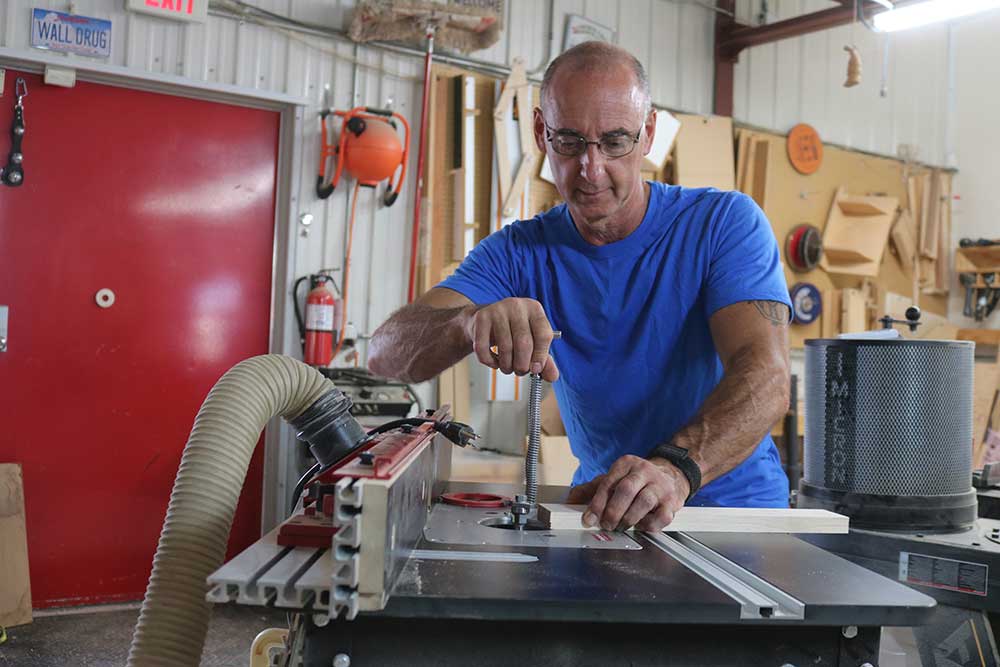
Working with Antler
George VondriskaIn this video on working with antler, George Vondriska says "antler" 33 times. He also teaches you how to properly mount a piece of antler in a four-jaw chuck on the lathe to chisel down and sand the antler into a smooth, shiny material that you can use for a variety of woodworking projects. Antler.
One of the things that I've really come to enjoy doing in my shop is working with antler. And I've just, I don't know what it is about antler. Maybe because I'm a deer hunter, but I really enjoy using this as a medium with which to work. I've made knife handles out of antler. I've made little finials for the top boxes out of antler.
So what I want to do is talk about antler and see if I can get you as excited about antler as I am. So we're gonna talk about getting antler set up here on the lathe. So one of the things I've done with the antler so far is I cut a chunk off the end of a piece of antler, then you'll find you can cut antler on the bandsaw. So I clipped this off to length, and because I was gonna turn it, I was looking for a piece that was fairly straight. So this is a piece of antler that's got a pretty good straight axis to it.
Now, if we look at the inside of the antler, you can see that it's a little bit soft inside there, so what we'll do is kind of stay away from that. We're primarily gonna work on turning the outside, stay away from the spongy antler inside. As it goes on the lathe, what I'll do is get the antler inside this four jaw chuck, and what we need to do is mess with it just a little bit to try to get the antler as centered as possible here on the lathe. So I'm gonna tighten her down... And then just kind of spin the antler by hand.
So what I'm doing is, as I turn this by hand, I'm looking through it at the floor to see if the antler is, You know, if it's bouncing around. If the antler looks like it's running pretty straight, then I think I'm pretty straight on the lathe, so let's go ahead and snug down that four jaw chuck. Now, antler is pretty hard stuff, so if you're gonna turn this, you want to use high-speed steel chisels, not tool steel, and they're gonna hold their edge against that antler a whole lot longer than tool steel would. Now, as you position the tool rest, you want to be careful, because of course, the antler is just a little bit funky shaped. So being clear on one side doesn't mean you're gonna be clear of the work on all sides, so be real careful about that.
Now we've got kind of a tenuous hold here with our four jaw chuck, so you want to take it nice and easy on your passes on the antler. Just real light cuts, little bit at a time as we work our way down. I'm gonna start on the antler with just a half inch bowl gouge and we'll get that cleaned up just a little bit. My least favorite part of antler is that it smells like your worst trip ever to the dentist. All right, let's stop and have a look and see what our antler looks like.
And I think we can do a good reposition on the tool rest here. Isn't that cool? The antler starting to get exposed inside there. So what's neat is we can leave a little bit of the antler exterior, where it's so knobby, but then also expose some of that nice hard work inside there. I'll do a little bit more cutting, and then we'll have a look at what it takes to sand antler and get it real pretty.
I'm not sure yet what I'm gonna use this particular piece of antler for, I just want to use it as an example to show you what working with antler is like. So I'm gonna leave it like that for right now, but let's talk about sanding. Now, this is already pretty smooth, pretty good cut quality, so I'm gonna start my antler sanding at 150 grit and we'll work our way up from there. It's gettin' shiny. Now, right here I'm at 320, and I'm gonna be done with conventional abrasive and I'm gonna go to a little bit of a buffing compound.
This is what you'd normally use on a buffing wheel or a strap. And with that applied, I'll go to a shop towel. Just a few minutes of sanding. Look at how nice that looks. Really shiny, really starts to show the color.
So like I said, I hope that I can get you as excited about working with antler as I am. You know, honestly, off the top of my head, I just don't know what it is about antler that makes me enjoy it so much, but given the opportunity, try a piece of antler in your shop, use it as a way to accent your woodworking projects, and I think you're just gonna love it as much as I do.
The dust coming off the antler when sanding is not something you want to breath in. I use a shopvac setup when turning. Also, when you use the antler to make pens, the center or marrow is beautiful when you impregnate with CA glue.
hi, I enjoyed your antler video, I found it very helpful. That being said, please consider adding some well thought out discussion regarding bone dust. That smell of bone dust comment you made being a bad day at the dentist is airborne bone particles you are breathing. any antler, bone or nail dust inhaled will cause death with even a small prolonged exposure. The macrophages in the alveoli in your lung can't process it and remove it so it builds scar tissue causing fibrotic lung disease... think mesothelioma.
Looks like fun. REALLY surprised he wasn't wearing a face shield.