Wooden Key and Mail Organizer
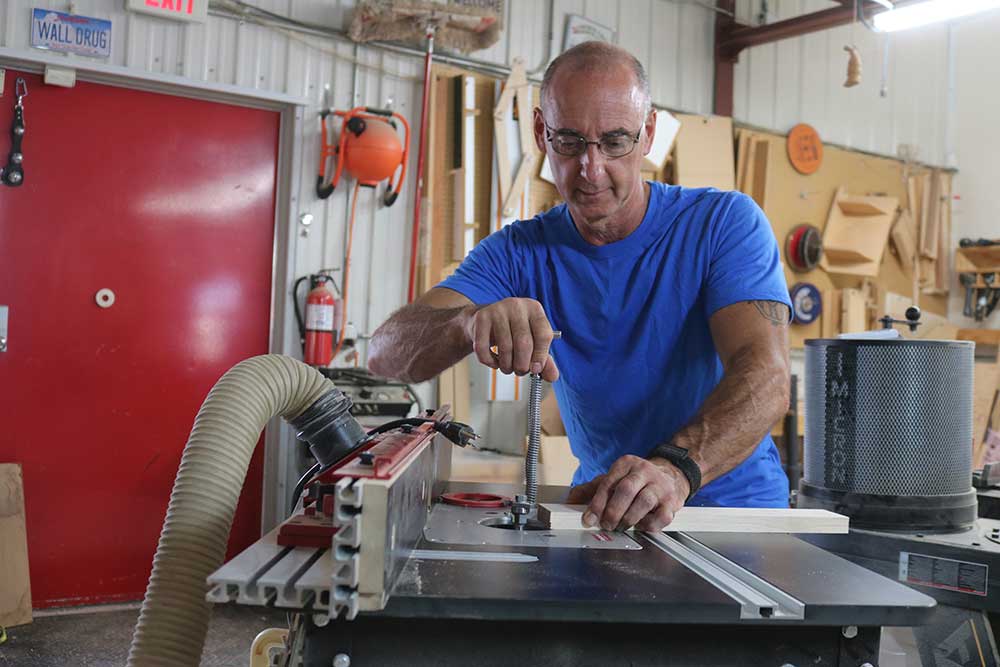
George VondriskaRemove the clutter from your kitchen counter with this easy-to-make key and mail organizer with space for envelopes, keys, phones, and other small accessories. In this week's project demonstration, master woodworker George Vondriska teaches you how to use some basic and intermediate woodworking techniques to build the shelf, including rabbet joinery for the sides, top, and bottom, resawing for book-matched edge-to-edge joinery, headless pinning for base assembly, laying out and drilling holes for the key hooks, and chamfering the front pieces for a smoother, more finished look.
You got a bunch of mail and keys and phones and stuff just laying on your counter in your kitchen? If you do this project is for you. It's going to help you organize all that stuff. What's cool about this, it's a very simple project. Construction is really straightforward.
You can bang this out in no time at all. It's going to give you a spot up here on top for phones and MP3 players and all sorts of other little stuff. Down here below, there's a spot where we can stand envelopes up on end to store those in there until you're ready to look at them and pay those bills. Then down below, we've got hooks in order to hang your keys on there. So it's a straightforward project, some rabbet joinery in here, a couple other things going on.
So it's simple to make, let's get started on a mail and key organizer. Joinery for this project is pretty easy. So let me walk you through how I got where I am today. What I've done so far is machine all of the case parts to size. So I've got the top, the bottom, the two sides, and that center shelf all cut to the right dimension.
Here at the table saw I've put in a dado ahead and with the dado head what I just did is I cut a rabbet in the top and the bottom of both sides. For our next step what I'm going to do is disconnect the saw, measure to the blade, and what I want is five inches from the very top to the top of the dado. That creates that upper compartment that you can use for your phone or MP3 player, whatever, the smaller of the two compartments. So I'll relocate the fence, and then we'll be able to make that cut. While the dado head is in, we're going to take advantage of it for one more cut, and that'll be to create a rabbet for the back to fit into.
The rabbet is going to be a quarter inch thick. All of these parts sizes around the cut list. That's on a PDF on the DVD, so that's where all the roadmap information is going to come for you. So I'm going to bury part of the dado head in my fence, set that for a quarter inch so that I can cut for the back, and we'll be ready to cut all of our pieces in order to have the rabbet that the back fits into. I told you the mailbox or the mail organizer was simple.
Here's what we've got our two uprights. Make sure that you do a left and a right. You want to look at them and make sure that we're cutting on the backs of the pieces. One way to remember that is that if on piece number one, the bottom, this long segment goes first, then on piece number two, the short segment has to go first. That way, when they come out of there, they're reverse images of each other.
So we've got that. I've got the rabbet cut in the top, I've got the rabbet cut in the bottom, and then working off of the cut list, I've got this part machined, which is going to fit into those dados in order to create the upper compartment. When you do this, make sure that it fits from front to back. So when I'm even with the front, I need to be even with or even just slightly inside the rabbet on the back. The last thing you want is for an interior shelf like this to make the back stick out.
So these parts are all ready, our joinery at the table saw is all done. The piece that we need for the back for the organizer is pretty wide, so wider than you're going to get from a single piece of Ash like we're working with here, really wider than you're going to get it from just about any single piece of wood. So what we want to do is come up with a way to get two pieces together so that we can make one big piece. So of course, we're talking about edge to edge joinery. What's cool with this is that if you're going to do that, let's resaw them from a single piece so that if you look at this one, we're actually bookmatched across the back, the grain on the left and the grain on the right are mirror images to each other, which we can actually see a little better if we spin that around.
So there's a glue seam that goes right down the center here. In order to bookmatch, we need to resaw, in order to resaw, and get a piece that wide, we're resawing a pretty good sized chunk of wood. So what I did here is I cheated, and this is a great way to make your resawing life a whole lot easier. I started with this piece of the table saw, and I cut this far and this far by making a pass, flip it, making a pass. Now when I come to the band saw, I'm going to set my fence on the band saw so that it's right down the center of that table saw curve.
It's easy to get it in the center because bandsaw blades are so little compared to table saw blades, there's quite a bit of wiggle room. What makes us so easy is that all the bandsaw blade has to do is get that last little bit of waste, it's going to be a really simple cut. Now there's our bookmatch. So there's that mirror image I was talking about. My preference when I'm doing this kind of thing is I jointed that edge when this was still a one by six.
Then when I caught them apart, that edge is ready to go together. So that can go and clamps get glued up, after the glue is dry, run it through the planer in order to bring this down to the final thickness of a quarter inch that we need for the project. And we get that cool bookmatch look on the back of the organizer. I love my 23 gauge headless pinner for this kind of stuff. Because small project, it doesn't take a lot to hold this little baby together.
In fact, that's enough right there. And there's the hole made by that thing. So 23 gauge that's smaller than 18 gauge. Remember as gauges go up size goes down. So this is a really good way to just get something in there to hold it until the glue dries.
When this is all done, what I'm going to do I'll put a drop of glue right on that dimple. And I'll just sand that, and the glue in the saw dust will make a little bit of a slurry over that hole and it's going to become absolutely invisible. So these 23 gauge pinners are a great thing to use for this kind of stuff. Making sure I'm flush with the front on this shelf. Very cool.
That takes care of assembly. So far so good. Next step, couple more parts to machine in order to wrap this up. Easiest way to make up these front pieces is to not rely on the cut list, but to mark them right from the project. So I would square up one end, make that end flush with the outside edge, mark the other outside edge, cut them to length.
Now from a design perspective, one of the things that wouldn't look very nice would be just sticking that on there, just like that. It's very blocky. So I'm going to go one step further on machining and I'm going to run a 45 degree chamfer all the way around the four edges. Do the same thing to both of these pieces, then it's going to lighten the look a lot, it's going to make it look more finished, and it's going to really give us a much better effect here on the front of the mail organizer. I put these components on, what I'm doing is I'm pulling it down below the area where it's going to be flushed when I'm done, put a mark on here.
Because what I want to know is where to put glue and where not to put glue. So that pencil mark is actually lower than the position that the glue is going to end up in, or the board is going to end up in. And then bottom of this front even with the bottom of the shelf or down here, the bottom of the frame. Nice. Now, one of the things that's cool about this technique where we're making this rabbeted frame, it also lends itself to making drawers, making shadow boxes, lots of things in this style.
So in general, it's a good thing to know and a little bit to go, and our mail organizer's going to be done pretty soon. Just a few components to go and our is going to be organized and all wrapped up here. The back of your organizer, what you want to do with that is plane it down to a quarter inch, so it fits into that quarter inch rabbet, cut it to size, don't put it in yet. A couple of reasons why you can't put it in. We've still got to get a divider in here that's going to vertically divide this lower section.
Be really hard to do that when the back is in, also it's a lot easier to finish these projects by finishing the back while it's not installed, finished the interior, then put everything together. So size it, but don't install it just yet. Here on the front, what we want to do is get the hooks on here. A lot of pencil lines on here, I'm not worried about that because of course the hardware has to come back off after we've got it installed in order to do final sanding and finishing. The way I'm going to do this is I put the hook on and these hooks came from a home center, there's nothing specialty special about them.
They're actually just a brass coat hook but they'll work great for keys. I measure the overall height of the hook, the overall height of this piece, what I did then is made a spacer that would center the hook on the height of that piece. So this dimension minus this dimension gives you some result, divide that result in two, that tells you how big this has to be. This is going to then be made even with the bottom and I'm going to clamp this down. So it doesn't run away when I'm working on it.
The pencil marks on here show me the center line of each hook. So I've got one right in the middle. Then these two are two inches in from this side two inches in from this side, you could sure add more in there if you want it to, it just depends on how many keys you're planning on hanging on this thing. I do need to pre drill, otherwise the screws are going to break when I'm trying to drive them in. And the best way to pre drill on this kind of stuff is with what's called a self centering drill bit.
So this has got a nose on it, the nose will go into the countersink of that coat hook. When I push on it, drill bit comes out, there's a stop on it that prevents me from drilling all the way through a three quarter inch piece. In this case, we're working with 5/8ths, even if I do go through it doesn't matter because nobody's ever going to see that. So I get right on the counter sink. The problem we're up against now is that the screws that came with these code hooks because they're coat hooks are really, really long.
That'd be a great thing if you were hanging a coat on here because we'd want a nice long screw so it had a good bite into our material, but in this case I don't want a bunch of this screw coming out inside my organizer. So I'm going to take care of that by clipping that off. I'm just going to do it with a rotary tool using a cutoff wheel. Makes really short work of that, much easier than using a hacksaw. When you put these on, because of the way we've clipped the screws, I would recommend that you drive these by hand, not with a power driver, just to make sure that you don't overdrive them and potentially strip them out inside the wood.
All right, we know that's going to work. Now, inside here we need to get this divider installed. So I've got a piece of quarter inch material and this can be resawn from one of your other pieces of Ash. In fact, it could be a secondary wood if you're short on material, because nobody's ever going to see it inside here. I have marked out where I want it to go, these lines indicate my left edge of that piece.
Doesn't take much to hold this in place. Just a little bit of glue on the back edge. And then we can do what's called a rub joint, it's interesting if you have a thick liquid like glue on a surface and you rub it against another surface, you'll actually create a little bit of a vacuum between the two surfaces and that's enough to hold this in place while the glue is drying. So I get it where I want it, rub it back and forth a couple of times, seat it to the bottom right on my pencil line. And then just don't touch it for a little while and that glue is going to grab.
So at this stage of the game, our mail and key and little gizmo organizer is all set to go. All this needs now is some finish sanding, then a coat of finish. Remember to take the hardware off when you do that, and your organizers are going to be all set and ready to help you organize your life.
The PDF cut list is for Mud Room Lockers and a stool, nor the Key and Letter holder.