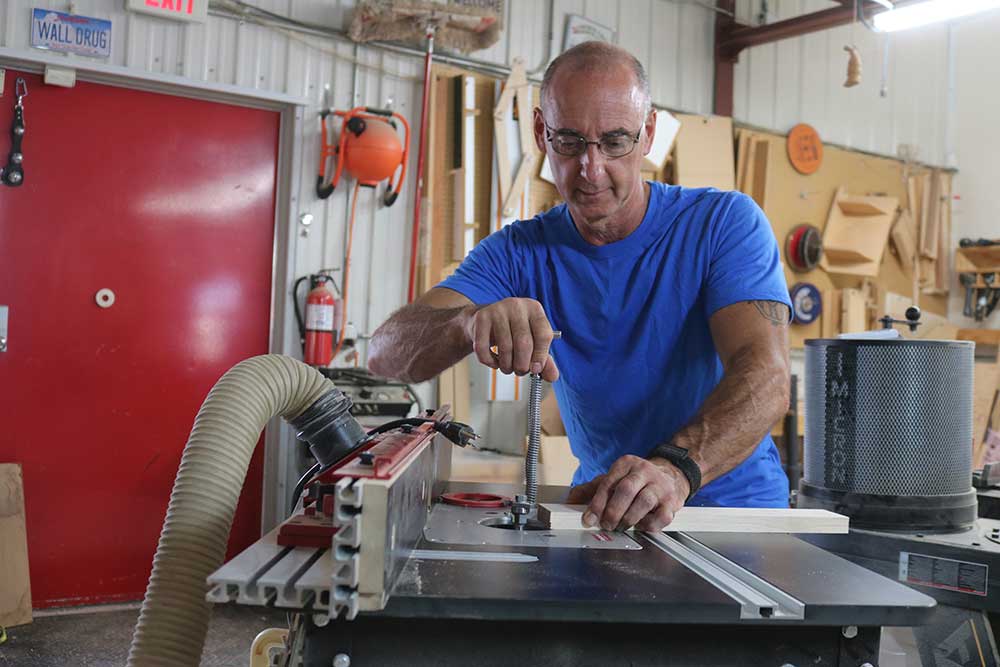
Tightening Loose Tenons
George VondriskaIf you’ve got a shop, it’s a certainty that people are going to ask you to do furniture repairs. It comes with the territory. The next time a piece comes into your shop that has round tenons, and they're loose tenons, you’re going to want to try this repair. It provides an easy way to tighten up loose tenons, by adding a simple shim.
Why not add more glue?
Some people would look at a repair like this and try to do the fix by simply adding more glue to the joint. Sorry, but that ain’t gonna work. The piece will be coming back to your shop for ANOTHER repair in no time. Standard yellow glue can only fill tiny gaps; nothing larger than a few thousandths of an inch. Paper is about .003”. If the gap in the joint is more than that, yellow glue won’t work long term. Instead you’ve got to build out the loose tenon to create a better fit, which will allow the glue to do it’s job.
Round versus rectangular tenons
Tenons that are square or rectangular are relatively easy to fix. Just glue on a piece of veneer, sand, chisel or plane the veneer to get the fit you want, and you’re ready to go. Round tenons are a different story. The technique shown here allows you to create a loose tenon wrap that will create the perfect fit.
What is a good fit?
How do you know when you’ve got the tenon right? You should be able to slip it into the mortise with hand pressure, not requiring a mallet. When you gently pull on the parts, friction in the joint should keep them together. They shouldn’t just fall apart.
More on tenons
Creating tenons from scratch? Be sure to check out this useful info on dimensioning the tenons. Our quick rule for tenon joinery is indispensable.
Share tips, start a discussion or ask other students a question. If you have a question for an expert, please click here.
Already a member?
2 Responses to “Tightening Loose Tenons”
So, a friend of mine dropped this baby off a couple of weeks ago, asking if I could fix it. So, I'm working on it and I think it'll come together. It's going to take some time and some patience, but seeing if that rail, that rung is going to come out, but I don't think so. One of the things I'm doing is going over all the rungs and getting the glue residue off. That's a really important step.
We want to get rid of all of that kind of stuff. Now here's the thing. I'm going to put this back together with conventional yellow glue. And in order for yellow glue to have a bond, we really need to have a good fit between the mating components. And let me show you where this is problematic.
That glue came off nice and easy. Now I want to look inside the hole as well and get any glue residue out of there. This one I've already taken care of. And this was the problem I want to show you. When I put that rung in look at how loosey goosey that is.
So, I can put half a gallon of yellow glue in there, and I'm not going to do my friend any favors putting this thing back together because we're just not going to have a good glue joint there. So here's a solution when you're working with round rungs like this. This is pretty cool. Here's what I'm going to do. I've got a piece of maple in a vice here, and I want to use something that's close grained and straight grained.
So maple would be good. Poplar, Cherry... Red Oak wouldn't be a great choice for what we're about to do. I've got a block plane set at a real light depth to cut, a Jack plane or something would be fine, if I owned a Jack plane, but the block plane is going to do okay. And let's get a couple curls coming off of here.
[Wood Scraping] And then we'll find a good one. [Wood Scraping Continues] All right. Woo, there's a beaut! What did I just make here? I made wooden filler tape.
So the way that this repair is going to happen is I'm going to end up taking these ends, applying some glue to them and wrapping this shaving around, in order to increase the diameter of that end. Once I get to the end of the shaving, I can tape that in place, allow the glue to dry, take the excess off the end, and then test the fit again. What that'll do is probably leave me a tiny bit oversized, so, I'll do a little bit of hand sanding and I'll tweak each one until I get a perfect fit. So, I think this adding veneer, adding a curl off your plane like this is a pretty cool solution to allow you to build this round stock back up to where it needs to be in order to get a nice tight fit between the rung and the hole it has to fit into so that this chair is going to last another few decades for my friend.

I think a thick shaving from a plane of similar wood is the best way to tighten a circular tenon. The natural curl forms to the shape and the similar shade is better camouflage than a piece of paper. More easily accessible than paper of a natural wood tone (that also curls.)
Those thin wood shavings are not going to hold up against any kind of movement for very long. I would fill the hole with an epoxy composite, jamb the tenon into it good and tight and let it set. The composite will dry way more solid than the wood itself.