Info Filled Icon
George Vondriska

Mortise and Tenon Joints on the Router Table

George Vondriska
Duration:   17  mins

Mortise and tenon joinery is undeniably one of the strongest forms of joinery that is used in furniture making. There are a lot of approaches that can be used to form both the tenon and the mortise, and one of the more popular methods that is used by hobbyist woodworkers uses the router table.

This approach does not require a long list of expensive tools, but rather takes advantage of some common tools that many hobbyist woodworkers already have in their shop.

A few items that can help you as you prepare for making mortises on the router table include:

Good quality router. Milling mortises requires both power, as you plunge deeply into a dense hardwood. The operation also requires precision to ensure that the mortise is consistently sized to receive the tenon with a perfect light friction fit.

Router table. Milling mortises with a router works best when the router is mounted on a high quality router table with accurate fence that can hold its adjustments well during repeated milling operations.

Spiral router bit, ideally the upcut style. Milling repeated mortises is a taxing operation and can quickly dull a traditional high speed steel bit. Carbide cutters are essential here, and the ideal bit is an upcut spiral bit that clears the chips effectively as it mills the mortise.

Large diameter carbide straight bit. This bit will be used to mill the tenon, and the large diameter will be necessary so that you can remove all of the material along the entire tenon in a single pass.

By following the steps that are presented here, you can consistently mill perfect mortises safely and efficiently. Once you have mastered this versatile form of joinery, why not try incorporating router mortises into your next furniture project?

Share tips, start a discussion or ask other students a question. If you have a question for an expert, please click here.

Make a comment:
characters remaining

No Responses to “Mortise and Tenon Joints on the Router Table”

No Comments

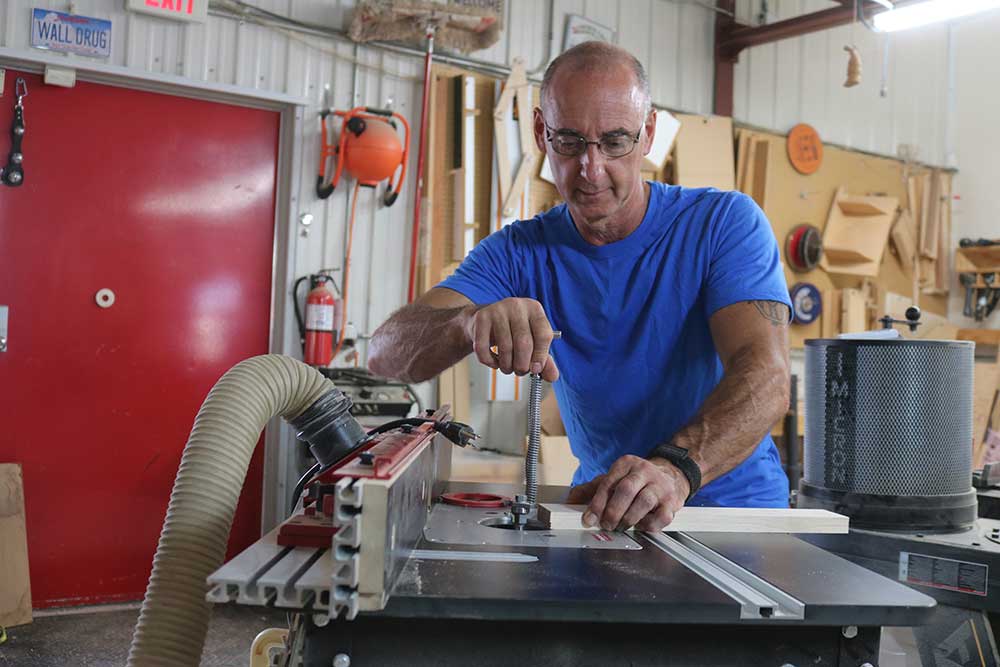
Morice and tenant on the router table. Pretty simple. I wanna lay out the limitation right away, which is I find this works really well for a quarter inch mortice, which of course matches a quarter inch tenant. General rule of thumb is that whatever the thickness of your tenant is, its length is twice that. So in this three quarter inch stock, when I have a quarter inch tenant, it's a half inch long, we're gonna get to where in order to make that mortis, we're gonna plunge onto that cutter.

When I do. If that's a really big bit, if it's three eights or half inch mortis, that's really hard to do. It's hard to do that plunge safely and effectively, you gotta find another way to make your mortis. So for us to cut our quarter inch wide, half inch deep mortis works great. Now to get this to happen.

A couple of things I have in the router table, a quarter inch up cutt, spiral router bit, the up cutt isn't critical, but it's nice because like the flutes on a drill bit, those up cutt flutes are gonna help take waste out of the mortice now, I was just talking about depth of cut and I was referring to it as half inch, twice as long as the tendon is thick. We really wanna go slightly more than a half. So there's a little room for glue at the bottom of the mortice. The last thing you'd want is for the tendon to bottom out before the shoulders of the tendon close against the leg. So here using my bar stack router unplugged, I'm set to about a 32nd beyond the top of the bar stock.

That's my depth of cut the way that's gonna work. So you understand the big picture, that's my mortis even if the mort is gonna end up close to the end of the leg, start with that layout away from the end grain. Having some extra wood out here makes us a lot easier to handle. Then go back and cut this to its final length relative to the mortis. After the joinery is complete, the lines are here and the mortis will be there.

Now, if I was really doing a set of legs and aprons, I would have lines here, lines here because we'd have mortices on two adjacent faces for the sake of this. I've got my layout here. So what we need to know is when I approach this and I have the fence in place, where do I make that plunge so that I end up starting and stopping in the right spot it's real simple to do, need a piece of scrap. And one of the things to pay attention to are the flutes on the cutter. This cutter happens to be sitting here the way I want it, which is this flute is pointed this way, this one is pointed that way as opposed to that where the flutes are like this.

So I want the flutes parallel to the fence. Next thing is to get the fence in the right spot pretty commonly when we do more to some tenant joints, we put them together with what's called a reveal. The reveal is at step. So you need to know this amount, the amount of this step in order to locate the fence. In this case, it's pretty easy.

I'm ending up with a quarter inch shoulder between the tenon and the face and a quarter inch reveal. So the distance from the mortice to the edge is a half inch. Now, I want to turn the flute toward the fence, bring the fence into play and I'm again gonna use bar stock in order to locate it, bring the flutes back. So they're parallel to the fence again and we're ready to do some layout. I want to know where the diameter of that cutter is relative to the face of the fence easier than it sounds.

Bring in a piece of scrap, the end has been cut square, go against the fence. Kiss the cutter, make a line same thing on the other side, come against the fence, kiss the cutter, make a line, those two lines. Now define the diameter of the bit. We need them up a little higher. We need them up here where we can see them.

So it's pretty easy. I'm just gonna do this and thus, and this and thus now when we bring our leg, it shows us where to start and where to stop, we're gonna initiate the cut on the line furthest away from me on that line, the leading edge of the router r plunge move to that line lift. Let me plug in, get some hearing protection and I'll show you there's our artist and of course, if we were doing another one here, we'd have another set of lines and we would do repeat that process on the adjacent face sequence of events always do the negative first, always do the mortis first and then make the tenant to fit the size of the Morice is dictated by the size of the cutter, whether that's a router bit or a forester bit or a a mortician bit on a dedicated morte, that cutter controls that size. So always do the negative. Always do the mortis first, make the 10 to fit, which is what we're gonna do next after I change router bits, now we're gonna make a tenon to match our mortis.

So I changed cutters. I've got a three quarter inch bit in there we know the tenant is gonna be a half inch long. I like the diameter of this bit to exceed the length of the tenant. So 583 quarter, any of that would work height of bit. Here's what we know when we're done in our three quarter inch stock.

If we have a one quarter inch tenant, that shoulder is a quarter, that shoulder is a quarter. So theoretically, if I set the height of that bit to a quarter, I should end up with a perfect tenant. But what you wanna do is start low right now, I am, I don't know, 1/16 of an inch below the bar stock. So I can feel top of the carbide, top of the bar stock, it's a little bit low because we can always take more material off. You can't put material back on.

It's really, really, really important that whatever you're doing for your tenants, you have extra pieces that are exactly the same thickness because the size of the tendon is thickness specific because we pass flip pass. So when you're doing your test cuts, we want to make sure this is the same thickness as a rail fence location is easy back to our bar stock. I have the cutter pointed extremely away from the fence. So basically top dead center in this direction, bring the fence over, use your half inch bar stock. Now, I want this to be even so right there, the face of the bar stack and the carbide, let me lock down and I'll show you the face of the bar stock and the Carbide are even in this case to give us that half inch 10.

And again, we're doing test codes to start. So we'll be able to double check all this stuff to get going. We're gonna do that bo that bo but you wanna have a piece of scrap to back it up for a couple reasons. One, this is a little bit narrow and we don't want it to walk on the fence. Two, we want to prevent any blowout chip out.

That could happen when the router bit exits here. So some kind of scrap to allow us to do this. We're ready to do a cut and then see if we have a fit. Well, I don't wanna have a fit but you know, if it fits and really what we're hoping for is this is too much big. So when I do that, it is, here's where you have to be careful if you're eyeballing this and it's 1/16 of an inch oversize.

We raise the bit by half that amount. So it's very easy. He says from experience to overdo this and come up too much. So I'm just gonna do half a turn of this would be a 32nd. I'm gonna do a little bit less than that.

And like I said, sneaking up on this is the way to go. Oh, that's so close. So what we're looking for is push that in. We've got a little bit of friction there but not so much friction that we would have to drive that in with a mallet. So again, be real conservative as you're raising the bit so that you don't overdo it.

Now that we know the height is right, our next step on a complete tenant is gonna be to cut it this way. So I wanna close the fence to make sure that this can't collapse in. That's gonna be done with the bit running and push the fence halves in. So now we're to a point where this is complete tenant cutting, which is with our stop block or our backer block, we're gonna cut, cut, cut. Got, you may have noticed we've got a square peg in a round hole.

The mortis has rounded ends on it. The tenant has square corners. The easiest way to fix this problem. It's much easier to round an external than to square an internal. So one solution would be a quarter inch mortice chisel.

That would be a pain, lots easier to use a utility knife or a bench chisel and just knock these corners off. And if I were to do a table full of these, I would, I'd have this rail and a vice and I'd be doing this with a chisel like that pairing with a chisel goes a lot easier and faster that should get us that fit that we're after. So when you cut those corners off, don't worry about losing contact between the end of the tenant and the end of the mortis. The glue strength on this comes from this face getting glued to the face here. Same with the other side.

It's this big surface that provides your glue strength. So when this goes in, if it's got a little vertical wiggle like this one does, that doesn't bother me at all. In fact, I want a little of that because I'm gonna take advantage of that to align this with its proper layout line, which is probably the end of the lake that my friends is your mortis and Tenon on the router table. If you do a lot of it, you gotta be a little bit careful because you can get tendonitis easy way to do mor to and 10 and keep in mind that limitation works great for quarter inch up, cut router bit, producing quarter inch mortice, quarter inch Tennant that is half inch long. It's a great way to go.

Get exclusive premium content! Sign up for a membership now!