Kitchen Tongs
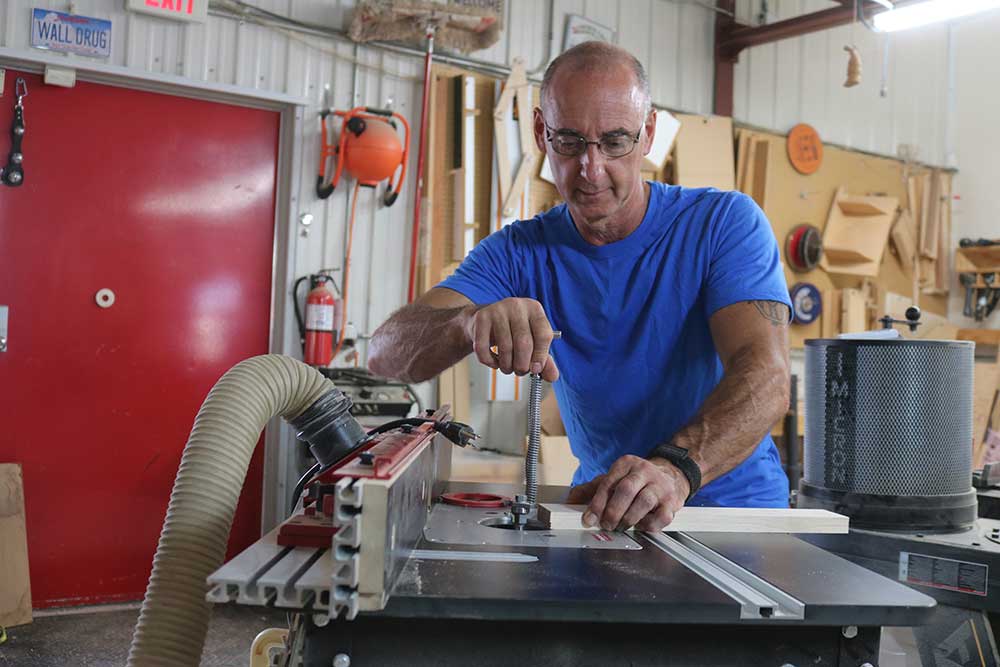
George VondriskaAdd kitchen tongs to your list of simple woodworking projects. George Vondriska walks you step-by-step through the planning and building process for making a pair of kitchen tongs that you can give as a gift for a friend or loved one or use in your own home. George teaches you the simple woodworking tips and techniques you'll need to cut the angle and width of the spacer and epoxy, sand, shape and finish the tongs.
You're gonna be amazed at just how simple it is to make these tongs. And the way they're made is such that if you're making one, you might as well make a dozen of these and people are gonna like them so much. You're gonna need a dozen anyway. Cause everybody's gonna be asking for them. They're very, very simple to make very useful and people love them because they look cool.
They're very organic. They feel good in your hands. And they work really well too. So first thing we gotta do is head for the table saw and have a look at how to make this spacer piece here with the perfect angle on it. Get started with the spacer.
What you're gonna want is a board that's about eight inches wide or so, 3/4 of an inch thick or more is okay. Less than 3/4 gonna be no good. To get going what we're gonna do is cross cut this. What we wanna do as long as we're making one, like I said, you might as well make a bunch of these things. So I'm gonna cross cut this numerous times.
I want every piece to be identical in length. So the way I'm gonna make that happen is by putting a stop lock here on the fence. Remember that when we're using the table saw, its never a safe idea to simply bring the fence close to the blade using the miter gauge to push the material through. It is safe if I measure to a stop block, which is on the fence. And then position the stop block ahead of the cut.
I've said it so its an inch and a quarter from the right side of the blade to the face of my stop block. Now the stop block gets clamped here. Well ahead of the cut. Whenever you put a stop block on anything a miter saw or your table saw. Notice that I've got the block up off the table of the saw.
If you make a handful of cuts, what's gonna happen is that, you'll get sawdust on the surface. If the staff block is tight to the table when you slide over, you end up with a little cushion of sawdust between the end of the board and the block and you're not gonna have accurate cuts. If you leave a little relief here, there's a place for the sawdust to go as your sliding. So it's just a good tip to give you a little bit more accuracy. In order to use this, come over kiss against the stop block, move forward, can make as many pieces as I want.
All identical in length, very safe way to do this. I'm ready to go. I can plug the saw in and make my cut. There's the block that we're after. As far as material selection goes, you do want this to be a hardwood.
It doesn't really matter what wood. As you're setting up to make your tongs, its nice to have a contrast between the spacer and the tongs themselves. Nice to make those tongs out of either maple or cherry. So I contracting wood for... To work against that is a nice touch.
In this case, I believe this wood is meranti but I'm not positive. I've had it for a really long time. Its a very heavy and dense wood. Its gonna work great for this. And it looks great against the maple tongs I'm going to be using later.
So that takes care of this step at the table saw. Couple more to go though. In order to get the spacer angle just right, we need to angle the saw blade and you wanna run that at four degrees. Now don't be too hair-splitting on setting this up because the number is a crazy critical. And to make this cut, we need the blade to be angled toward the fence.
On my particular saw, this is a saw where the blade tilts to the left. So what that means is I'm gonna end up moving my fence over here onto the left side of the saw blade. For the height of the blade, I wanna stay below the top edge of my material. When these are done, I need there to be a little shoulder up here. That'll make more sense when we assemble these things.
The height of the blade needs to be such that the tooth at its top 10 center, is gonna be an eight to 31/16, seven inch below the top of the material. All right about there. Now, when the blade itself enters the material, I want the left side of the blade to be right here at this outside corner. So I'm gonna dial this down so that a tooth here is even with the tabletop. Because this is not a through cut, I need to do this with the guard off, which is a great time to have your riving knife on the saw.
So what I'm checking here is right there. That tooth is just skinning that face. That's perfect. That's right where we wanna be. So with a push block, I'm gonna feed this material past, then rotate it end for end cause that's going to produce a cut on one face.
Need to make the same cut on the other face. So ready to plug the machine back in and get to work. Well, that's exactly what we want. We've got the four degree angle on the sides. And then...
If I get away from that chip, you can see it better. Right there. That little bit of ledge. So the purpose of the ledge is gonna be when we slide our tongs on there, they can't slide all the way up hill and slip off the spacer all together. So that's what these parts should look like when you're done and this step is complete.
In this step, what I'll be doing, is cutting the spacers in this direction. So this way, this way, this way. So we're using the miter gauge. It kinda feels like a cross cut. But remember the grain is going this way.
So its actually a ripping cut. So I've still got the ripping blade in the table. Dimensionally, this should be slightly larger than the width of the tong that you're gonna put on here. I'm make in my tongs an inch and an eighth. So this is set.
I'm gonna set this up for about inch and three sixteenth. So the way I did that is on this board, which will end up on the miter gauge, I've measured from the end, made a mark at an inch and three sixteenths. Now I'm gonna bring that to the saw blade with the saw unplugged and I'm locating it on the right side of the blade, that pencil mark. So the way that'll work for me is that my spacer blanks are gonna go up against here, be made flush with the end, move forward, make a cut. So one of the reasons we need to work with a wide board here is because its gonna get to a point where I can't safely hold this anymore.
So we're not gonna get entire thing cut up. So back a step or two, the wider the board is, that you're starting with, the more of these cuts you're gonna be able to get out of it. Takes care of that step. My piece, which was about eight and a half inches wide, the way I was cutting it here then yielded 12 of these spacers. So we can make a lot of these in one fell swoop.
Here's where we're going. Here's where we are. We haven't talked much about these yet. Its a good idea to stick with a close grained wood for the tongs themselves. In this case I'm using maple.
Cherry would be a good choice, minor an eighth inch thick, inch and an eighth wide. For length, I suggest you mess with different stuff. This set is 10 inches. This set is 13 inches resulting in these two different sizes. So those numbers work good, but like I said, it's a good idea to just play with this just a little bit.
What we need to do is glue these parts together. And if I go with just yellow glue it's probably not gonna hold up very long cause of the pressure that we put here every time we're springing the tongs. So we epoxy is the way to do this. Doesn't take much for one pair of tongs. In fact, way less than I just squoze out there.
Always with your epoxy make sure you mix it up good cause it won't cure out if you don't have the hardener mixed in well with the resin. You really have an icky mess. This is where the ledge that we left on that spacer is gonna make a lot of sense. Its imperative that you have it cause what I'm gonna do is butter the epoxy up onto the spacer and I'm gonna stay away from that bottom edge. And I'm what I'm trying to avoid is getting squeeze out in the inside corner where the tong arms themselves exit here cause that's really hard to clean up.
Now, when you assemble, put the spacer flat on the bench. Bring the tongs to it, keeping them flat on the bench. So I'm registering everything down to that flat table. And when I put the tongs on the way I'm gonna do this is, I'm gonna contact the point and then rock it in. And the reason for that is so that if they're squeeze out, I'm pushing it up toward that inside corner, toward the top of the spacer so that it doesn't end up squeezing out on the inside corner, making a big oogy mess.
Spring clamp has plenty to hold this in place. Now, push everything down to the table, tap like that to make sure that everything is lined up. This is why that little shoulder has to be left on there. If I didn't have that, as soon as I put pressure on with the spring clamps, they just keep going. The tongs themselves would just slide right past that.
So that ledge is gonna stay on there until the glue is dry. We're going to cut it off a little bit later. So go ahead and glue up all your sets. And then once the epoxy is dry, we can start working with them to get them shaped. Shaping of the tongs is gonna start of course after the epoxy has dried.
Let that set overnight. And one thing we need to do before we start doing any sanding, is take the excess off here. Additionally, if the spacer is a lot wider than the tongs themselves, you can do some trimming on that at the bent side. On this set, they came out pretty close. So I'll take care of that with sanding.
In order to make this cut, what I'm gonna do is use a straight edge and simply connect the dots from the end of the maple to the end of the maple. And trim that off here at the band saw. That's all we need. They're simple cut and everything else we do, we're gonna do with sanding. Here's a real easy way to do the shaping and sanding on these tongs.
I've taken my belt sander, put it upside down on a advice. Very gently squeezing it so I don't crack the housing but this is a really easy way to then work on small parts like this. Couple of things are gonna happen here. Initially, what I wanna do is just get the excess epoxy off, clean things up a little bit. So I'm gonna run it this way, this way, this way a little bit.
Eventually I'm also gonna do the shaping on the end here. So those are nice and round. So at this point, I'm just gonna do some clean up on the glue, and we'll go from there. I dawn the top a little bit. There's nothing...
There's no rocket science about that. Just put any shape on there you want. The big thing is get the band saw marks off. Now, the shape, the tips down here. I want them both to look the same.
So I'm gonna close them and keep them closed with a little bit of masking tape. And that'll let me work on both of them at the same time so that they remain identical. For a final sanding step, I'm gonna hit this with a random orbit sander, get any marks out that were left by the belt sander. And also with a little hand sanding, I'll just knock these sharp edges off of here and shaping and sanding will be complete. That nicely sanded maple with its figure is really looking cool under the mineral oil.
Before you give these away as a gift make sure you do some tongy tests on them. If anything is gonna fail, most likely it would be if you ran into some short grain in the tong arms themselves and you're gonna know that really quickly when you tension them like that. If they're going to snap, they're gonna snap probably right away. So do a couple of tong tests on them. Make sure they're okay.
Couple of good coats of mineral oil on there and looks great with the contrast. And this one is ready to serve salad or bread or whatever it is you're gonna use your tongs for. So remember that this is a great project that really lends itself to making multiples at one time, great stocking stuffer Christmas gifts and something that everybody who sees this is gonna wanna have. So have fun making tongs in your shop and giving them away.

Spacers were made by crosscutting 1 1/4" slices off an 8" wide board. The wide board was used to get as many spacers as possible safely as each 8" slice then has to be cut into 1 1/8" sections with a miter saw. Since I do not have any wide boards, I was wondering if it matters structurally if I rip the 1 1/4" slice off the board longnitudally instead of crosscutting? This will give me one long piece to make the short spacers, instead of getting several short pieces from crosscutting the board. Thank you.
Great project.
Why use epoxy instead of wood glue. I am horrible at mixing epoxy and my tongs fell apart after about 4 uses. Can I use wood glue instead, or is there a reason not to use it.
You said you used 3/4" thickness for the spacers but you never say how long they should be. I guess I could figure it out if I knew how thick your stop block is since you say you measure 1 1/4" from the fence. From the looks of the picture it looks like the length is bigger than the width. So is it 1" for the length of the spacer?
Nice for gifts. Great idea. Question, How you get the tongs. Are they pre cut or you cut them from a piece of wood?
What did you use on the belt sander to clean in between sanding?
Can you tell me what the material is that is used to clean the sander?
Really nice tongs
Nice Project