Repairing a Cracked Table Leaf
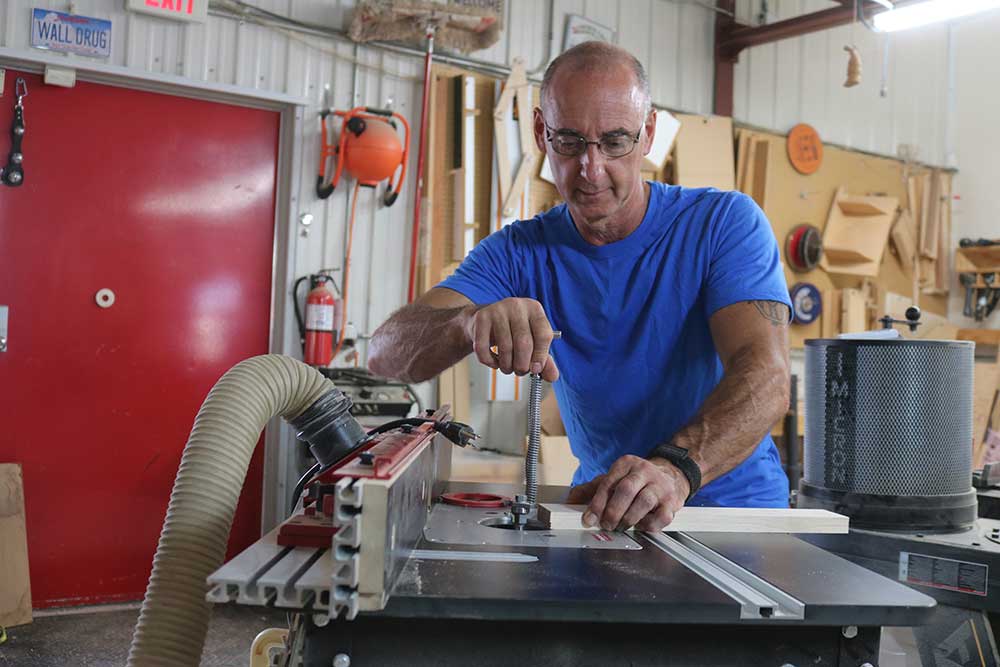
George VondriskaA friend of mine owns a very old dining room table. It belonged to her parents, and has an heirloom aspect that she’s very proud of. Unfortunately, over time, some of the table leaves developed cracks. Not huge cracks but, still, unsightly. I wanted to help her save the table.
What NOT to do
Sometimes when woodworkers run into splits like this they want to simply push glue into the crack, get clamps on it, and squeeze the crack closed. The good news: you’d probably be able to get the split to close. The bad news: that’s not a long term fix. In all likelihood the crack will simply open up again over time. There’s internal tension that causes the crack, and you’re fighting that tension trying to squeeze it closed.
What you SHOULD do
The best way to take care of this is to cut right through the crack, typically a ripping cut, joint the sawn edges, and glue the pieces back together. For the table leaf I fixed I used a bandsaw instead of a table saw for the rip cut. This keeps the kerf and lost wood as small as possible. Because the table was already finished I used biscuits to keep the finished faces in alignment as I glued them back together. Biscuits aren’t necessary for strength, only for alignment.
The result was a nearly invisible repair. The heirloom table is back in business, and ready for many more years of service. It’s tips like these that can help keep your woodworking going smoothly. WWGOA works hard to keep the tips flowing. Be sure to have a look at all of our great woodshop tips.
Share tips, start a discussion or ask other students a question. If you have a question for an expert, please click here.
Already a member?
One Response to “Repairing a Cracked Table Leaf”
A friend of mine has a kitchen table that belonged to her mom and dad originally, now it's in her kitchen. And one of the problemas with it is that the leaves have started to develop these cracks on the end. I dunno how old this thing is, but it is interesting too to look at how it was originally joined. They did a little tongue and groove joint there when they put 'em together, which is cool. This is actually a kinda thing that comes across to us here at GOA as a question pretty often, which is, how do I deal with this kinda stuff?
If all I do is put glue in that crack and clamp the heck outta this, I could probably get enough clamp pressure on that to pull it closed, but it's not gonna stay. We've got, something caused this to open. It kinda looks to me like this maybe sat in water a little bit. And when it did, that caused this end to deform like that and split. So what we really need to do is repair the crack, not just force it again into a closed position.
That being said, I wanna maintain this original as much as possible. I don't wanna do any refinishing here, 'cause then this'll end up as a different color than the table. So here's what we're gonna do. Bandsaw, jointer, biscuit jointer, clamps. I'm here at the bandsaw, 'cause what we're gonna do is rip right through that spot.
And I'm on the bandsaw, because it's got such a narrow curf. The curf on this bandsaw blade is about .032 of an inch. On most table saw blades, you're maybe, if it's an eighth of an inch, that's .125. So I'm gonna lose a lot less material here, and as a result, when I put this back together, it'll be less obvious. Then jointer in order to clean those edges up and get everything put back together.
But we'll get there in a second. I've got the fence set so that when I do this rip, I'm gonna start right on that crack. Next. Off to the jointer to clean those edges up. We gotta do just a little bit of work here at the joiner.
Honestly, the seam between these two boards isn't horrible right off the bandsaw, but it's not great. So, just, the jointer's gonna do what jointer's do, which is clean up that edge and make the glue joint way more better. So the question now is just, is that enough? Man, I'm pretty thrilled with that, because when I close it, that's where the crack was. But boy, that closes seamlessly all the way down.
From here, workbench, we'll get this baby glued up. Back at the jointer. Very, very light pass. And it's better to do a number of light passes to see just how much you have to take off, than take off a heavy pass and have more than you need. So the bottom line is, we're trying to remove as little material as possible in order to get these to go back together so that we don't change the overall dimension much and we don't change the overall look much.
Now I have cut a couple of domino slots in these boards and they don't need it for strength. The only reason they need it is for registration. You could do dominoes, you could do dowels, you could do biscuits. But that's gonna help me across the center here make sure that those top faces stay in line, because when this comes together, there will be no opportunity to sand this surface after the fact. The tape is on there, because that's how I put my marks on there for the slots I was gonna cut, my layout marks so that I wouldn't have to put marks on the wood surface.
I'm gonna start in the middle, have good levelicity there. Pull closed. Pulled closed. And then on the ends here, if you wanna buy a little alignment, you can bridge the seam with another clamp. That's good.
Pull closed. Now that everything is closed, I'm gonna take the clamps off. And you probably know, I'm not a big fan of wiping glue with a wet rag, except in these cases, because we've got a finished surface here. So I wanna get that glue residue off of there now, so I don't have to come back and try to scrape glue later, which would then mess up the finished surface. All right, what do you think?
That's pretty darn seamless, I'd say. I like it. I've actually got two more of these leaves to do the same process to. But this is a great way, again, the concept here is, we're not just forcing the crack back together with glue in it, we're actually repairing the problem. We're cutting the stress out, jointing the edge, just like you would a fresh project, putting her back together.
And that gives us a really good look here, and a good repair that hopefully is gonna last as long as this heirloom table already has. Problem fixed.
That's a great tip and beautiful work. But on my band saw, I would have trouble cutting as straight as you appeared to do. I have an old, Sears band saw with a 1/4" blade in it now. Perhaps a 1/2" blade wouldn't do this but the 1/4" wonders and attempted straight cuts are never straight enough. I mainly use it for scroll-work because I don't have a scroll saw. I would be inclined to use the table saw, even with its 1/8" kerf, in order to get a straight cut that would then require less passes across the jointer. What do you think?