Top 5 Stationary Woodworking Power Tools for Beginners
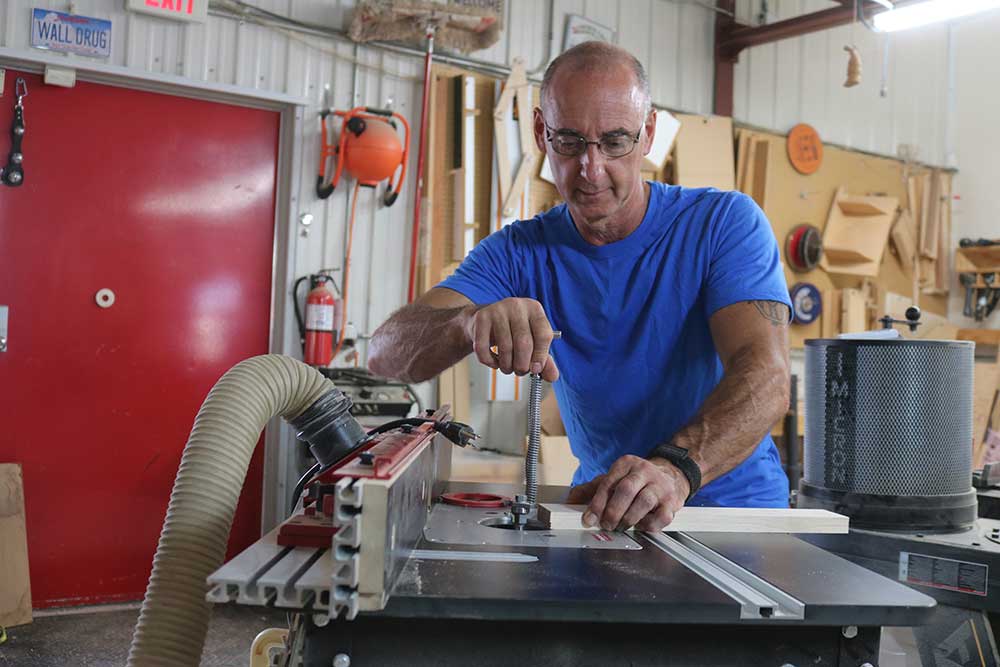
George VondriskaWhether they’re just getting started, or have been involved with woodworking for a while, many woodworkers wonder what woodworking power tools they should add to their shop. The answer to this question can be subjective, and depend on what types of woodworking projects you commonly build, but George Vondriska is ready to provide you with his opinion on which five woodworking power tools should be considered top tier tools for your shop.

1. Table saw
I don’t think there will be much argument here. A table saw is at the heart of most shops, and can’t be beat for ripping, crosscutting, and a gazillion types of joinery. The only real question is what type of saw is best for you. In large part, that’s a question only your checkbook can answer.
2. Router table
This might be where the fist-to-cuffs start. Why a router table as my second choice? It’s so versatile. With the right fence set up, I can edge joint boards, like I could on a jointer. (No, you can’t face joint, but I’ll live with that for now.) I can make any number of joints, create doors, and profile edges. I can remove the router and use it hand-held for work at my bench. A good router table simply provides lots of bang for the buck.
3. Planer
Planers are used to clean up rough sawn stock and get material to a precise thickness. A planer also guarantees that every piece you machine comes out at exactly the same thickness. Need thin stock for a smaller scale project? A planer is the go-to machine for that.
4. Jointer
A jointer makes the dges of your material smooth, straight, and square. This creates what’s commonly called a reference edge that you need for additional steps like ripping or crosscutting. In addition to perfecting the edges of your stock you can also straighten faces, called face jointing. Like edges, you’ll end up with faces that are nice and smooth, and dead flat; a precursor to other machining steps.
5. Band Saw
I use my band saw a lot. I’ve got a sled I use for crosscutting tiny pieces, like I’d use for pen turning. Big blades go on when I’m cutting fireplace logs into usable lumber for my woodworking. The band saw is a great way to cut tenons, and I’ve even mastered cutting through dovetails on the band saw. Another extremely versatile tool.
Tool buying advice
Once you’ve determined what tools you’ll be getting, be sure to get good tool buying advice before making your purchases. WoodWorkers Guild of America works hard to provide you tool education and tool reviews. Have a look at what we offer.
Projects to build
With your tools set up and ready to go, you’re ready to get started on woodworking projects. If you’re looking for beginner woodworking projects, we’ve got you covered. Projects range from birdhouses to jewelry boxes; there’s something for everyone. You’re sure to find a project that’s a good fit for your skills and tools, and that you’ll enjoy creating.
WWGOA is here to help
If you’re just getting started in woodworking, Woodworkers Guild of America is here to help you wherever we can. If you’ve got questions, we’ve got answers. We produce lots of articles and videos designed to make woodworking for beginners go more smoothly, with fewer errors along the way.
Do you have a different Top 5? Join the discussion in the tab above or email us at editor@wwgoa.com.
If you're ready to get going in woodworking or you've been woodworking for a while but you're kind of wondering, what does George think I have to have in my shop for stationary tools? That's what I'm gonna give you right now. Let's start right here at the table saw. I don't think anybody's going to argue with me about that. If you're gonna do woodworking, you almost have to have a table saw.
This will allow you to rip and cross cut your stuff to size. Depending on its capacity, you can do anything from small bird house parts all the way up to cabinet parts. In addition to cutting stuff to size, we got your dados, we got your rabbits. Then, more advanced cutting. You can do cove cutting, you can do finger joints.
Very versatile tool. Must have, heart of the woodworking shop. This way, Chris. We're gonna head on over to one of my next favorite tools, router table. What do I like about this?
Versatility. We can hang a router in there or we can take that motor out, use it for handheld operations like dovetail jigs and edge forming. Here in the router table, you can make doors, you can do raised panels, you can do joinery. Very versatile tool to have. In fact, you could even use this for edge jointing if you don't have one of the tools we're gonna talk about in just a second.
Now, we're gonna make Chris walk backwards without tripping. Nicely done. And we're gonna hit benchtop planer. Why do you need a planer in your shop? Well, this gives you a lot of opportunities.
One is, instead of buying your lumber surfaced, you can buy it rough sawn. That's gonna save you some money at the mill. The other thing is, when we need thin stack, how are we going to produce that? Well, we can send three quarter inch stack through the planer, take it down to half, three-eighths, quarter, whatever it is you need. It's gonna flatten the boards for you.
Remember that we've got a building block process going on here. So if we start with kerflooey boards, we're gonna have a kerflooey project. We want to get them nice and flat here at the planer. So we get dimensioning, we get flatness. That's a great attribute to think about adding a planer to your shop.
Now, jointer. Kind of like the planer, this fits into that building block idea. Jointers are used to produce flat faces, that's face jointing, and to produce edges that are smooth, straight, square. We're back to that idea of, if your parts are kerflooey, your project's gonnna be kerflooey. This is a great starting point with your material to make sure that when we take it from here to other parts of our project, it's gonna be nice and straight and true so that our project is nice and straight and true.
What if you don't want straight and true? What if you want curves? Then you gotta have one of these. Bandsaws are one of my favorite tools. Why?
We can change the blades and we can do so many different things here. Put a small blade in there, you can cut jigsaw pieces. Put a big blade in there, we can resaw stuff down to size. Then, we can take it to the planer and plane it to get off the bandsaw marks. Very versatile.
It gives you the opportunity to cut really thick stuff. In fact, even thicker than that, there we go. This particular saw has a 12 inch thickness capacity. What other tool in your shop can you do that kind of work on? Lots and lots and lots of things we can get out of having a band saw in the shop.
So, a quick recap. Table saw, router table, planer, jointer, bandsaw. Outside of the table saw, no particular order to those projects. But now you've got George's top five stationary power tools for your woodworking shop.
What about a mitre saw?
Not having room for a tablesaw, I have four of you five George and a floor standing drill press. All my tablesaw work is done with a tracksaw (rips & crosscuts), router (dado & rabbets) or bandsaw (rips) depending on the operation.
I certainly agree with #1–4. However, I'd replace the bandsaw with a drill press, even a bench top model. I went for many years without a bandsaw, still use it only occasionally. But I use my drill press regularly.