How to Apply Flocking
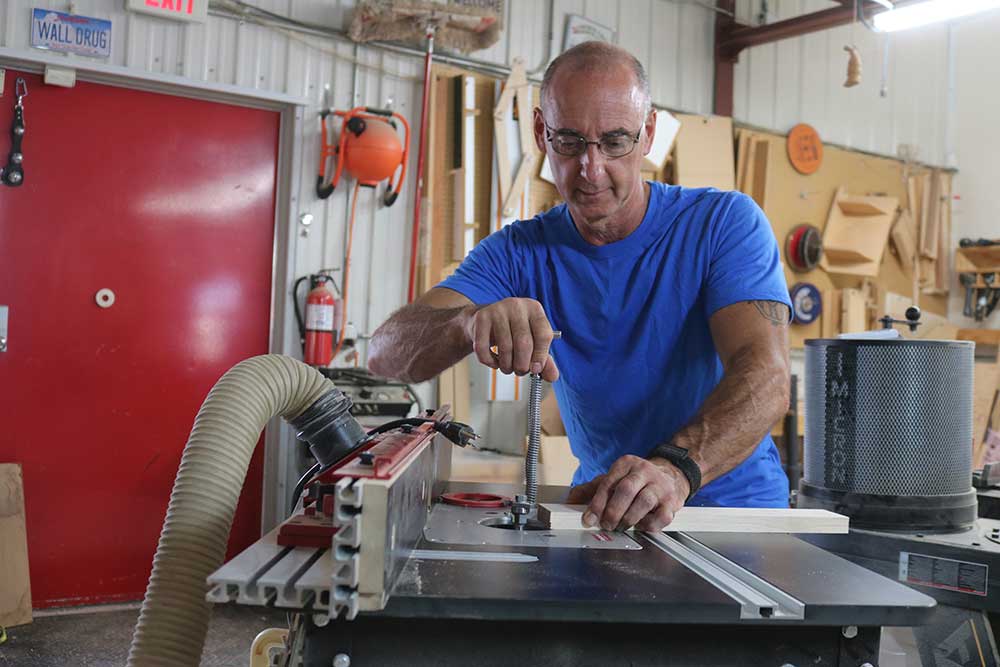
George VondriskaMaster woodworker George Vondriska provides tips on how to apply flocking to wood for your woodworking projects. A WoodWorkers Guild of America (WWGOA) original video.
The inside of this tray is coated with what's called flocking. Flocking is a material that's been ground very, very, very fine. I've got some here. Look at those tiny, tiny, tiny particles. So here's, what's gonna happen.
I'm gonna get an adhesive painted inside the tray. While the adhesive is still wet, I'm gonna distribute the flocking over the wet adhesive, let it sit until the glue dries. Now, a couple of things are key here. One is that, the adhesive that you get has to match the flocking that you're gonna use. The reason for that is just that, if for some reason you get imperfect coverage, as long as the glue is the same color as the flocking, you're never gonna know.
The other key is that we wanna get plenty of flocking covering the glue to make sure that we do have complete coverage. Couple things need to happen here. It's recommended that you seal the surface that you're about to flock. So I've got this coated with shellac. You can use shellac, you can use lacquer.
Once that's sealed, I taped off the outside corners to make sure that I don't get adhesive up there. Now, I can get this brushed on, just like putting paint on. I want a good coating inside there. Now, with the whole inside painted with adhesive. And I'm just gonna kinda strike some of the excess off.
Now, small project like this, I could probably take this spoon, just dip it into there, drop it inside there. But let me show you on a bigger scale a real easy way to do this. This tube is specifically for applying the flocking. So I'm gonna put a little bit in there. Don't worry about putting in too much, 'cause you can basically reclaim it later.
Then, this cap goes on. Now, it's kinda like a big pepper shaker sorta. There's a bunch of holes in here. So what that's gonna let me do, I'm gonna push all the air out. Now, turn this over, that gets the flocking down there, and it shoots it right in.
Make sure that I'm getting it on the sides. Make sure I'm getting it on the bottom. Good coverage everywhere. Now, the directions say, when you think you've got enough flocking in there, put some more in. You wanna make sure you've got good coverage.
Now, remember I said, don't worry about putting too much in here because we're gonna reclaim it? I'm working on this paper so that, once the glue and everything is dry, I can crease this paper together, pour this excess right back in the bag. I can open this up, pour it back in the bag. With this, I'm gonna let that sit about 10 hours. Let it sit overnight, then after it's had a chance to cure, I'm gonna lift this up, pour the excess off, right back in the bag, then it's gonna leave behind that nice uniform coating like this one that's already done has got.
It's a great way to get this velvet look to the interior of this project. Great way to finish the inside, have it have a really nice look. It's available in a lot of different colors. Like I said, just make sure you match your adhesive color to the flocking color. It's also recommended that, because you wanna be color-specific.
You get a tube for each color that you're gonna apply to make sure that particles don't get stuck in here and end up mingling into another color. Imagine if you went with red and then maybe green or something and they got together inside here, your finished project would look a little weird. So, one tube per color, one glue per color. Very easy to do. Try adding this to one of your projects, I'm sure you're gonna like it.
Could I use wood glue or white glue that dries clear ?