Cutting Mortises on a Router Table
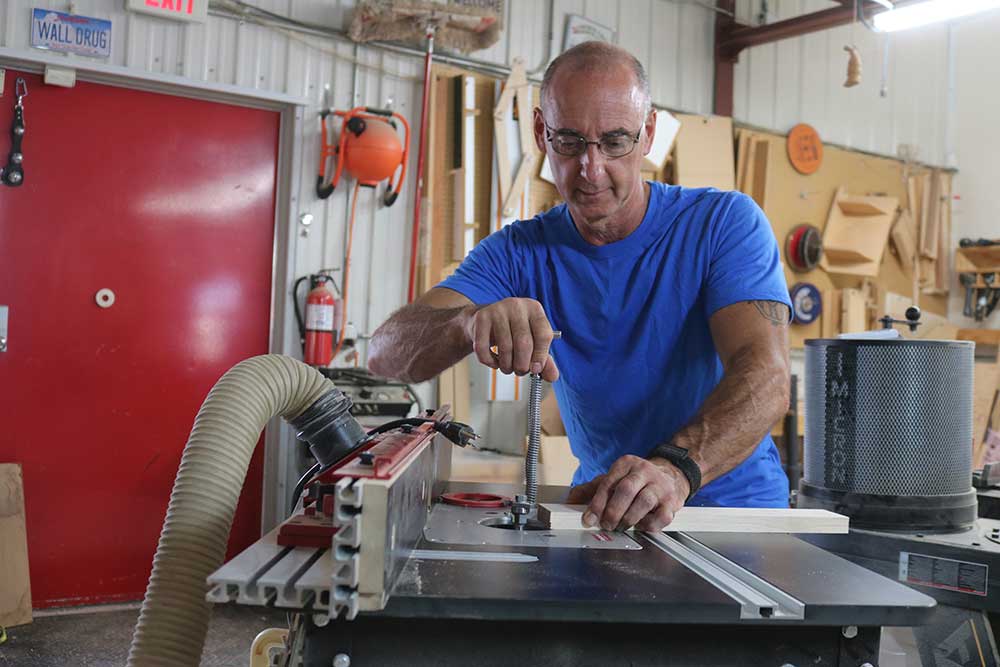
George VondriskaGeorge Vondriska demonstrates the expert way to use a router table for cutting mortises for your woodworking project. For this process, George recommends using a quarter-inch up-cut spiral router bit that is slightly taller than the mortise, because it will draw the sawdust out of the mortise as you make the cut and allow your joinery to fit together perfectly. He lays out the dimensions on the wood and the fence, and shows when you should stop your plunge cuts.
The router table provides a real fast and easy way that you can cut mortises anytime you're doing a leg and rail assembly that's what I want to walk you through here. So what I've already done is with the router unplugged put a quarter inch up cut spiral router bid in the table. So with an up cut bit, the benefit we get is that it's actually gonna draw the sawdust out of the mortise as we're making the cut. So it just helps make everything work a lot better. I've set the height of the cutter using a piece of brass bar stack.
I'm using a piece of half inch bar stack because I have half inch tenons on my project. I'm gonna set my cutter so that it's just a little bit higher than the bar stack 'cause what you want is for the mortises to be slightly deeper than the tenon is long. Otherwise, what can happen is you end up with a glue pocket at the bottom of the mortise and you won't quite be able to push things together 'cause the glue is preventing you from assembling. So a slightly greater here, in other words slightly deeper mortise than tenon length. Next thing we need to do is locate the fence.
Now on this project, what I'm looking for is an eighth inch reveal on the outside of my rails and reveal is just a fancy woodworking word for a shoulder that will leave here between the face of the rail and the face of the leg. So let's do a little bit of math here. I'm gonna have an eighth inch reveal and I'm gonna have a three-quarter inch rail. So somewhere here is the center of my rail. If it's three eight, seven inch from here to the face of the rail, another eighth inch from the face of the rail to the edge of the leg, that's a half inch.
If I'm working with a quarter inch cutter, which I am I need to know half the cutter which would be an eighth inch. So I take that away from this measurement I'm back to three eights. So I'm gonna use three eights bar stack in order to set up my fence position. What I'm doing is just gently sliding over a lock one end. And I want to pivot this end until that bar stack is just kissing the edge of the crowder bit right there.
What we know now is that the height of the router bit is correct. The fence location is correct and test cuts will confirm all of that for us what we don't know is as we're cutting, when do we step. So here's how that works. On this project what we end up with is a short mortise here at the top of the leg than a blind mortise that's just a little bit further down. And for this particular project it's one and a half inch rails.
I'm gonna have a quarter inch shoulder on the bottom of the rail. So I need to measure one and a quarter here. What I've done is kiss the end grain of my leg up against the cutter measured over to here one and a quarter from that point that's gonna be the stopping point. As I'm cutting into the leg this way. Now I need to do the same thing going the other way.
So I kiss up against the edge of the bit measure over one and a quarter. I'm gonna extend that line up. So it's easier to see, and you'll see in a second why we need this on each side of the bit. Now down here for the blind mortise on the bottom that terminates at seven inches. So measuring from here, the rail terminates at seven the mortise then terminates at six and three quarter because I'm gonna have a quarter and shoulder on the bottom.
And then from there for the length of my mortise I'm gonna measure back three quarters of an inch Same thing going the other way. We've got two different styles of cuts we're gonna make here on this first one. I'll push into the bit when at the edge of my material reaches that pencil line I'll lift off. Then I'm gonna come down here, plunge onto that line push forward until I hit that line lift off then we'll have a look at you the other side. There are resulting mortises.
Now the math on this is such that because of the diameter of the cutter, when I measure three quarters of an inch off of my first line, that results in a one inch long mortise. So that's an important thing to remember. What I need to do now is get the similar mortises on my adjacent face over here. So on this one it's gonna be just like it but different. I get my dust out of there.
What I'll do is start out here plunging on that pencil line, pushing way to the next one. Then I'll come to this pencil line plunge onto it push through the end of my material. So the reason that we're doing it this way is that you have to always work from right to left on a router table. If we came to this face and try to just cut in the opposite direction the router bit would be pulling the material off the fence and it would be really ugly really fast. Well, there we go.
Perfect mortises cut into the leg with an easy setup and easy layout system here on the router table.

Share tips, start a discussion or ask other students a question. If you have a question for an expert, please click here.
Already a member? Sign in
No Responses to “Cutting Mortises on a Router Table”