Ebonizing Wood
George VondriskaThe next time you're working on a project that calls for a dark, opaque accent that looks like ebony, try ebonizing wood for the right look. It's a fairly simple process, but works better on some woods than others.
Ebonizing wood is not the same thing as simply coloring wood with ebony stain. When you ebonize wood, you're causing a chemical reaction that makes the material turn black.
The benefit of this process is opacity. When wood is stained you can sometimes see the grain through the stain. When wood is correctly ebonized it becomes pitch black, and you won't be able to see the grain through the color.
It's important to understand that this is more art than science. You should definitely experiment before using this technique on a project.
Suitable Woods
Ebonizing depends on the wood having a lot of tannin content. As a rule, hardwoods have more tannins than softwoods, and dark hardwoods more than light hardwoods. That makes oak, cherry and walnut good candidates for ebonizing. Birch and maple are not good candidates, but I'll show you a way to work around their shortage of tannins.
Even among the usual suspects there's tannin and there's tannin. One piece of walnut may ebonize completely differently than another. You'll need to experiment with the pieces you're using to see what it takes to get the results you want.
What You Need
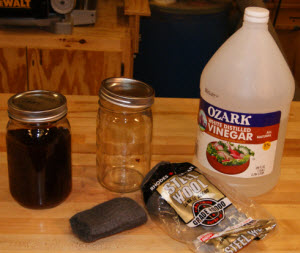 Ingredients for ebonizing are all household items:
- - Tea
- - Steel wool
- - Vinegar
Ebonizing Requires Iron Acetate
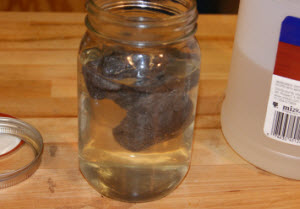 The reaction with tannins is caused by iron acetate being brushed on the wood. Don't run off to the hardware store looking for it. It's simple to make.
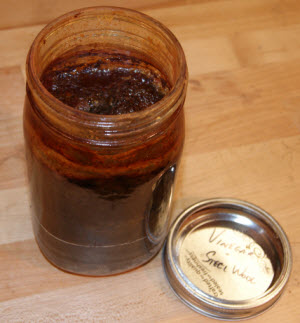
Start by washing the steel wool with soap and water to remove any oils. If you don't do this the oil may prevent a reaction with the vinegar. With the steel wool in a glass jar, pour vinegar over it. You'll know it's working when bubbles are coming off the steel wool. Bubbles should start to form within minutes of the vinegar contacting the steel wool. You can cap the jar, but cap it loosely. The gas must be allowed to escape.
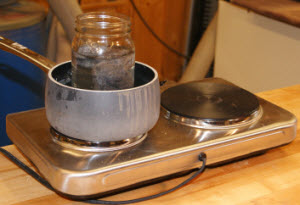 The steel wool and vinegar need some time to react; a couple days would be good, a week would be better. If you suddenly realize you need iron acetate for a project NOW, you can accelerate the reaction process by heating the mix in a double boiler. Gently heat the mix for a couple hours, then let it sit overnight. You should be able to use it the next day.
 I bought the hot plate for my shop at a thrift store. It's earned its keep a number of times.
In addition to making iron acetate, make yourself a nice pot of tea. Steep 10 tea bags in a quart of hot water to make a really strong brew. The tea will be used to add tannins to wood.
A good jar of iron acetate will look pretty icky.
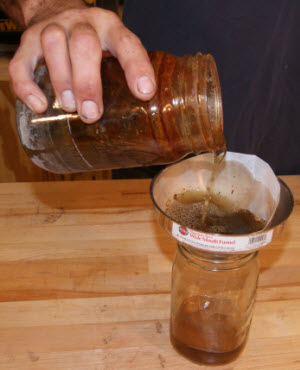 Remove particles from the iron acetate by pouring it through a coffee filter.
Do Some Testing
 Brush the iron acetate on to some sample boards and see what you get. Results are not instantaneous. Elapsed time on these boards is two minutes. The tannin-heavy woods-walnut, oak, cherry-are much darker than the other woods.
 Want things to get even darker? Add tea. Brush tea on to the wood and let it dry a little. I find results are best if the tea is slightly damp to the touch when brushing iron acetate over it.
 The tea really helps. The top board is birch with tea and iron acetate on the right, iron acetate only on the left. The bottom board is walnut, raw on the left and iron acetate only on the right. The center board is walnut with tea under the iron acetate. It's significantly darker and more opaque then the other walnut board.
You can also brush tea on top of the iron acetate. The bottom line is that tea has a lot of tannins in it, so it's a tannin-additive for low tannin woods.
Final Notes
 Ebonizing only affects the surface so machining, such as routed profiles, should be done before ebonizing.
The ebonizing process may raise the grain, especially if you use tea. It's a good idea to do a pre-ebonizing grain raise. Brush on a little water and, after the wood dries, sand off the whiskers. That should prevent you from having to sand the ebonized piece and taking the risk of sanding off the ebonizing.
The iron acetate needs to get into the wood, so don't sand finer than 220-grit or you may prevent the liquid from soaking in and having the chance to react.
Give yourself ample opportunity to experiment with this process before using it on a project. Keep the test boards and record how you made them.
Photos By Author
Share tips, start a discussion or ask other students a question. If you have a question for an expert, please click here.
Already a member?
2 Responses to “Ebonizing Wood”
Bubble, bubble, toil and trouble, I've got a little science experiment I'm doing here. Specifically, what I'm after is a process called ebonizing wood. Just like the name implies, what we're gonna do is take a standard piece of wood, make it look like ebony, just as black, just as opaque. I'm gonna show you a couple different processes for this. Now, if you want to complete how-to on this, go to wwgoa.com and look for the story called "Ebonizing Wood." All the recipes, everything I'm gonna show you here is on the site there in that story.
So let's have a look at just what this can do for you. What I'm doing here is I'm brushing a solution of iron acetate onto this piece of oak, and what that'll do is nearly instantly turn the grain black. Iron acetate is very easy to make, pretty much household stuff is all that it takes, and what it does is it reacts with the tannic acid that naturally occurs in the wood. So walnut, cherry, oak are good candidates for this. Not every wood is as good a candidate, and again, have a look at that article, it'll talk more about that, but you can see just how readily it blackens the surface of this oak.
Now, a couple things about this process, it really did a nice job of turning this piece of oak dark, dark, dark, dark, dark. But remember that this calls for wood that's naturally high in tannic acid. This is a piece of birch. Birch does not have a lot of tannins in it, so as a result, it's nowhere near as dark. That's where this comes in, and what we want to do with woods like this is help them along down the tannic acid road by adding tea to the mix.
So in this case, what I'm gonna do is I've got my recipe here for the tea that I need. It's a pretty strong solution. And I'm gonna brush the tea on the surface, and I'm gonna follow that with my iron acetate solution after letting that tea dry just a little bit. Now I'm gonna brush my iron acetate over the tea that I put on there. So that tea is just a little bit damp to the touch still.
So basically what the tea does is it provides a way to add tannic acid to the surface. And as this reacts, what we'll be able to do is compare on this side, where I've got tea and iron acetate, to this side, where I only have iron acetate. As an example, I've got some walnut here. In this case, that is simply iron acetate on walnut. In this case, it's iron acetate and tea on walnut, and this side is significantly more opaque.
We'll give this birch a little bit of time to react and then come back and have a look at that. I've given this birch some reaction time. It's actually only been, it's been less than five minutes, but look at how much blacker it is on this side, this is the tea and iron acetate, compared to this side, which is iron acetate only. So definitely worth doing, definitely worth adding the tea in cases where you want to get more color out of your iron acetate solution. You know, honestly, once you've got the recipes and the how-to, ebonizing wood is pretty simple to do.
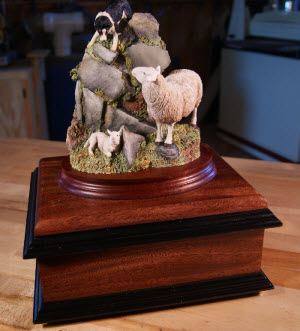
And like on this project that I did, it's a very simple way to add a really neat accent to materials, to the wood that you're working with, and get that ebonizing effect in place.
Thank you for the good writeup. It in fact was a amusement account it. Look advanced to far added agreeable from you! However, how could we communicate?
Is this suitable for outdoor projects? Can you apply varnish after<strong></strong>