 Nope, that's certainly not your grandpa's jointer cutter head. It's called a spiral cutter head. It is a newer design that uses the concept of insert tooling rather than traditional straight knives installed in the cutter head. Small square carbide cutters are placed near one another along a machined spiral pattern in a steelhead. This same technology is also available for other tools, such as planers, shapers, and molders. Still, since the purchasing criteria may differ for these applications, I will focus on using spiral cutter heads in jointers for this article. Spiral cutter heads are considered an upgrade for a jointer and generally carry a premium of $300 to $1,700, depending upon the size of your cutter head. Many manufacturers now offer this as an option that can be factory installed in their jointers when initially purchased. They are also available as a retrofit that you can install yourself. They are superior to traditional knife-based cutter heads in nearly every respect. Whether it makes sense for an individual to purchase one depends on whether the incremental cost is worth it to that particular woodworker, given their specific requirements. To evaluate whether or not it is worth the money to you, here are some of the key benefits to consider:
 Edge longevity. Spiral cutter heads utilize carbide steel inserts, while most knife-based cutter heads incorporate knives made of high-speed steel. Carbide normally holds an edge for at least three times as long as high-speed steel, much longer than that in many cases. This translates to less time between swapping out cutters. Plus, the insert cutters for spiral cutter heads normally have four cutting edges on each one, so if one gets dull, it can be rotated, and the jointer is immediately back in production. Depending upon the cost of sharpening and replacing knives in your area, it is unlikely that this longevity advantage alone will ever singlehandedly justify the cost of the spiral cutter upgrade. Still, it is a factor that can offset some of the price differentials, so it is worth consideration.
 Super easy cutter changes. Depending upon the design of a given cutter head, swapping out knives can be a cumbersome, time-consuming process. With spiral cutter heads, the process could not be much simpler. Remove one screw, rotate the cutter 90 degrees to a new edge, tighten it down, and resume jointing.
 Setting knives can be frustrating. This can take a while and lead to inconsistent results in getting the knives consistently set to the perfect height. Of all the factors to consider with spiral cutter heads, this one appeals to me the most, as I am not a fan of swapping knives in a jointer.
Minimal disruption from nicks in knives. With high-speed steel knives, if you nick one of your blades, you either have to remove the blades and sharpen the set or try to slide the knives so that the nicked portions of the blade no longer align. This presents either a cost factor, hassle, or both. With spiral cutter heads, you rotate and are back in business. Plus, since the inserts are made of carbide, the likelihood of getting nicks in the cutters goes way down in the first place.
Quieter. The spiral cutter heads operate much more quietly than knife-based cutter heads. Although I don't own a sound level meter, I can't quantify this, but the difference to my ears is pretty dramatic.
 Joint MDF or plywood. If you ever have a requirement to join man-made materials such as MDF or plywood, you can do this with confidence using a carbide insert cutter head, while this is not recommended with traditional knives (although I will admit that I have jointed plywood with knives a time or two).
 Easier dust collection. A minor benefit is that the smaller cutters on spiral cutter heads break the material into smaller pieces, so slightly less suction is required to extract the waste back to a central system.
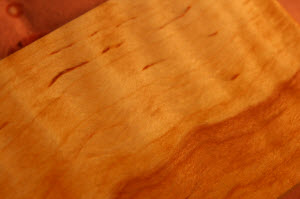 Better surface on figured wood. This is the point that seems to get all the attention around the internet. From my standpoint, I have used a jointer with HSS knives for over a decade and have had good results when face jointing figured stock, provided my knives are sharp and set properly, the jointer is tuned, and I take light cuts with a slow feed rate. I don't rely on a jointer for a finish-ready surface, so even with a spiral cutter head, I will continue to scrape or sand to a final surface. The results I have seen so far using a spiral cutter head on figured wood have been spectacular. I have face-jointed birds-eye maple, curly birch, quilted maple, and quarter-sawn white oak, all with great results.
 Helical vs. Spiral. When looking into spiral cutter heads, you will hear the terms "spiral" and "helical" used nearly interchangeably, but there is a slight difference between these two designs. Both designs feature a machined steel head with small square cutters placed along the surface in a spiral pattern. The primary difference lies in the orientation of each cutter. Spiral cutter heads position each blade, so the active cutting edge is perpendicular to the jointer's feed direction. This would be a similar cutting action to a hand plane, taking a cut straight into a piece of the wood grain.
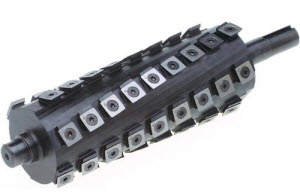 Helix cutter heads, on the other hand, operate more like a sheer or skew cut taken with a hand plane, as the cutters are positioned at an angle to the feed rate. Theoretically, this shearing action should provide a superior finish, as it does with a sheer cut on a hand plane. In practice, however, when applying a slow feed rate and a shallow cut, the surfaces produced on a figured stock by each style cutter head are nearly perfect to the naked eye, so it isn't easy to substantiate a claim that one is better than the other without employing some level of magnification. And at that point, it becomes a science project rather than a meaningful measure of woodworking precision or productivity, which causes me to lose interest.
Decisions, Decisions. Is a spiral cutter head right for you? Considering this upgrade, the following simple table might help you determine the trade-offs.
Knife-based Cutter head vs. Spiral Cutter head
- Do you use your jointer for multiple weekly hours? Heavy use is a good indicator that spiral might be a good fit.
- Do you do a lot of face jointing? Face jointing is quieter with spiral cutter heads and produces a superior surface.
- Does spending a few hundred dollars make you cringe? Traditional knives can save you several hundred dollars compared to spiral cutter heads.
- Are you intimidated by changing jointer knives and precisely setting the height of each knife?
- Insert tooling is a breeze to rotate, re-seat, and resume playtime.
- Are you a tool junkie? Spiral cutter heads are newer technology with a major cool factor, and I'll bet your neighbor doesn't have one yet, so you will have bragging rights.
Conclusions
I like the concept behind spiral and helical cutter heads, and I took the plunge and ordered one with my recent jointer purchase. As a hobbyist, I consider this a luxurious indulgence. I need to use a jointer more to justify the expense based on any cost savings I will incur down the road. But the surface quality, quieter operation, ease of blade change, etc., make it an attractive upgrade for any woodworker who can afford one without cutting into grocery money.

This upgrade is a no-brainer for professional woodworkers who use their jointer. Minimized downtime due to blade swaps, less sanding time on face jointed surfaces, and fewer sharpening expenses add to real savings and competitive advantage due to better productivity.
What do you think? Are you using a spiral cutter head in your jointer? If so, let us know why you bought it and what you think of it in the comments section below. Questions? Please feel free to post those in the discussion forum so we can continue to add to the knowledge base that is growing there.
Photos by Author unless otherwise credited.
Share tips, start a discussion or ask other students a question. If you have a question for an expert, please click here.
Already a member?
I just got my first planer and jointer. Both are Wen with spiral heads. I waited for an Amazon Prime day special and got BOTH, and an extra set of replacement blades for both, for a little over $700. Their 3 knife versions were about the same, and on Prime day it was actually LESS than both 3 blade versions would have been normally. I am really happy with both of them, although they are spiral heads, and not helical, and not carbide. Glad I waited for a sale, too!
Can I get a replacement helical spiral cutting head for my W2864 20" planer?
I use a spiral head cutter on my Grizzly jointer. Love it. Would not work with anything else.
I've been a hobbyist woodworker for 40+years. I just upgraded my planer ($1200) and jointer ($650) with helical cutter heads. Wish I had done it a decade ago. However, the price was always the deterrent. Every manufacturer that sells to "hobbyists" gouges them. ("Get as much money as you can as fast as you can" and "What the market will bear" are their mantras.) Any reasonable comparison with similar machine tooling removes any legitimate, (or honest), defense of the prices for this tooling. Nevertheless, if you are a professional, or you are someone for whom "money is no object", OR you are just old and retired and have decided that you 'deserve' the performance in spite of the gouging, GET one of these cutter heads. You WILL appreciate it. And if you're not happy with the performance of the new head, (ignoring the cost), you are doing something wrong.
I currently own one jointer and one thicknesser, both made by Invicta/Delta in Brazil about 30 years ago and still perform very well. I changed the cutterheads of both machines by also made in Brazil helical carbide cutterheads. I think all your remarks about these cutterheads absolutely true and I am very happy with them in spite of the cost. I am a weekend woodworker and really don't need superior machines but rewarding myself with these upgrades made me feel very good, fixing blades is in the past and I have more time to really enjoy woodworking.
Can they be use on an old Craftsman joiner. Mine is about 30 years old and gets little use because of the pain of setting the knives.
My shaper and planer are older knife style. Where can I find out whether or not they are compatible for replacement with either the spiral or helix cutter heads? Is there a model chart of compatibility available?
I have an old but beauty INCA over under 8.5" jointer/planner. In spite of having the gauges to set the knives this was pretty much a day long job. I bit the bullet and bought a SHELIX replacement head sold by BYRD Tools. Due to the age of my machine it was a custom order. It took some effort=time to install but in the end what a difference. I buy my lumber in the rough and the first job after installation was a Lacewood and Black Walnut box. It machined the figured wood with no problem or tear out. I was so impressed that i immediately ordered a head for my dewalt thickness planner. i am equally pleased here. Noised factor is greatly reduced as you are not turning a solid blade through the air. With the cutters the air can move with less effort between them resulting in less resistance and hence less noise. My only knock on the cutters is that they tend to snipe a bit more than blades. It is an easy solution on the thickness planer by passing a sacrificial piece behind your good wood. Not so easy on the jointer. I have checked my tables and they are aligned so right now i simply leave a little extra length to be trimmed at the miter station. In the end what sold me was the ease of changing the cutter heads especially when you get the inevitable nick in a nice new set of blades. Even if you are simply a weekend warrior the price is justifiable. Think of it this way . With 4 rotations per cutter, you may never have to buy another set of blades.
And no tear out. You can pretty much forget about grain direction. This is a huge deal, and extremely important on figured woods. (At least with Shelix.)
I do a lot of work with Teak and as most folks know, teak is very destructive on sharp steel due to the silica in the wood. I traded in my jointer for a new jointer with a spiral head.... Worked so well that I also bought a new planer with a spiral cutter head. My large band saw even has carbide tips on the blade. Carbide is the only way to go in my opinion.