A well turned leg can make an ordinary leg extraordinary. To put the icing on the cake, just add flutes. Flutes are a decorative element that's been around for thousands of years. Think of all those fluted columns scattered about ancient Greek and Roman ruins. The fact that fluting is still used today is a testimony to the visual interest it adds to a column or leg.
www.wwgoa.com
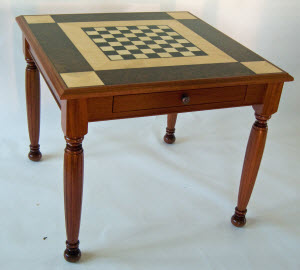
Traditionally, flutes are cut by hand with a fluting chisel. In the hands of a skilled carver, the results can be outstanding. Unfortunately, some of us have limited carving skill; one slip of the chisel and an entire leg becomes firewood. A friend who builds traditional furniture came to my rescue when I needed to flute the legs on a mahogany game table I was building (Photo 1). He taught me a technique that utilizes a simple shop made jig and an old file to scrape rather than carve the flutes. What I like about this system is that it guarantees straight, evenly spaced flutes. I find scraping goes faster than my ability to carve and that's an added benefit. Scraping also prevents tear-out and leaves a surface that requires minimal sanding. You still need to employ chisel work to clean up and define the beginning and end of each flute, but the chances for messing up the whole leg with a slip of the chisel are greatly reduced.
www.wwgoa.com
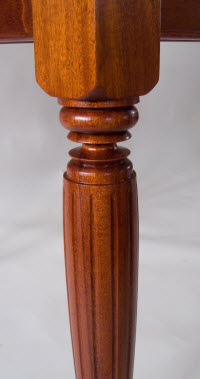
The legs for the game table are 3" x 3" square with a long fluted section on the lower section (Photo 2). With a complex leg like this, I always start out turning and fluting a practice piece. Typically, I'll glue up a couple of 2 x 4's to make the blank. This gives me a chance to refine the design and develop a strategy for the tools and techniques I'll use to turn the leg. It also gives me a chance to double check the size and spacing of the flutes I will make on the final legs.
www.wwgoa.com
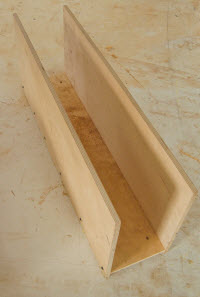
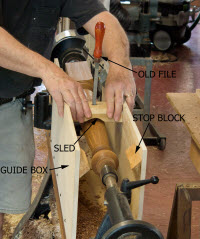
The first thing you'll need is a simple guide box (Photo 3). Build the box from stiff plywood. Size the base to fit over your lathe bed.
www.wwgoa.com
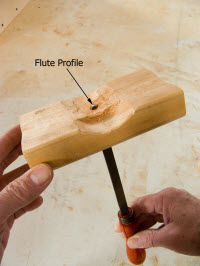
Construct a sled from a length of ordinary 2 x 4 (Photo 4). The beauty of this technique is the use of an old file as a scraper. Once you have the size and spacing of your flutes figured out, grind the profile on the end of an old file. Use a burnisher to roll a hook on the file in the same way you would a bowl scraper.Turn the legs and sand smooth.
www.wwgoa.com
Secure the guide box to your lathe with clamps (my lathe has wooden ways that allows me to use screws instead of clamps). Use your lathe's indexing system to lock the leg blank on place. Set start and stop blocks to define the flute length. Drop the 2 x 4 sled on top of the leg at the start block and scrape in one continuous motion from top to bottom (Photo 5). Repeat until the scraper no longer cuts which tells you the flute is fully cut. Then, release the indexing pin and rotate the leg to the next position. Repeat the process until all the legs are fluted.
www.wwgoa.com
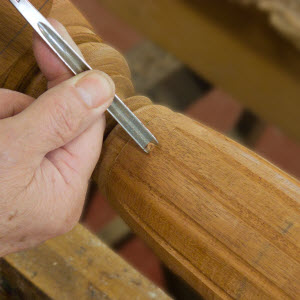
Use a standard fluting chisel to define the beginning and end of each flute (Photo 6).
www.wwgoa.com
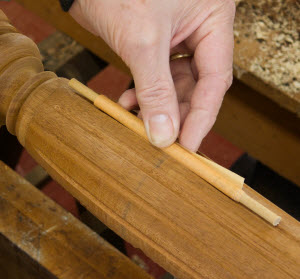
All that now remains is a little light sanding (Photo 7) and you're legs are done. Happy fluting.
Photos By Author
Share tips, start a discussion or ask other students a question. If you have a question for an expert, please click here.
Make a comment:
Already a member?
One Response to “Cut Leg Flutes Without a Chisel”
Paul Fiebich
Cool idea, I needed to make a replacement leg for a sewing hamper. It needed to have flutes to match the other legs. My lathe does not have an indexing head. So, I made a fixture into which the leg was held and indexed, then used a Dremel tool to not only make the flutes but also to create the tapered exit of the flute. I photographed the entire process and even made a short video of the fluting process in action. I think this might be a project for others who do not have an indexing head on their lathe. Let me know, I would be glad to share my fluting fixture.
Sign up for our free newsletter today
Get our latest woodworking videos, plans, tips and techniques delivered right to your inbox.
Get exclusive premium content! Sign up for a membership now!
Cool idea, I needed to make a replacement leg for a sewing hamper. It needed to have flutes to match the other legs. My lathe does not have an indexing head. So, I made a fixture into which the leg was held and indexed, then used a Dremel tool to not only make the flutes but also to create the tapered exit of the flute. I photographed the entire process and even made a short video of the fluting process in action. I think this might be a project for others who do not have an indexing head on their lathe. Let me know, I would be glad to share my fluting fixture.