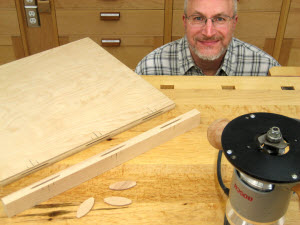
So you need to cut a few biscuit grooves but don't own a biscuit (plate) joiner -- No problem, cutting the grooves with your router and a slot-cutter bit is easy. So I'll bet you're wondering if it's so easy then why even own a biscuit joiner? Well there are pros and cons:
Pros:
Great solution if you don't own a biscuit joiner and you cut less than 30 biscuit grooves a year.
Very accurate for flush aligning two work pieces.
If you can't afford a $200 or so biscuit joiner, then a router and a $40 biscuit joining router bit set is a real money saver, assuming you already own a router.
This technique can be used to cut grooves in tight corners where sometimes the body of a biscuit joiner interferes. Knowing this work around may be useful in those situations even if you own a biscuit joiner.
Cons:
Way slower than using a biscuit joiner.
To cut a groove you have to plunge the bit into the workpiece, move the router a distance, and then remove the router bit from the cut. Routed groove lengths can be inconsistent. Biscuit joiners cut groove lengths right-on every time.
Grooves cut using a router setup do not match the shape of a biscuit as well as grooves cut using a biscuit joiner. That makes aligning biscuits in the routed grooves a littler trickier, and the resulting joints are not quite as strong.
Although it is possible to rout grooves in beveled edges, doing so is much more complicated when using a router.
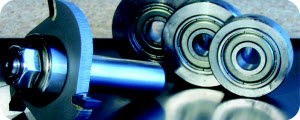
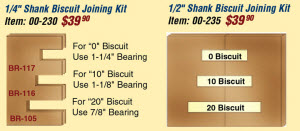 The Tools. You need a midsize handheld router with a 1/2-in. collect preferably, and a 5/32-in. thick slot cutter router bit. Infinity Tools offers a very nice $40 bit set that cuts grooves for #20, #10, and #0 biscuits. It's one cutter with three interchangeable bearings (see Source).
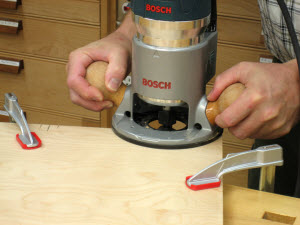 The procedure. To rout the groove you will lay out a center mark and a routing start and stop mark. The layouts for different size biscuits are shown below. Mount the slot-cutter bit with the appropriate size bearing in your router and set the bit height. Clamp your workpiece securely to your workbench. Rest the router sub base on the work piece and plunge the slot-cutter in so the bit shank is relatively centered on the start mark. Move the router right until the bit shank aligns with the end mark, and then pull the slot-cutter out of the groove. You'll get the hang of this rather quickly. Using a clear router sub-base may be helpful.
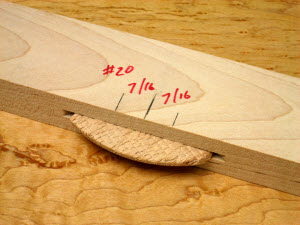 #20 groove cutting setup. Use the 1-7/8" dia. slot cutter with the 7/8" bearing. Mark a centerline and then place a start and stop mark 7/16" on each side of that centerline. That will cut a 2-1/2" long x 1/2" deep groove.
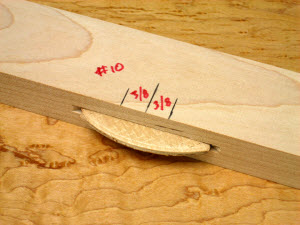 #10 groove cutting setup. Use the 1-7/8" dia. slot cutter with the 1-1/8" bearing. Mark a centerline and then place a start and stop mark 3/8" on each side of that centerline. That will cut a 2-1/4" long x 3/8" deep groove.
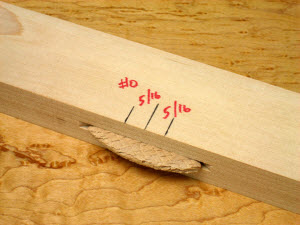 #0 groove cutting setup. Use the 1-7/8" dia. slot cutter with the 1-1/4" bearing. Mark a centerline and then place a start and stop mark 5/16" on each side of that centerline. That will cut a 2" long x 5/16" deep groove.
Photos By Author
Source:
Biscuit joining router bit set
Infinity Tools
(800) 872-2487

Using jig table how to set up biscuit bit with fence. Is their a video sight
well why bother, just set up the router under a saw bench and run a slot full length, then cut a strip in the rip saw and there you are, give yourself clearance on the joint, not a hammer fit, to hold glue, that is my 10 cents worth
When I make solid tops (I don't have a overhead sander), I slot the boards on my table saw then use biscuit's where ever I want when I glue and clamp. I find there is a lot less belt sanding. Works great for me. Although I do have a biscuit joiner, use it all the time. Happy tips!
Splines are good, but biscuits have some advantages. They are compressed so they swell and lock in place when glue is added, and the grain is cut at 45° which makes them very strong in their joints.
I too have a biscuit joiner and use it as i need but I also use a spline on joints. Using a router table uith holdowns. I cut splines from 1/4 cut oak or similar wood and use them to join two peices soild with glue.
The idea of using splines is sound, but remember that Baltic Birch plywood is a metric product. What we call 1/8" ply is actually 3 mm, and slightly undersized. It may be a little too loose for joinery. Try it before you commit to using it.
Great article. Even though I own a biscuit joiner (which I freely admit I don't use very often), I also own a router so perhaps I'll buy the slot cutter set and try this sometime.
Another alternative (to me) seems plywood splines with appropriate straight bit and a table mounted router and a fence, for example 1/8" Baltic Birch splines and 1/8" bit.
When I make solid tops (I don't have a overhead sander), I slot the boards on my table saw then use biscuit's where ever I want when I glue and clamp. I find there is a lot less belt sanding. Works great for me. Although I do have a biscuit joiner, use it all the time. Happy tips!
Splines are good, but biscuits have some advantages. They are compressed so they swell and lock in place when glue is added, and the grain is cut at 45° which makes them very strong in their joints.